
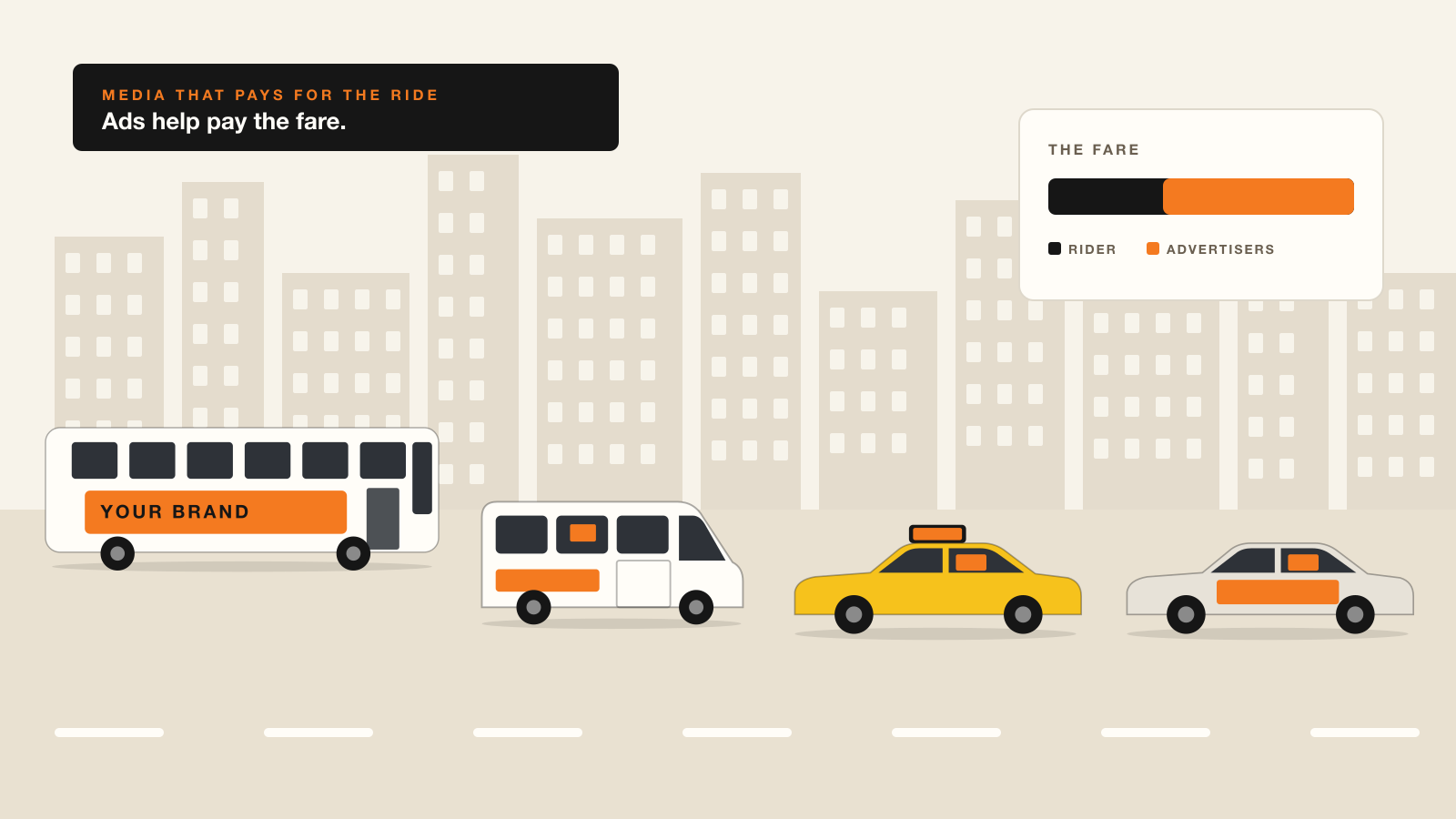
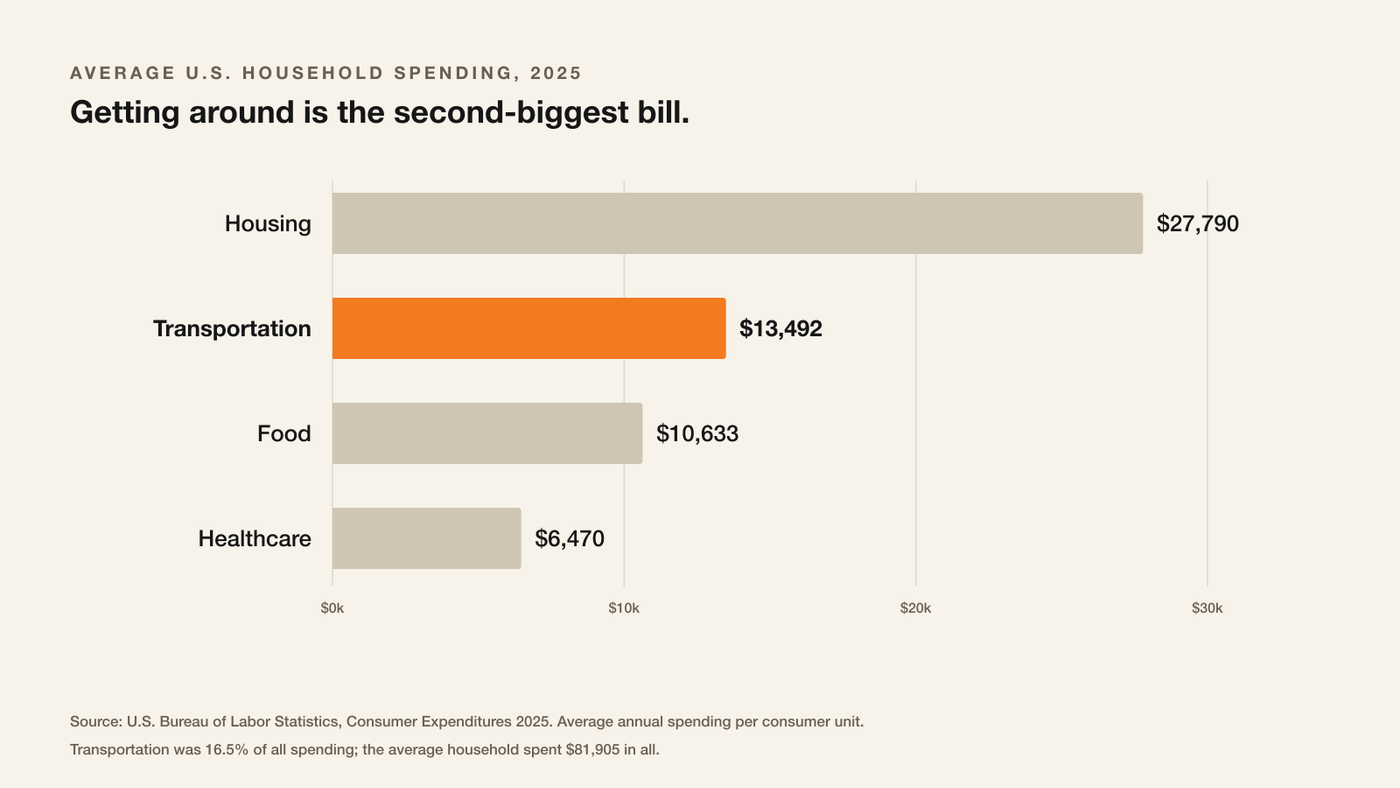
Getting around is the second-biggest bill an American household pays. Only housing costs more. For years, though, two of the country's biggest cities made it illegal to help pay that bill in one of the simplest ways there is: by letting a brand buy a few seconds of a rider's attention.
Vugo started in Chicago on the idea that media can help pay for the ride. Before we could launch there, we learned that Chicago's rules made our business illegal. We moved to Minneapolis, founded the company there in 2015, and then went to court, first in New York and later in Chicago. Both cities have since changed course. This essay is about why they were right to, and why every city, transit agency and regulator should see advertising on buses, microtransit, taxis and rideshare cars as a way to serve the public, not a threat to it.
The second-biggest bill in the house
In 2025, the average U.S. household spent $13,492 getting around, 16.5% of everything it spent. That's more than food, about twice what it spent on healthcare, and second only to housing at $27,790 (Bureau of Labor Statistics, Consumer Expenditures 2025). Across 138 million households, it comes to about $1.86 trillion a year (Vugo arithmetic). That's significantly greater than what the federal government paid in interest on the national debt in fiscal 2026, $1.14 trillion, a bill that itself now tops Medicare and the military (Congressional Budget Office, 2026). We set out the full picture in What a Mile Costs, and What It Takes to Make It Free.
Most of that is the cost of owning and running a car. Cheaper rides change that math for almost everyone, because almost everyone lives where rides are: about 86% of Americans live in a metro area (U.S. Census Bureau, 2025). The people riding aren't who many assume, either. Rideshare riders lean toward the top of the income range: in 2022, 27.3% of people in households earning $150,000 or more took a rideshare in the past month, and those households make up about a third of all riders (Who Rides). On transit, half of riders hold a bachelor's degree or more, their households are about as likely as the nation's to earn $100,000 or more, and more than half have a car they could use (APTA). They ride because it's convenient, and they ride more when it costs less.
Lower fares aren't charity. They're a better deal for the professional heading downtown, the family going to a game, the traveler leaving the airport and the student getting to class, as much as for the 41% of people in car-free households who took a rideshare in the past month. When the price comes down, people ride more, and advertising is one of the few ways to bring it down that doesn't come out of a public budget.
Riders already don't pay most of the cost
Here's something most riders don't know. The average U.S. bus trip costs about $8.24 to run, and fares bring in about 90 cents of it. That's what's collected per boarding, below the posted fare, because passes, transfers and reduced fares all count. The rest is paid by someone other than the rider, mostly taxpayers (Vugo arithmetic from the National Transit Database, 2024: bus operating costs and fare revenue divided by boardings). On average, fares paid just 13% of a U.S. transit agency's operating costs in 2024, and at half of all agencies they paid 6% or less (Tyndall, 2026).
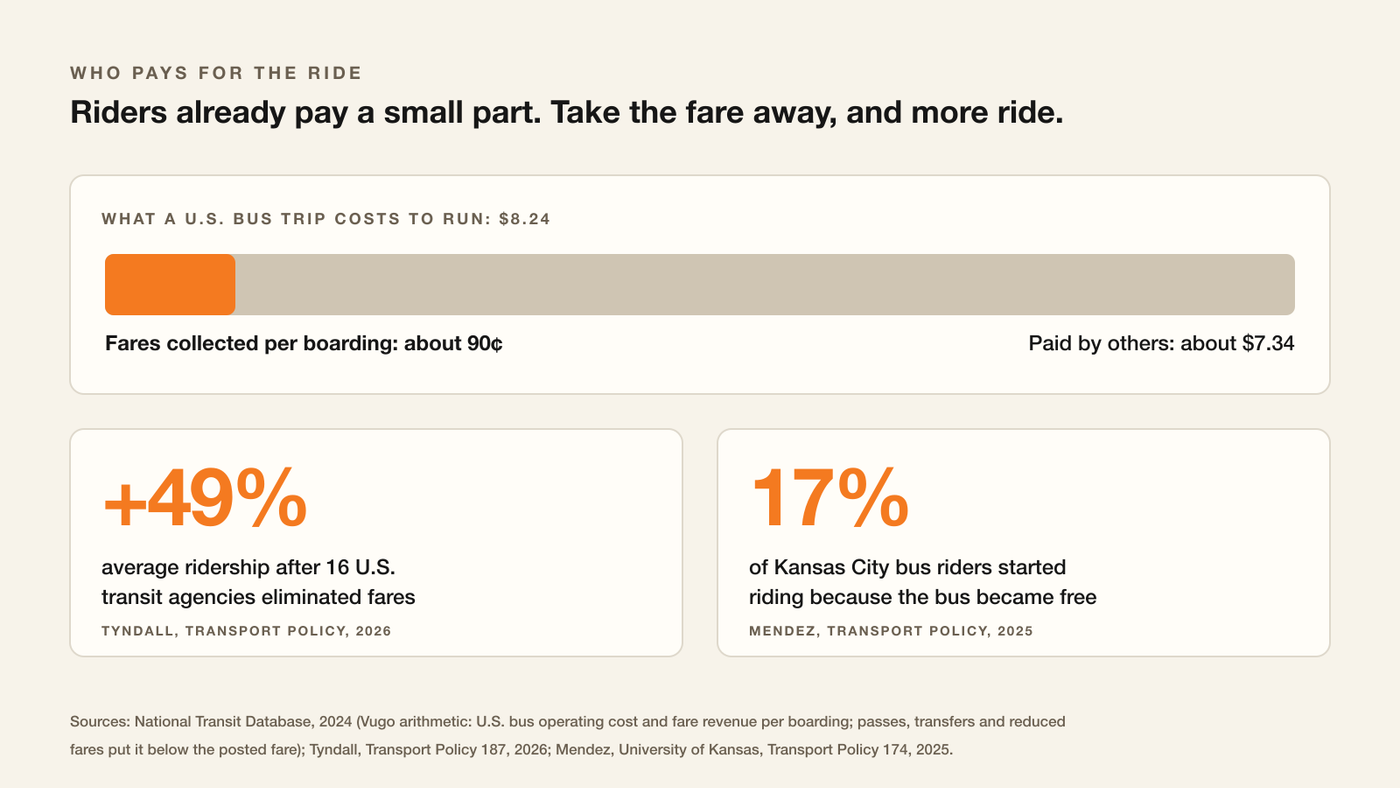
The question was never whether someone other than the rider should help pay for the ride. Someone already does. The question is who, and how much of the burden lands on the public budget.
The fare decides who rides
When the fare falls, people ride. When it disappears, they ride a lot more.
- Ridership rose 49% on average when 16 U.S. transit agencies eliminated fares, and service tended to grow rather than shrink (Tyndall, Transport Policy, 2026).
- In Kansas City, 17% of bus riders started riding because the bus became free, and almost 40% of existing riders rode more often (Mendez, University of Kansas, 2025).
- Riders are coming back. Americans took 8.1 billion trips on public transportation in 2025, up 6.0%, and demand-response service, which includes microtransit, led the recovery at 93% of its 2019 ridership (APTA, 2026).
- Microtransit is filling the gaps. Cities and agencies run on-demand vans and shuttles that riders book in an app, to reach neighborhoods and hours a fixed bus route can't serve well. Those vehicles carry riders who have time to look at a screen, and every dollar of ad revenue on them goes toward a service the public is already paying for.
There's a catch, and Kansas City shows it. After six years without fares, the city brought them back on June 1, 2026. Free fares have to be paid for, year after year, by money that lasts. Advertising is one of the few sources that grows as ridership grows: the more people ride, the more the space in front of them is worth.
Cheaper rides change how people get around
The biggest savings don't come from a cheaper fare on one trip. They come when rides are cheap and easy enough that a household needs one car fewer. Owning and running a new car costs about $12,863 a year (AAA, 2026). The research shows people already moving in that direction:
- More Americans ride. 17.2% of Americans 16 and older used rideshare in 2022, up from 9.8% in 2017 (NHTS 2022). By late 2018, 36% of adults had used a ride-hailing app, up from 15% three years earlier (Pew Research Center, 2019). In Clemson and J.D. Power's 2025 survey, rideshare use rose from 22% to 28% of respondents in four years, and public transportation from 21% to 27% (Clemson / J.D. Power, 2025).
- Riders often go without a car. In UC Berkeley's survey of San Francisco riders, 43% had no car in the household, against 19% of the city as a whole, and half or more of their rides replaced something other than a taxi, including transit and driving (UC Berkeley, 2016).
- Younger riders question owning one at all. 41% of Millennial and Gen Z ride-hailing users said they question needing to own a car (eMarketer, 2020).
- Rides make cities safer. In UC Davis's survey of seven major metros, 21% of adults used ride-hailing, and avoiding driving when they might have been drinking was one of the top reasons riders gave, cited by 33% (UC Davis, 2017).
Every one of those trends grows when the ride costs less. Ads are one of the few ways to lower the price without lowering what drivers earn.
Ads already help pay for public life
Advertising pays for much of what the public uses every day: broadcast television and radio, most of the internet, newspapers, stadium naming rights, bus shelters and benches. Transit agencies have sold ads on their buses, trains and stations for generations. In 2025, transit advertising, which the OAAA counts as ads on vehicles and in stations and airports, brought in $1.68 billion in the U.S. (OAAA and Miller Kaplan, OOH Revenue by Format 1970–2025). New York's yellow cabs carried screens in the back seat for years.
People spend a lot of time in vehicles, which is what makes that space valuable. The average American spends 44 minutes a day in one, as driver or passenger (NHTS 2022). The average driver spends an hour a day behind the wheel, and Americans drove for 96 billion hours in 2024 (AAA Foundation, 2025). The average commute is 27.4 minutes each way, and 69.8% of workers drive to work alone (U.S. Census Bureau, 2025). Vehicles on U.S. roads covered 3.32 trillion miles in 2025, the most in the federal report's table since 2000 (FHWA, 2025).
People notice ads on vehicles, too:
- Wrapped vehicles are the second most-noticed outdoor ad. In Nielsen's 2019 study, 64% of people had noticed a wrapped vehicle in the past month, behind only roadside billboards, and 31% had noticed ads on taxis (Nielsen, 2019).
- Half of adults notice ads on vehicles. In a 2023 survey for the OAAA, 49% had noticed advertising on wrapped or signed vehicles in the past 30 days, 22% ads on or in a ride-share vehicle, and 54% said they notice outdoor ads more when they're tailored to where they are (OAAA and Morning Consult, 2023).
- Transit riders act on what they see. In a 2024 Harris Poll for the OAAA, 58% of adults noticed digital transit ads, and 85% of recent viewers did something about one in the following three months, from visiting a restaurant to making a purchase (OAAA and The Harris Poll, 2024).
- Moving media moves sales. MOOHA's 2025 campaign for C4 Energy around Knicks game days in New York, which Vugo took part in as a member of MOOHA, lifted ad recall by 59% and in-store sales by 11.6% across the whole campaign (MOOHA, 2025). MOOHA's separate campaign for Xumo, which Vugo wasn't part of, lifted consideration by 26% among people exposed to it (MOOHA, 2025).
Screens inside the cab do best of all. In Nielsen's 2020 study for the OAAA, 76% of people who saw ads on screens inside taxis noticed them all or most of the time, and two in three did something on their phone afterward (Nielsen for the OAAA, 2020). That attention is worth money to advertisers, and that money can go toward the ride.
Researchers have shown what happens to the fare when it does. In 2019, three Northwestern engineers modeled how a ride service should price its trips once ads earn revenue. Their answer: the fare should fall where ads earn the most, and riders as a whole don't lose out (Northwestern, 2019; we wrote about it in Ads Can Lower the Fare).
Chicago: made illegal, then made right
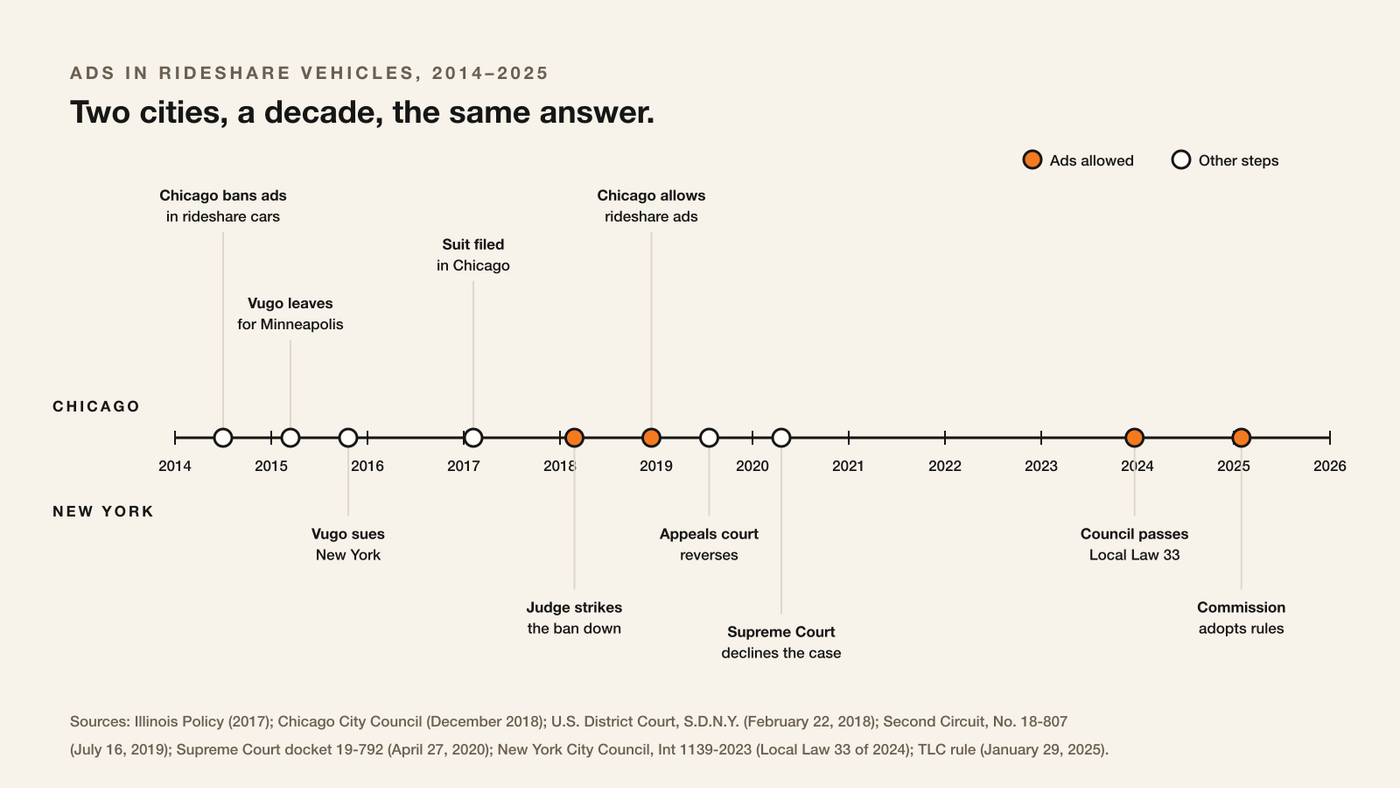
In 2014, Chicago passed an ordinance to regulate rideshare vehicles. Among its rules was a ban on commercial advertising inside and outside them. Taxis could still carry ads, and so could personal cars. Only rideshare drivers were left out (Illinois Policy, 2017).
Our co-founder James Bellefeuille drove for Uber in Chicago at night while working in marketing by day, and he saw two problems that could solve each other: drivers who needed more income, and brands that wanted to reach people on the move. We started Vugo at Chicago's 1871 incubator. Then we found out our business was against the law there, so in 2015 we left for Minneapolis (Chicago Inno, 2015; why we chose Hot Dish over Deep Dish).
On February 2, 2017, the Liberty Justice Center filed suit in federal court on behalf of Vugo and rideshare drivers, arguing that the ban violated free speech and equal protection by treating rideshare drivers differently from taxis (Vugo, Inc. v. City of Chicago, No. 17-cv-864, N.D. Ill.). That August, a federal judge denied the city's motion to dismiss, and the case went forward (Memorandum Opinion and Order, August 9, 2017). In December 2018, the Chicago City Council amended the law to allow commercial advertising in and on rideshare vehicles, as part of its 2019 revenue ordinance, and the suit was dismissed (Liberty Justice Center, December 11, 2018). The coverage, from the Chicago Tribune and WBEZ to the Cook County Record, is on our press page.
Chicago didn't lose anything by changing its mind. Drivers gained a way to earn more from the car they already drive, riders lost nothing they had, and the city stopped favoring one kind of vehicle over another.
New York: a win, a reversal, and a law
New York took longer. In October 2015, Vugo sued the city in federal court in Manhattan over the Taxi and Limousine Commission rule that banned advertising in for-hire vehicles, the category that includes Uber and Lyft cars (Vugo Launches Federal Lawsuit Defending Freedom of Speech in NYC). Yellow cabs, meanwhile, carried ads on their back-seat screens and on their roofs.
On February 22, 2018, a federal judge in Manhattan struck the ban down on First Amendment grounds, finding that the city couldn't justify it (Vugo, Inc. v. City of New York, No. 15-CV-8253, S.D.N.Y., Opinion and Order; Vugo Wins Lawsuit Defending Freedom of Speech in NYC). The story ran from the Associated Press and USA Today to CBS and FOX 5, and I made the case for ad-supported rides on CNBC that March (Vugo on TV, early 2018).
The city appealed, arguing that the ban protected passengers from unwanted ads. In July 2019, the Second Circuit agreed and reversed the ruling, even though yellow cabs kept their screens (Vugo, Inc. v. City of New York, No. 18-807, 2d Cir., July 16, 2019). In our view, that protection came at a price. Riders were shielded from a screen they could ignore, and in exchange every dollar of the ride stayed on them, with no advertiser allowed to carry any of it. The commission ordered every for-hire vehicle owner to take down interior and exterior ads by August 31, 2019, and drivers who had been earning from them lost that income overnight. When the ban came back, we took our screens out of New York's for-hire cars and kept them out until the law allowed them again. Not everyone stepped back. At the commission's own public hearing in August 2024, with the ban still in force, a competitor said it had kept paying drivers in and around New York City, and drivers testified they'd had its tablets in their cars since 2021 and 2022 (NYC Taxi and Limousine Commission, public hearing, August 14, 2024). It said it wasn't showing ads in the city, but its network was in place the day the law changed. Our petition to the Supreme Court, backed by friend-of-the-court briefs from the Pacific Legal Foundation, the Goldwater Institute and the Cato Institute, was denied on April 27, 2020. The coverage of all of it, from Reuters to SCOTUSblog, is on our press page.
That could have been the end, but it wasn't. On December 20, 2023, the New York City Council passed a bill allowing screens in the back of for-hire vehicles, and it became Local Law 33 of 2024. Local Law 56 of 2024, which followed, guarantees drivers at least 25% of a screen's gross ad revenue. Riders can switch the screen off or mute it, providers are licensed by the commission, and the commission adopted its rules in January 2025.
We don't claim New York's law as ours. We were just one of many advocates, which included drivers, council members and the Independent Drivers Guild. We like to think we were one of the sparks that got it moving, because the law the city adopted is the argument we made in court a decade earlier: a rideshare driver should be able to earn from the same kind of screen a taxi carries, and riders are protected by sensible rules, not by a ban.
Florida: a state that wrote the rules
Not every government sees ads on vehicles as a threat to the public. Florida took the opposite view: instead of banning advertising on rideshare cars, the state wrote rules for it. In 2020, the Legislature passed a bill that lets a rideshare driver, or someone the driver chooses, contract with a company to put a digital advertising display on the roof of the car. The display can be no bigger than 20 inches tall and 54 inches long, and it runs only while the car is on. Ads for illegal products or services, or with nudity or violent images, are off limits, and the companies involved aren't liable for an advertiser's content unless they knew it broke the law. Governor Ron DeSantis signed it on June 23, 2020, and it took effect that day (Chapter 2020-87, Laws of Florida; Florida Senate bill summary). We don't know of another state that has written a law like it.
That's what a rule written for the public looks like: drivers can earn, the content stays appropriate, and it's clear who answers for it. It treats advertising on vehicles as a public benefit to manage, not a nuisance to forbid, and that's the view this essay argues for, because the same money that pays drivers can bring the price of a ride down. Florida drivers have carried Vugo's rooftop campaigns since, from Dash in Miami in late 2021 (case study) to the Bitcoin 2022 conference (case study).
The duty a city really owes
The case against ads in rides usually rests on a sense of duty: that a city protects the public by keeping commerce out of the vehicles it regulates. We understand the instinct, but look at what the duty actually is. Cities owe their residents affordable ways to get around, fair treatment of the people who drive them, and protection for riders. Advertising, done well, serves all three.
Affordable rides. Every dollar an advertiser pays toward a ride is a dollar that doesn't come from a fare or a tax. On public transit, that's money that can hold fares down or keep service running. On sponsored rides, a brand already pays the whole fare, and the rider sees who paid. Rules that block that money don't protect riders. They leave riders paying more, or leave the bill with the public.
Fair treatment of drivers. Driving pays less than it looks. One University of Colorado Denver researcher drove for Uber and Lyft and earned $15.57 an hour before costs and $8.15 after the cost of the car (Henao and Marshall, 2019). Most people who do gig work do it on the side: 70% spend less than five hours a week on it, and only 21% call it their main job (Federal Reserve, 2024). Screens and wraps let drivers earn more from the cars they already drive, without driving more hours. Rules that let taxis carry ads but not rideshare cars, as Chicago's and New York's once did, decide winners and losers for the ad income. New York's law now writes a driver's share into the code.
Protecting riders. The biggest thing most riders need protecting from is the price of the ride. Riders who pay less, or nothing at all, because an advertiser covered the fare are better off than riders shielded from a screen and charged the full price. Protecting riders means making the ride cheap, and where it can be done, free. The rest is standards, not bans: ads that are appropriate, not intrusive, and respectful of privacy. New York's law lets riders switch the screen off or mute it. Transit agencies set content standards for their own vehicles. Vugo's Content Guidelines keep whole categories off the screens, and the screens themselves don't sense who is in the car. When a rider scans a QR code, Vugo records which ad and when, not who.
Accountability for public money. When a city or an agency sells advertising, the public deserves to know it delivered what was sold. That's a reason to ask for proof, not to refuse the revenue.
Toward free rides
Advertising alone won't make every ride free today. The driver's pay is most of what a ride costs, and in a big city a rideshare runs several dollars a mile. The cost of a mile, though, is about to fall a long way.
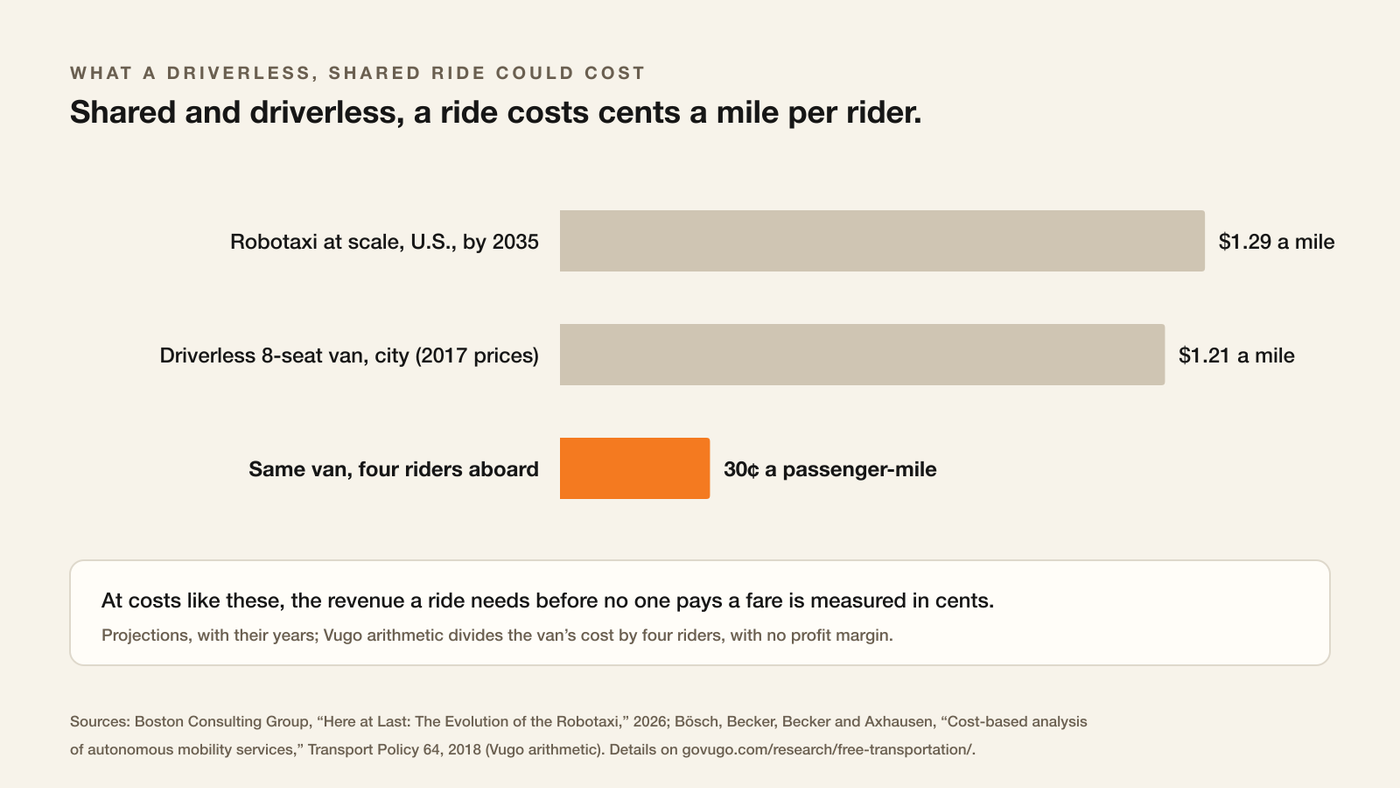
Take out the driver, run the vehicle on electricity and share it, and the research puts the cost of a ride at a fraction of today's fare. Boston Consulting Group expects a robotaxi at scale in the U.S. to cost about $1.29 a mile by 2035. In a peer-reviewed Swiss model, a driverless eight-seat van costs about $1.21 a mile in 2017 prices, which comes to about 30 cents a passenger-mile with four riders aboard (Vugo arithmetic from Bösch and colleagues, 2018). At costs like those, the revenue a ride has to earn before no one pays a fare is measured in cents, and media in the vehicle is one of the obvious places for it to come from. The math is in The Math of a Free Ride and What a Mile Costs.
Sharing matters as much as automation. The average rideshare ride carries 1.4 riders, and the same Denver study estimated that ride-hailing added about 83.5% more vehicle miles than riders would otherwise have driven, counting the miles cars drive empty (Henao and Marshall, 2019). Fuller vehicles mean fewer empty miles and a lower cost per rider, which is why microtransit vans and shared rides matter to the math.
We should be honest about the limits. Fraunhofer's 2019 study of driverless taxis in New York found ads came to about 2% to 5.6% of the fare, not enough on their own for a free fleet. It modeled single-rider robotaxis and older taxi-screen ad prices, so we read it as a lower bound, but it's a fair warning. Projections slip: in 2017, Fast Company asked whether ride-hail would be free by 2021 (Fast Company, 2017). It wasn't, and we were early on the date. We still think we're right about the direction. Free rides already exist, when a brand sponsors them. Free rides for everyone will come from the cost of a mile falling and the value of a rider's attention adding up, and cities that welcome that revenue will get there first. James set out the goal in The Case for Free Transportation in 2018, and it's still ours.
How Vugo takes part
We're not a neutral party. Vugo sells advertising on screens and vehicle wraps on rideshare, taxi, microtransit and fleet vehicles, and sponsored rides, so we earn from the revenue this essay describes. Here's how we try to do it in a way a city can stand behind.
- Relevant, not intrusive. TripIntent® reads context about the places around the vehicle, and the destination when the driver sets one, to put the most relevant ad first. It's a priority, never a filter, and it never uses medical, religious or legal places.
- Paid for what actually ran. Advertisers pay for validated impressions: plays confirmed on a working screen in a vehicle out on the road. Plays that can't be confirmed are free.
- Shared with the people who drive. Drivers and fleets earn from the ads in and on their vehicles. That has been part of Vugo since the first day.
- Standards the operator sets. Vugo has built in-vehicle screen networks for on-demand transit. For transit authorities running buses and microtransit, the screens carry rider information alongside advertising, under content standards the authority sets.
- Proof for public revenue. Vugo Measure, coming soon, verifies delivery for transit and fleet advertising: the hours a vehicle carrying a campaign was in service, from the operator's own realtime and dispatch data, with an evidence grade from A to E and, on paid plans, a signed receipt anyone can check. It claims no impressions or audience. It's built so an agency selling ads on its buses can show advertisers, and the public, what they paid for.
- The fare itself. With sponsored rides, a brand pays for the ride as part of its campaign, and the rider sees who paid.
What we'd ask of every city
- Treat every vehicle the same. If a taxi can carry an ad, so can a rideshare car, a microtransit van or a bus.
- Write standards, not bans. Content rules, a way for riders to mute or switch off a screen, and limits on what data is used will protect riders better than a prohibition.
- Make sure drivers share. New York's 25% minimum is one way to do it.
- Ask for proof of delivery. Public revenue deserves public accountability, so require that what was sold is verified.
- Put the money toward the ride. Use ad revenue to hold fares down, keep service running and, one day, take the fare away.
Chicago and New York both came around to that view, and Florida wrote it into state law. The point is bigger than any one city, though. Getting around is the second-biggest bill American households pay, about $1.86 trillion a year across the country. Advertising is one of the few ways to make that bill smaller without asking taxpayers for more, and, taken far enough, to make the ride free. Every dollar that stays in a household's budget gets spent somewhere else: on rent, on groceries, on a night out, on the local businesses that advertise in the first place. At that scale, cheaper rides aren't only good for riders. They're good for the economy around them. That's not a conflict with a city's duty to the public. It's one of the best ways to meet it.
Sources
- U.S. Bureau of Labor Statistics, Consumer Expenditures 2025; summarized in What a Mile Costs, and What It Takes to Make It Free.
- U.S. Census Bureau, Some Metro Areas' Population Gains Reversed COVID-19 Era Trends, April 2025: about 86% of the U.S. population lived in a metro area on July 1, 2024 (86.4% in the Bureau's March 2025 release).
- FHWA, 2022 National Household Travel Survey, Vugo's tabulation in Who Rides, with its script and data.
- APTA, Who Rides Public Transportation, January 2017; summary.
- Time and miles in vehicles: FHWA, NHTS 2022; AAA Foundation, American Driving Survey, 2025; U.S. Census Bureau, ACS commuting 2025; FHWA, Traffic Volume Trends 2025.
- Who rides and why: Pew Research Center, 2019; Clemson University and J.D. Power, 2025; UC Berkeley, Transport Policy, 2016; UC Davis Institute of Transportation Studies, 2017; eMarketer, Connected Cars 2020 (Deloitte data); Henao and Marshall, University of Colorado Denver, 2019.
- Ads on vehicles: Nielsen, 2019; OAAA and Morning Consult, 2023; OAAA and The Harris Poll, 2024; MOOHA, C4 Energy, 2025; MOOHA, Xumo, 2025.
- Congressional Budget Office, Monthly Budget Review: Summary for Fiscal Year 2026, November 9, 2026, Table 3: net interest on the public debt $1,142 billion, Medicare $1,069 billion, Department of Defense military $917 billion.
- Federal Transit Administration, National Transit Database annual metrics, 2024: cost and fare per bus trip (Vugo arithmetic).
- Tyndall, Fare-free transit in the United States, Transport Policy 187, 2026; summary.
- Mendez, Advancing mobility through fare-free transit, Transport Policy 174, 2025; summary.
- APTA, Public Transportation Ridership Update, April 2026; summary.
- OAAA and Miller Kaplan, OOH Revenue by Format 1970–2025.
- Nielsen for the OAAA, Digital Taxi OOH Engages Consumers and Drives Action, 2020; summary.
- Yu, Wei and Berry, Northwestern University, Proceedings of the ACM, 2019; summary.
- Federal Reserve Board, Economic Well-Being of U.S. Households in 2024; summary.
- Chicago: Vugo, Inc. v. City of Chicago, No. 17-cv-864 (N.D. Ill.), filed February 2, 2017; Memorandum Opinion and Order, August 9, 2017; Liberty Justice Center, December 11, 2018; Illinois Policy, February 7, 2017; and the coverage on our press page.
- New York: U.S. District Court, S.D.N.Y., Vugo, Inc. v. City of New York, No. 15-CV-8253, Opinion and Order, February 22, 2018; U.S. Court of Appeals for the Second Circuit, Vugo, Inc. v. City of New York, No. 18-807; TLC Industry Notice 19-10; Supreme Court docket 19-792, with Vugo's petition and the friend-of-the-court briefs of the Pacific Legal Foundation and of the Goldwater Institute and the Cato Institute (filed jointly); New York City Council, Int 1139-2023 and Int 0172-2024; TLC interior advertising provider rule; NYC Taxi and Limousine Commission, public hearing on the Interior Advertising Provider License, August 14, 2024 (video).
- Florida: Chapter 2020-87, Laws of Florida (CS/CS/HB 1039), approved by the Governor June 23, 2020; Florida Senate, 2020 bill summary.
- Autonomous costs and the counterpoints: Boston Consulting Group, 2026; Bösch, Becker, Becker and Axhausen, Transport Policy 64, 2018; Block and Herrmann (Fraunhofer), Transportation Research Procedia 41, 2019; all on What a Mile Costs, and What It Takes to Make It Free.