
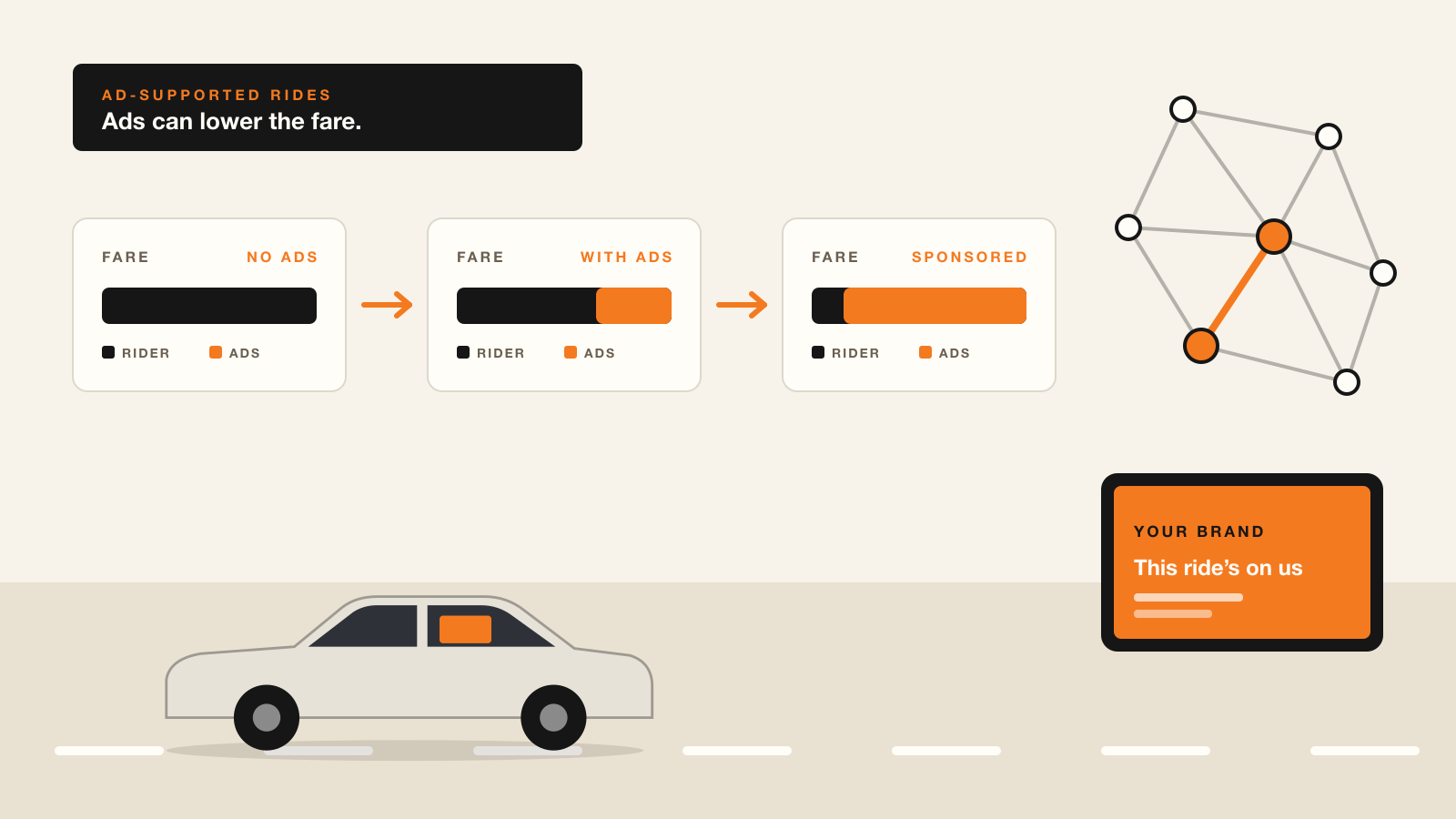
Every ride has two possible payers: the person in the back seat, and a brand that wants that person's attention. Since 2018, when we published The Case for Free Transportation, Vugo has argued that the second one can carry more of the fare, and one day all of it. In 2019, three engineers at Northwestern University came at the same question from the other side, with a model of how a ride service should set its fares once ads earn money.
The paper, "Analyzing Location-Based Advertising for Vehicle Service Providers Using Effective Resistances," by Haoran Yu, Ermin Wei and Randall A. Berry, was published in the Proceedings of the ACM on Measurement and Analysis of Computing Systems. It cites Vugo as an example of in-vehicle advertising, along with Vugo's 2016 look at 30,000 rideshare trips. Vugo had no part in the research. Here's what it found, and what it doesn't claim.
The question
A ride service that shows ads earns from two places: the fare and the ads. Some routes are worth more to advertisers than others, because of where the riders are coming from and going to. The catch is that a ride service can't price each route on its own. Every car that drives from one neighborhood to another has to end up somewhere, so a change in one fare changes where the cars go and what every other route costs to serve.
The authors solved that puzzle with an idea borrowed from electrical circuits. They treated the city's ride network as a network of resistors, where two places with many easy routes between them have low resistance. That let them work out the best fare for every route once ad revenue enters the picture.
What the model found
- The fare should fall where ads earn more. As a route's ad revenue rises, the best fare on it goes down, so more people ride it and see the ads.
- Riders as a whole don't lose out. Some routes can cost more as the service moves its cars around, but the total benefit to riders doesn't fall as ad revenue rises.
- The best routes to sponsor are busy and long. A sponsor is worth most on a route with lots of riders, long rides and many ways for cars to get there.
- Choosing sponsors by route pays. Tested on real rides in Chengdu, China, picking advertisers with the authors' method earned the ride service about a third more than picking at random (34% in one test, 32% in another), and came within 0.7% of the best possible choice in the first test.
What it doesn't say
It's a model, not a campaign result. It assumes a single ride service in a city, steady demand and set patterns for what riders will pay. Its test data is from one city in China, in 2016. It leaves out any annoyance at watching ads; the authors point to the entertainment on screens like Vugo's as one way to make up for it. Its ad revenue figures are the authors' estimates from online video advertising, not measurements from inside cars. And it says nothing about whether the ads work for the brands that pay for them. For that, see the industry research on ads on vehicles.
Why it matters
The model gives a careful, peer-reviewed answer to a question people ask about ad-supported rides: if ads pay part of the fare, does the rider end up paying some other way? In this model, no. The ride service makes more money by passing ad revenue on as lower fares, because a cheaper ride brings more riders who see the ads.
That's the idea behind sponsored rides, which Vugo already offers: a brand pays for the ride as part of a campaign, and the rider sees who paid. It's also the long-run case for free transportation: as the cost of a mile comes down, ads can pay a larger share of the fare.
For advertisers
Two ideas carry over to a campaign today. First, where a rider is coming from and going to is useful targeting. Vugo's TripIntent® reads the car's surroundings, and the destination when the driver sets one, and uses them to prioritize ads, never to filter riders out. Second, long, busy routes are where a screen has the most time with the most people. In-vehicle screens are available by market, and every campaign is quoted.
The full summary, with the method and its limits, is on the Research page.
Sources
- Haoran Yu, Ermin Wei and Randall A. Berry, "Analyzing Location-Based Advertising for Vehicle Service Providers Using Effective Resistances," Proceedings of the ACM on Measurement and Analysis of Computing Systems 3(1), Article 6, 2019: ACM Digital Library and arXiv