
Vugo was built around an idea that sounded far-fetched in 2015 and sounds less so every year: that transportation could be free for most short rides, paid for the way the internet is paid for.
In 2018, Vugo co-founder James Bellefeuille set it out in The Case for Free Transportation, and I made the case on CNBC. Fast Company had asked the question a year earlier: Will ride-hail be free by 2021?
Rides aren't free for everyone yet. But free rides already happen. Vugo offers sponsored rides: a brand pays for the ride as part of its campaign, and the rider sees who paid for it. Rides like that have happened in limited numbers since, and they still do. The question is how to make them the rule instead of the exception. Here's the math.
The short version
- A ride is free when what it earns covers what it costs. Revenue per passenger-mile has to match the cost of a vehicle-mile divided by the people on board.
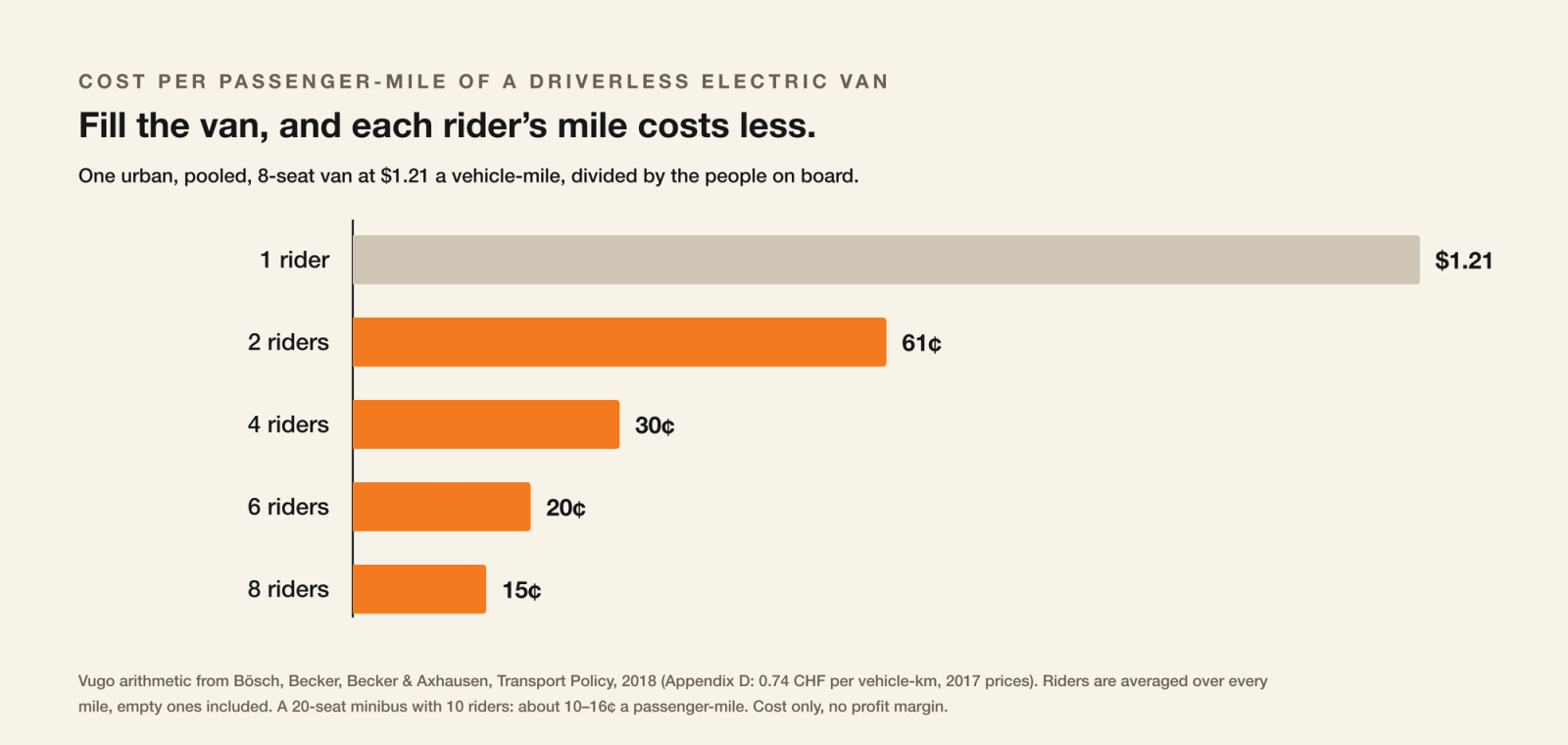
- Sharing the vehicle does most of the work. A driverless electric van that costs $1.21 a mile to run costs 30 cents a passenger-mile with four riders, and about 15 cents with eight.
- The bar falls to pennies. With four to ten riders, covering a shared driverless ride takes about 2 to 32 cents a passenger-mile across the projections, depending on the vehicle and how full it is.
- The passenger experience pays. Media, advertising, commerce and services for people on the move: Intel's passenger-economy study put the new services alone at $200 billion by 2050.
- Free rides already happen. Sponsored rides let a brand pay for a passenger's ride as part of its campaign.
- Transit shows it already works. On the average U.S. bus trip, the fare covers about 90 cents of an $8.24 cost. The rest is paid by someone other than the rider.
Start with the cost of a mile
A mile in a big-city rideshare costs a rider several dollars today, and most of it pays the driver. Take the driver out, run the vehicle on electricity, and the research says the cost falls by most of the way:
- about $1.29 a mile for a robotaxi at scale in the U.S. by 2035 (Boston Consulting Group);
- $1.21 for a driverless electric 8-seat van in a city, and $1.00 for a 20-seat minibus outside cities (Bösch et al., Transport Policy, 2018, in 2017 prices);
- $0.29 to $0.61 for a shared driverless fleet in Manhattan (Lawrence Berkeley National Laboratory);
- 16 cents, falling to 10, for "transport as a service" (RethinkX).
Then divide by the people on board
That cost is per vehicle-mile. What matters to a rider is the cost per passenger-mile: the vehicle-mile divided by everyone sharing it, averaged over every mile, empty ones included.
- Robotaxi at scale, $1.29 a mile (BCG, 2035): $1.29 with one rider, 32 cents with four, 21 cents with six, 13 cents with ten.
- Driverless van, 8 seats, $1.21 a mile (Bösch): $1.21 with one rider, 30 cents with four, 20 cents with six.
- Driverless minibus outside cities, $1.00 a mile (Bösch): $1.00 with one rider, 25 cents with four, 17 cents with six, 10 cents with ten.
- Shared driverless fleet, 29 cents a mile (LBNL, low end): 29 cents with one rider, 7 cents with four, 5 cents with six, 3 cents with ten.
- Transport as a service, 16 cents a mile (RethinkX): 16 cents with one rider, 4 cents with four, 3 cents with six, 2 cents with ten.
Vugo arithmetic from each source's cost per vehicle-mile: cost only, no profit margin.
Researchers have modelled what sharing does to a whole city. An MIT simulation found that 2,000 ten-passenger vehicles could meet 98% of the trip demand served by New York's 14,000 taxis (Alonso-Mora and colleagues, 2017, as cited by UC Davis and ITDP). And UC Davis and the Institute for Transportation and Development Policy expect small buses of 8 to 16 seats, once automated, to become "the cheapest per-passenger-kilometer on-demand travel option in the world" (Three Revolutions in Urban Transportation, 2017).
For scale, today's vanpools carry about 4.5 people per mile, and city buses about 6.5 (National Transit Database, 2024). A shared van with ten riders needs only a dime or so from each passenger-mile to cover its costs, even at today's cautious projections.
Then ask what the passenger experience earns
A ride doesn't have to be paid for by the person riding. Broadcast TV, radio, search, email and maps are free to the people who use them, because what the audience watches and buys pays for them. The time people spend riding is the same kind of opportunity.
The passenger experience is the market. Intel and Strategy Analytics, in the 2017 study that named the "passenger economy", put new consumer services in driverless vehicles at $200 billion in revenue by 2050: dining, entertainment, tourism, healthcare, services that come to the passenger. Their report expects the vehicle "to finally become a media and entertainment hub."
Media and advertising are part of it. People who aren't driving watch, and what they watch carries advertising. In-vehicle screens already show what that looks like: a video, a message, and a QR code within reach.
So is commerce, and commerce brings its own ads. Amazon is an e-commerce platform, not an ad company. Yet the ads its sellers buy to be found have made it one of the largest advertising businesses in the world. Services sold to passengers will carry the same kind of advertising, alongside the traditional kind.
The idea isn't Vugo's alone. McKinsey's Monetizing car data (2016) described "free mobility": rides offered in exchange for watching targeted ads or making purchases in the car, or free rides to a store paid for by the store. RethinkX (2017) expected advertising, data, entertainment and product sales to "open a road to free transport" in shared fleets.
What has to be true
The vehicle has to be shared (at least for now). The math works because the cost of a mile is divided among many riders. UC Davis and ITDP make the same point: ride hailing doesn't deliver the savings if it's "dominated by single-occupant trips." A driverless car carrying one person a mile still costs a dollar or more at most projections, so the revenue a single rider generates has to cover far more.
The costs have to fall as projected. Today, BCG puts a robotaxi at $5 to $10 a kilometer in its first years in a city. The cost-per-mile figures above are for fleets at scale, years from now, and some earlier forecasts have already slipped.
The revenue has to come from more than one place. A 2019 Fraunhofer study of driverless taxis in New York found advertising alone came to about 2% to 5.6% of the fare: "not sufficient," on its own, for a free fleet. Read it with three caveats:
- It modelled single-party robotaxis, one fare at a time, not shared vehicles carrying several riders.
- It measured ad revenue against a taxi fare, not against the cost of running a shared driverless vehicle, which is a fraction of today's fare.
- Its ad prices may be the taxi screens of its day. The paper's summary doesn't say what ad prices it assumed, only that the model is built on real-world New York data. If those prices came from the taxi screens of the time, they were low: a fixed loop of ads with no targeting, which we estimate sold for about $5 to $10 per thousand impressions. Connected TV ads average about $26 to $27 per thousand today (EMARKETER, December 2025), and in-vehicle screens that target by place and time typically run $20 to $25.
It's a lower bound for ads alone, not a verdict on shared mobility. Media, commerce and services together are a different calculation.
Some rides may need the public too. Transit already works this way. A bus trip costs $8.24 to run on average, and the fare covers about 90 cents of it. Free transportation may come from passenger revenue, public support and lower costs together.
Where Vugo fits
Every one of those revenue streams needs a place in the vehicle to happen: a screen people can see, content worth watching, and a way to act on what they see. That's what Vugo builds.
In-vehicle screens play advertising while the car is on the road, and a QR code puts the next step in a passenger's hand. That advertising earns money for the drivers and fleets that carry it. And sponsored rides already let a brand pay a rider's way, with its name on the ride.
The cost of a mile is falling. The more of that mile the passenger experience can pay for, the closer the free ride gets.
Every figure in one place. Vugo's research reference brings the costs, projections and sources together: What a mile costs, and what it takes to make it free.
Sources
Every figure above comes from the source named beside it, and every source is public. Where we did the arithmetic ourselves, it says so, and the method is here.
The cost of a mile
- Boston Consulting Group, "Here at Last: The Evolution of the Robotaxi," January 2026 (bcg.com): 80 cents a kilometer in the U.S. at scale by 2035, and $5 to $10 a kilometer in a robotaxi's first years in a city. Converted at 1.609 kilometers a mile.
- Bösch, Becker, Becker and Axhausen, "Cost-based analysis of autonomous mobility services," Transport Policy 64 (2018), 76–91 (doi.org/10.1016/j.tranpol.2017.09.005; free version at ETH Zurich): the cost per vehicle-kilometer of a driverless electric 8-seat van on urban trips, and a 20-seat minibus on regional trips (trips that start and end outside urban areas), in Swiss francs at 2017 prices. Converted at 1.609 kilometers a mile and about $1.02 a franc, 2017's average exchange rate.
- Bauer, Greenblatt and Gerke (Lawrence Berkeley National Laboratory), Environmental Science & Technology, 2018 (doi.org/10.1021/acs.est.7b04732; PubMed abstract): $0.29 to $0.61 per revenue mile for a shared, driverless electric fleet in Manhattan.
- RethinkX, Rethinking Transportation 2020–2030, May 2017 (publisher's page; PDF, archived copy): 16 cents a mile falling to 10 (Box 2, p. 17); "open a road to free transport" (p. 7).
Dividing by the people on board
- Vugo arithmetic: each source's cost per vehicle-mile divided by the average number of riders on board, averaged over every mile the vehicle drives, empty ones included. Cost only, no profit margin. For example, $1.21 ÷ 4 riders = 30 cents a passenger-mile.
- Alonso-Mora, Samaranayake, Wallar, Frazzoli and Rus, "On-demand high-capacity ride-sharing via dynamic trip-vehicle assignment," PNAS, 2017 (doi.org/10.1073/pnas.1611675114; PubMed abstract): 2,000 ten-passenger vehicles serving 98% of the demand of New York's taxis. Cited by UC Davis and ITDP (p. 13).
- UC Davis and ITDP, Three Revolutions in Urban Transportation, Fulton, Mason and Meroux, 2017 (PDF, archived copy): small buses "the cheapest per-passenger-kilometer on-demand travel option in the world" (p. 19); ride hailing "dominated by single-occupant trips" (p. 3).
- Federal Transit Administration, National Transit Database, annual data, report year 2024 (data.transportation.gov): passenger-miles divided by vehicle revenue miles, vanpool about 4.5 and bus about 6.5; for buses, total operating expenses divided by unlinked passenger trips ($8.24) and fare revenue divided by trips (90 cents). Vugo arithmetic.
What the passenger experience earns
- Intel and Strategy Analytics, Accelerating the Future: The Economic Impact of the Emerging Passenger Economy, June 2017 (Intel's announcement; report, archived copy): "US$200 billion in revenues" from new consumer applications and services (p. 11); the vehicle "to finally become a media and entertainment hub" (p. 21).
- McKinsey, Monetizing car data, September 2016 (PDF): "free mobility" in exchange for watching targeted ads or making purchases, and free rides to the store (pp. 54–55).
What has to be true
- Block and Herrmann (Fraunhofer), "Estimating Advertisement Revenue for Robocabs," Transportation Research Procedia 41 (2019) (doi.org/10.1016/j.trpro.2019.09.084): advertising revenue of about 2% to 5.6% of the fare.
- EMARKETER, Digital Video and Forecast Trends Q4 2025, December 9, 2025 (emarketer.com): streaming-service CPMs averaging about $26 to $27. The $5 to $10 for the taxi screens of the time is our estimate, and $20 to $25 is Vugo's typical range for in-vehicle screens; every campaign is quoted.