
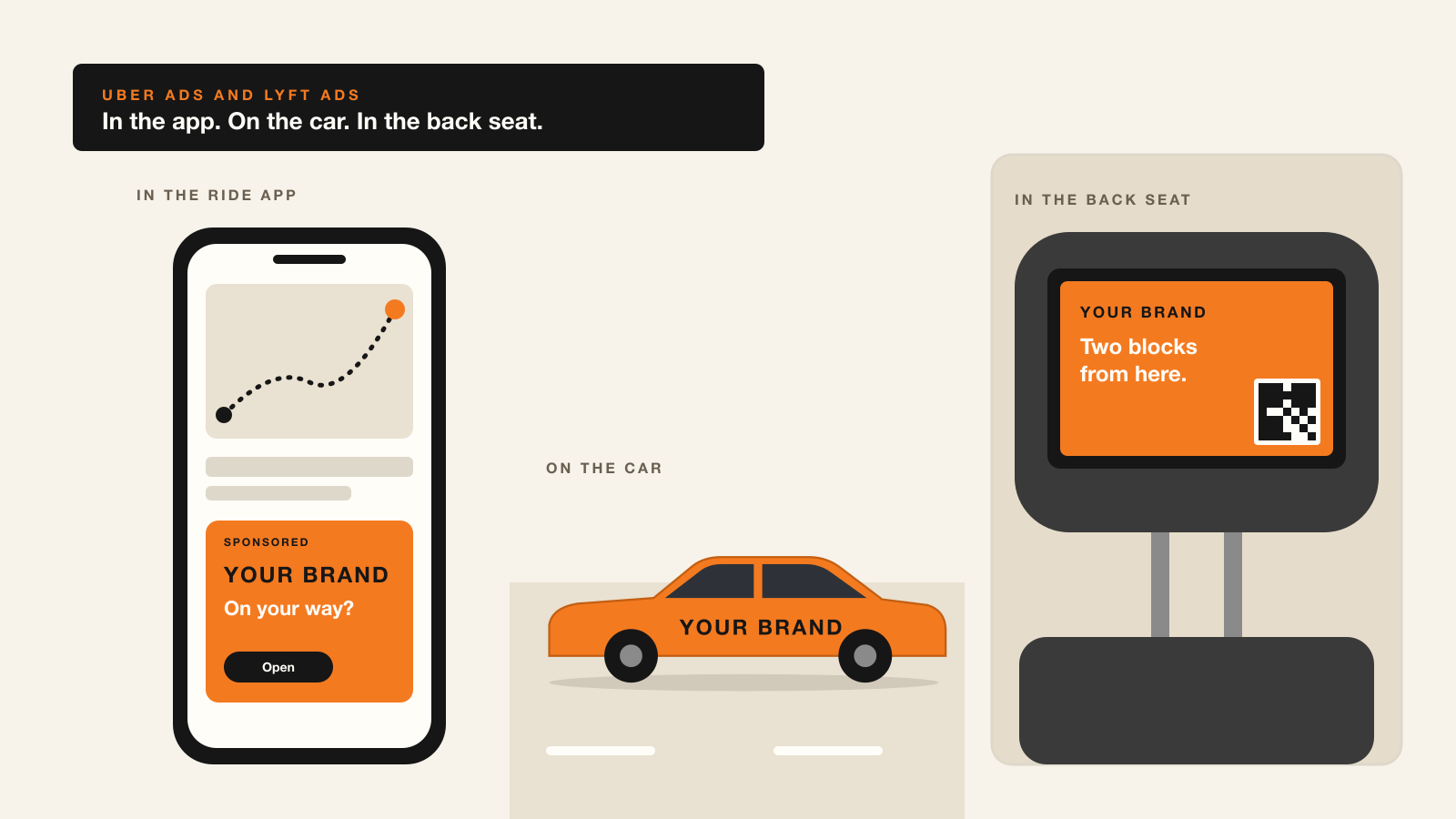
Search for "Uber ads" or "Lyft advertising" and you'll find two different buys. One is the advertising Uber and Lyft sell inside their own apps. The other is advertising on and in the cars themselves, sold by independent networks such as Vugo, which has run screens in rideshare cars since 2015.
The difference matters more than it looks. Ride companies sell their own apps and their own trips. Independent networks sell the car, inside and out, whichever app the driver is working, and they can put taxicabs and fleet vehicles in the same campaign.
Vugo isn't affiliated with Uber or Lyft. Everything below about them comes from their own public pages, linked, as they read on November 16, 2026.
What Uber and Lyft sell
Both companies sell mostly in-app advertising, built around their own riders and trips.
- Uber sells Journey Ads in the Uber app, from the moment a rider books to the ride itself, plus sponsored listings and other formats in Uber Eats (ad specs) and ride offers. Its in-car screen product, JourneyTV, is built around the Uber trip, with the Uber trip map, arrival time and driver details on the screen. Uber doesn't run those screens itself: its newsroom says they come through an exclusive partnership with T-Mobile Advertising Solutions. Uber announced car-top ads in 2022; its current ad specs list no car-top or wrap formats.
- Lyft sells in-app ads and sponsored ride credits, branding on its bikeshare systems, and programmatic ads on other sites and apps, with a $50,000 monthly minimum for the managed version. It also wraps Lyft cars, noting that location restrictions and vehicle count minimums may apply. Lyft once sold tablets and rooftop screens (2023); neither appears on its ad site today.
If you need to be on the screen while someone books a ride or orders dinner, their in-app ads are the way to do it. For the back seat and the street, an independent network does more.
What an independent network like Vugo sells
One screen, every app
Rideshare drivers rarely work for just one company. Many drive for both Uber and Lyft, switching through the day, and some drive a taxi or for a fleet as well. Any screen tied to one company's trips does its job only during that company's rides.
Vugo is platform agnostic. Its screens aren't tied to any ride app, so they keep playing while the car is out on the road, whether the driver is on an Uber, a Lyft, a taxi dispatch or a fleet's own trips. Your ad reaches the riders in that car no matter which app brought them there. Drivers earn from it whichever app they're driving for.
Every kind of vehicle in one plan
Because the network isn't tied to one company, a Vugo campaign can run on rideshare cars, taxicabs and other fleets at once, inside and outside. Screens run in many U.S. markets, on drivers' own tablets and fleets' embedded screens. Wraps are recruited for each campaign in the metro you choose, from rideshare, delivery and fleet drivers in Vugo's driver database of thousands of cars.
Inside and outside, together
The rider in the back seat and the people on the street are two audiences, and Vugo sells both.
- In-vehicle screens. Video up to 60 seconds facing the back seat, with a QR code a rider can scan on the spot. Captions carry the message, so it lands with or without sound.
- Wraps. Full and partial custom wraps, or the Standard Wrap on both sides and the rear window, turning the car into a mobile billboard for two to six months.
- Tiles. 20 × 18-inch panels, two or four to a car, that drivers apply themselves. They're a fast way to put a message on many cars at once.
- Swarms. With a swarm, the wrapped cars come to a place or along a route at the hours you choose: a stadium on game day, a convention center, your own store's opening.
Pay only for plays that count
Screen ads are billed per validated impression: a play confirmed in a working car out on the road. Plays Vugo can't confirm are free. Wrapped cars are checked with install photos before billing and send photo proof every month.
Placed with intent, and measured
TripIntent® puts the ads that fit the places around the car first, such as a restaurant's ad near dinner spots, without shrinking where your ads can play. Vugo Planning lines your flights up with the moments that matter in each city. Reports show where and when your ads played and the QR scans they brought in, and you can follow up with people who visited your scan page.
Priced plainly
Every Vugo campaign is quoted. In-vehicle screens typically run $20 to $25 per thousand impressions, and wraps and Tiles $0.75 to $5, depending on how long the campaign runs. The cost comparison sets those ranges beside TV, digital and billboards.
How to choose
- To be in the app while someone books or orders, buy from Uber or Lyft. Only they sell that screen.
- To reach riders in the back seat, whichever app they booked with, use an independent network's screens.
- To put your brand on the street in any metro, recruit wrapped cars or Tiles from drivers of every kind, with a swarm when you need the cars in one place.
- To run one plan across rideshare, taxi and fleets, use a network that isn't tied to any of them.
Many brands do both: an app campaign for the booking moment, and a Vugo campaign for the ride and the street.
Questions to ask any seller
Whoever you buy from, the same questions apply.
- Which vehicles carry the ad, and does it reach riders from every app the driver works, or only one?
- Which markets are available for your dates, and is there a vehicle or spending minimum?
- How is delivery proven? What counts as an impression, and do you pay for plays that can't be confirmed?
- What do you get to act on? A QR scan, a click, a visit to your location, or a report after the flight?
- What happens if it under-delivers? Are there makegoods, and how are they decided?
Where to go next
The 2026 rideshare advertising guide covers Vugo's formats, targeting and reporting in depth, and Rideshare, Taxi or Bus? helps you pick the vehicle. When you're ready, share your markets and dates and Vugo will put a plan together.
If you drive, a Vugo screen earns whichever app you're driving for. See how rideshare tablet advertising works.
Sources
Each page was pulled on November 16, 2026.
- Uber Advertising, ad specs, Journey Ad and JourneyTV.
- Uber Newsroom, JourneyTV in New York City, May 22, 2025.
- Uber Blog, ride offers and offsite ads, June 15, 2026.
- Uber, launch of its advertising division, October 19, 2022.
- Lyft Ads, home page, car wrap branding and programmatic.
- Lyft Blog, Lyft Media's 2023 expansion, August 10, 2023.