A wrapped car is a moving billboard, and most of the time that's the point: it goes where the trips go, through the neighborhoods, business districts and commutes where your customers are, all day, every day of the flight.
But some moments matter more than others. A store opening. A conference. A game day. The first weekend of a festival. For those, you don't want your cars spread across the city. You want them right there.
That's what a swarm does.
What a swarm is
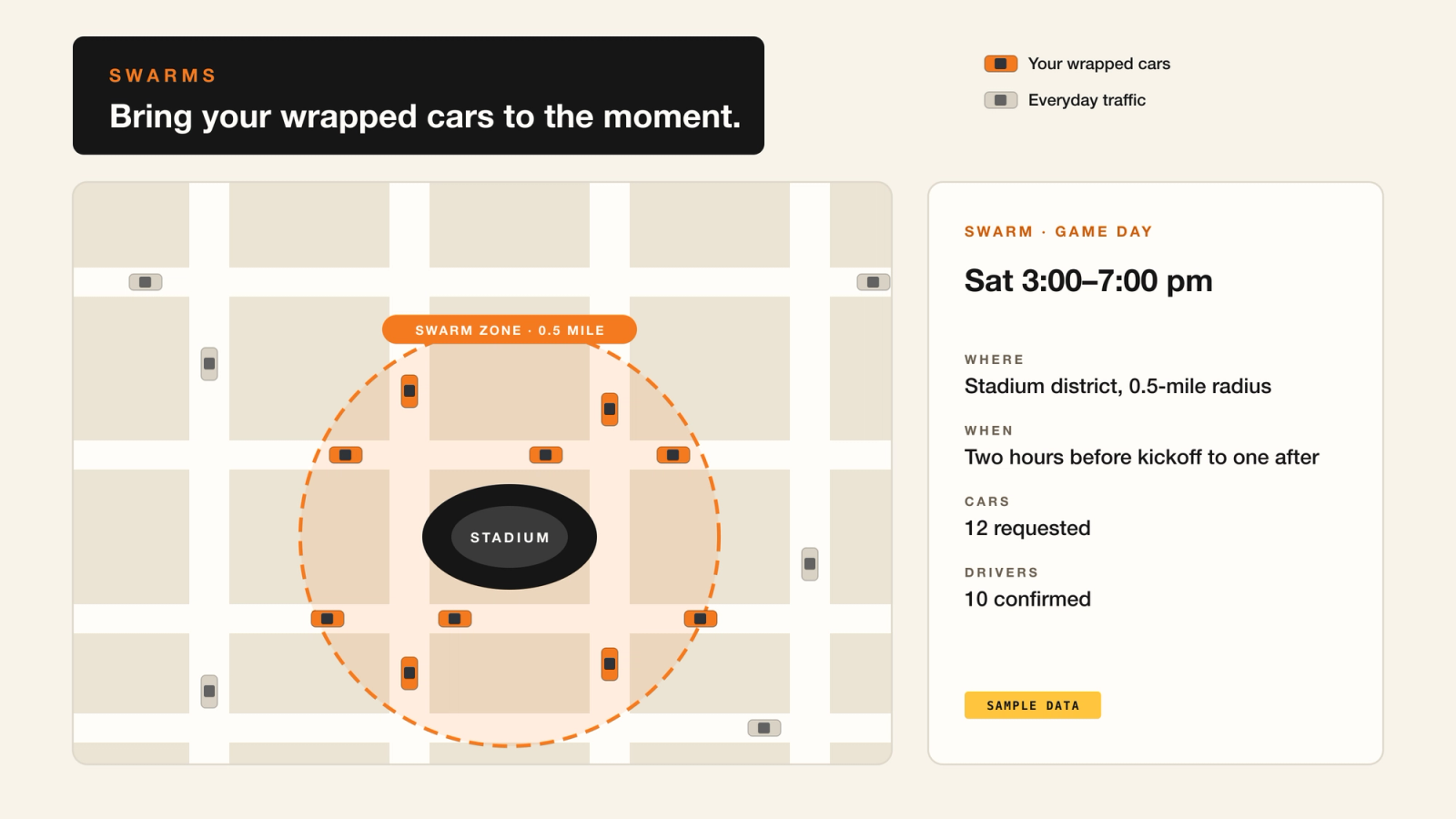
A swarm is a scheduled session on a wrap campaign. You choose a place and a window, and the campaign's wrapped drivers are paid to bring their cars into that zone for the hours you set.
The rest of the time, the same cars keep doing what wraps do best: covering the metro. A swarm doesn't replace that. It concentrates it, on demand.
How a swarm works
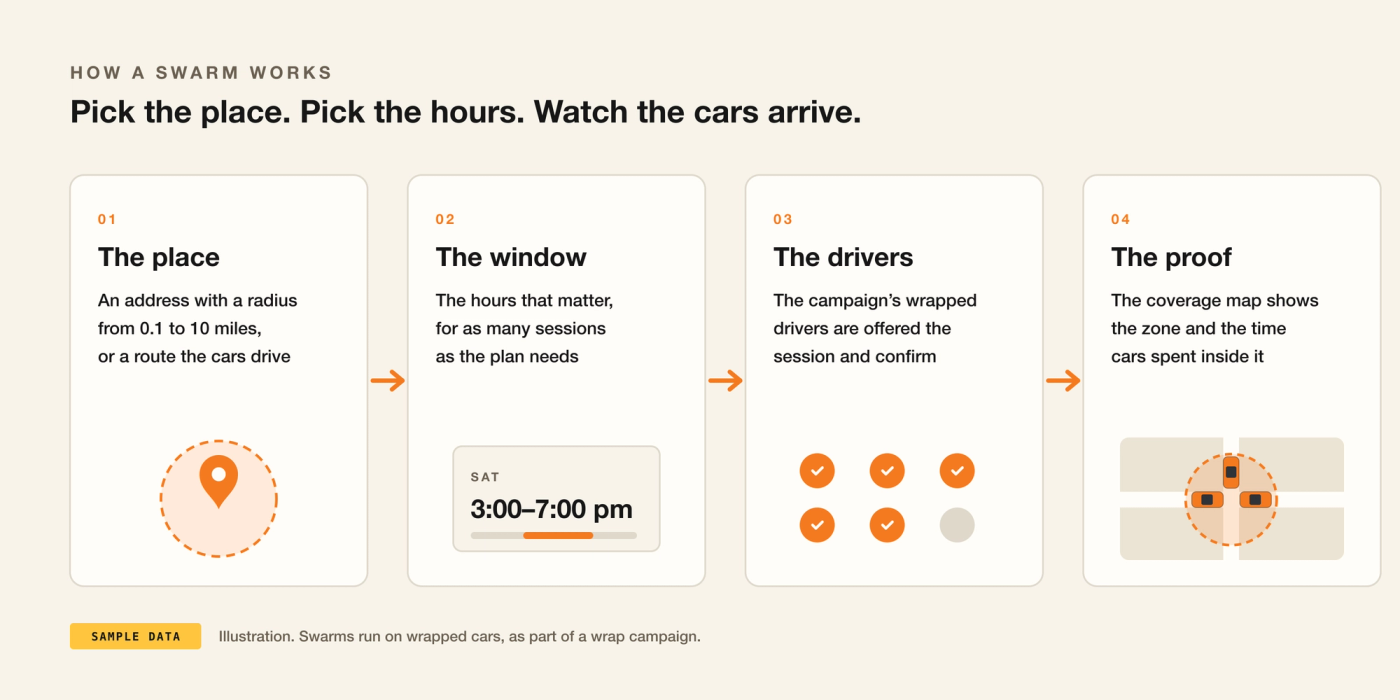
- Pick the place. An address with a radius anywhere from a tenth of a mile to 10 miles, or a route the cars drive, like the corridor from a parking garage to an arena or the main street of a festival.
- Pick the window. The hours that matter: arrivals at a convention center, the two hours before kickoff, a Saturday afternoon on a shopping street. Plan one session or as many as the campaign needs, and sessions can run late and cross midnight.
- The drivers confirm. The campaign's wrapped drivers are offered the session in their Vugo driver account and by text. They accept, and you see how many have confirmed before it starts.
- See it happen. The coverage map highlights the zone and the time cars spent inside it, so you can see the swarm, not just take it on faith.
Swarms are priced by the hour per car for the hours a session runs, and quoted with your wrap campaign.
When to swarm
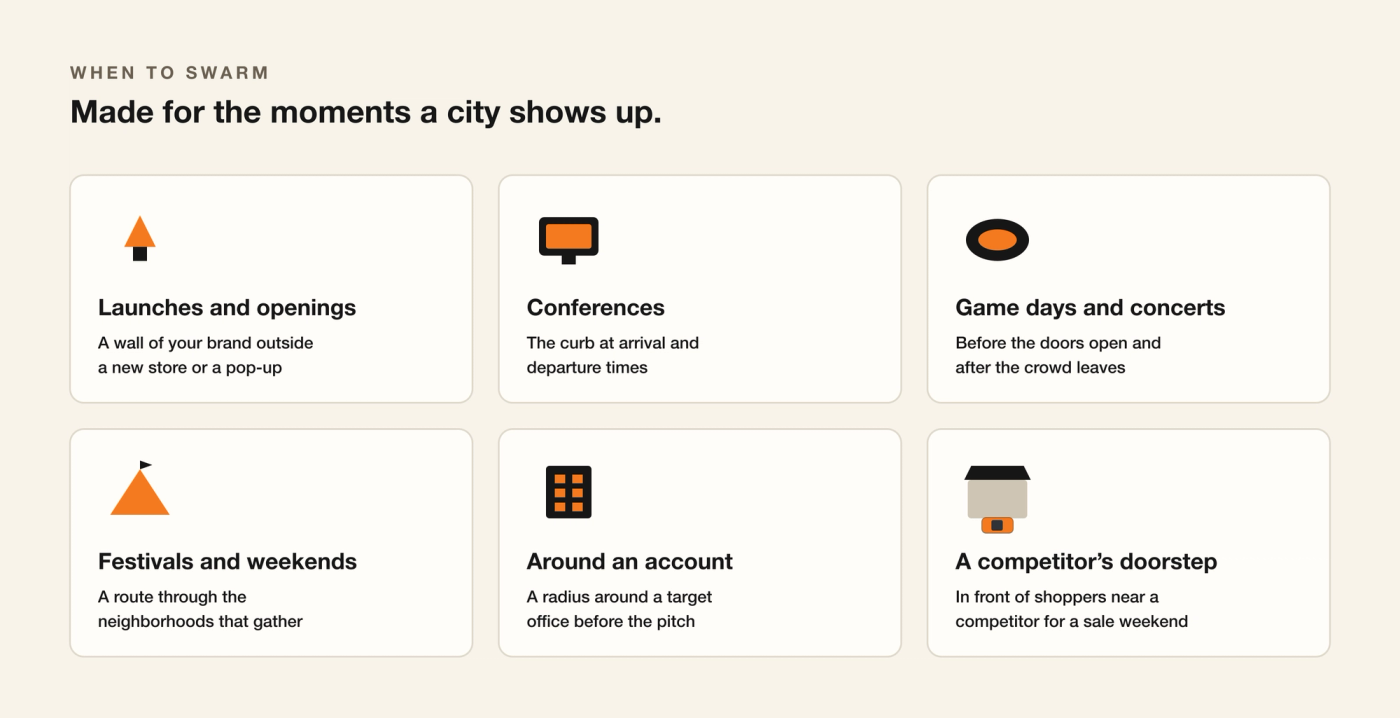
- Launches and openings. Put a wall of your brand outside a new store, a product launch or a pop-up for its first days, when first impressions decide whether people come back.
- Conferences and trade shows. Surround the convention center at arrival and departure times, when attendees are on the curb waiting for a ride.
- Game days and concerts. Bring your cars to the stadium or arena district for the hours before the doors open and after the crowd leaves.
- Festivals and big weekends. Hold a route through the neighborhoods where the city gathers, for the whole weekend or one night.
- Around an account. For B2B, set a radius around a target account's office or campus for the week before a meeting or a pitch.
- A competitor's doorstep. Put your cars in front of shoppers near a competitor's location for a sale weekend.
What it looks like in practice
When the Bitcoin 2022 conference came to Miami Beach in April 2022, Vugo put the event on every format it ran: wraps, digital rooftop displays and in-vehicle screens, each with a QR code to the ticket page. Wrapped cars swarmed Miami Beach around the convention center, and programmatic mobile retargeting followed up with people who had visited the ticket page. The conference and its music festival sold out. Read the case study.
The idea scales across a whole market, too. In 2025, the Moving Out of Home Association (MOOHA) ran an eight-week campaign for C4 Energy in New York City that centered on Madison Square Garden: vehicles carrying C4 swarmed the blocks around the arena on New York Knicks game days, and covered the boroughs the rest of the week. MOOHA's study found a 59% lift in ad recall, four times the category benchmark, and an 11.6% in-store sales lift. Vugo took part as a member of MOOHA. See how the study was done.
Why it works
It's attention where the decision gets made. A swarm puts your brand in front of people at the moment they're closest to acting: walking into the venue, standing at the curb, a block from the store.
It's frequency people notice. One wrapped car is a sighting. Ten in the same few blocks is a takeover. Seeing your brand again and again in a short window is what makes it stick.
It moves when the moment moves. A billboard is fixed to one corner for the whole contract. A swarm can be outside the convention center on Thursday morning, at the stadium on Saturday and gone on Sunday.
You can see it. The coverage map shows the zone and the in-zone time, so you know the cars were there.
Plan it
A few things to settle before the first session:
- Start with a wrap campaign. Swarms run on wrapped cars, so they're part of a wrap campaign. Plan them with the flight, or add them to a campaign already on the road. Most wrap campaigns run two to six months, which leaves room for several moments.
- Choose the place and the window. The address or route, the radius, and the hours that matter. A tight radius works for a storefront; a wider one, or a route, works for a stadium district or a festival.
- Know the local rules. Some venues and cities limit stopping or staging near an event. Plan the zone around those rules, and keep election-day swarms away from polling places.
- Give people a next step. Put a short web address or a QR code on the wrap for the moments people are on foot and close: a curb, a line, a parking lot.
Learn more about swarms, see the Event Takeover play, or talk to Vugo about where your crowd will be.