
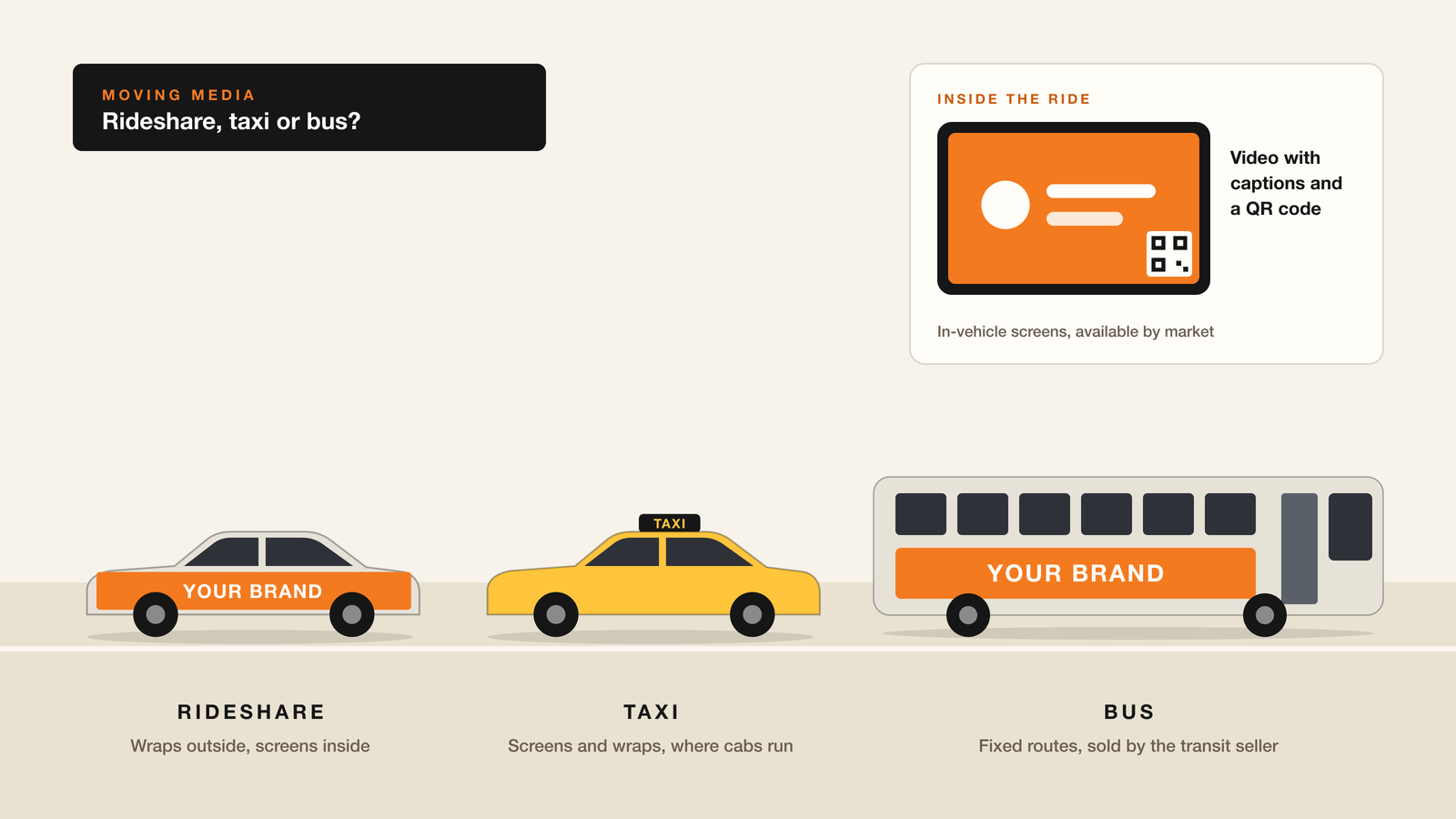
When a brand decides to put its ad on something that moves, the first question is usually which vehicle. Rideshare cars, taxis and buses all carry advertising, and from the sidewalk they can look like the same idea. They aren't. Each builds reach its own way, reaches people at a different moment, and asks for different creative.
Here's how they compare, so you can pick the one that fits the job, or combine them.
Three ways to build reach
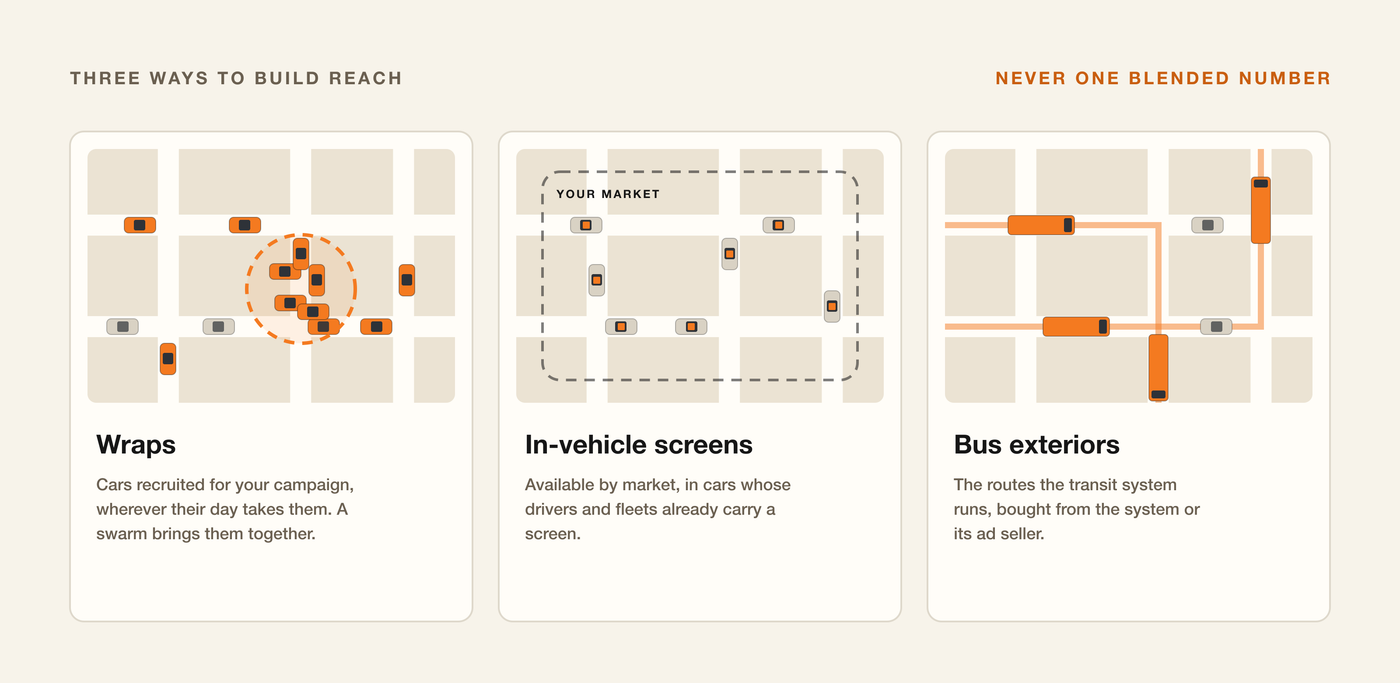
Car wraps are recruited for your campaign. There's no fixed inventory of wrapped cars waiting on a lot. For each campaign, Vugo recruits drivers in the market you choose, from rideshare, delivery, taxi and fleet drivers, and a professional shop installs every wrap before the flight starts. The cars then go wherever their day takes them. When one place matters more than the rest, a swarm brings the campaign's wrapped cars into a zone you choose, around a venue or along a route, for the hours you schedule.
In-vehicle screens are available by market. Passenger-facing screens run in working rideshare and taxi cars where drivers and fleets already carry them. Vugo doesn't install them for your campaign; you choose the metros, and the ad plays on the screens running there.
Buses run fixed routes. A bus campaign is bought from the transit system or the company that sells its advertising, usually by route, by garage or as a package across the system. You know where the buses will go, because they go there every day on a schedule. Inside, some buses and on-demand transit vehicles carry passenger screens too: Vugo has built in-vehicle screen networks for on-demand transit services in several states.
Keep those numbers apart when you compare plans. Cars that could be wrapped for your dates, screens running in your market today and buses on a route are three different things. A single "network" figure that blends them tells you very little.
Where each one is seen
Wraps are seen by the street. People walking, waiting at a light, in the next lane or in a parking lot. Because rideshare, delivery and taxi cars drive all over a metro, a wrap shows up in neighborhoods, business districts, campuses and airports, not just on main roads.
Screens are seen by the rider. The screen sits in the back seat, at arm's length, facing the passenger. It's the one format here that reaches someone who is sitting down with a few minutes to spare.
Bus exteriors are seen along the route. A bus side is a big canvas on the streets the route runs, seen over and over by the people who live, work and wait along it.
Ads on cars and on transit are both widely noticed. In Nielsen's 2019 Out-of-Home Advertising Study, 64% of people had noticed an ad on a wrapped vehicle in the past month, 55% an ad on the side of a bus, and 31% an ad on a taxi. In Morning Consult's 2023 study for the OAAA, 22% of adults had noticed ads on or in a ride-share vehicle in the past 30 days, and 21% on a taxicab. Both measured noticing, not recall of a brand.
How long people spend with it
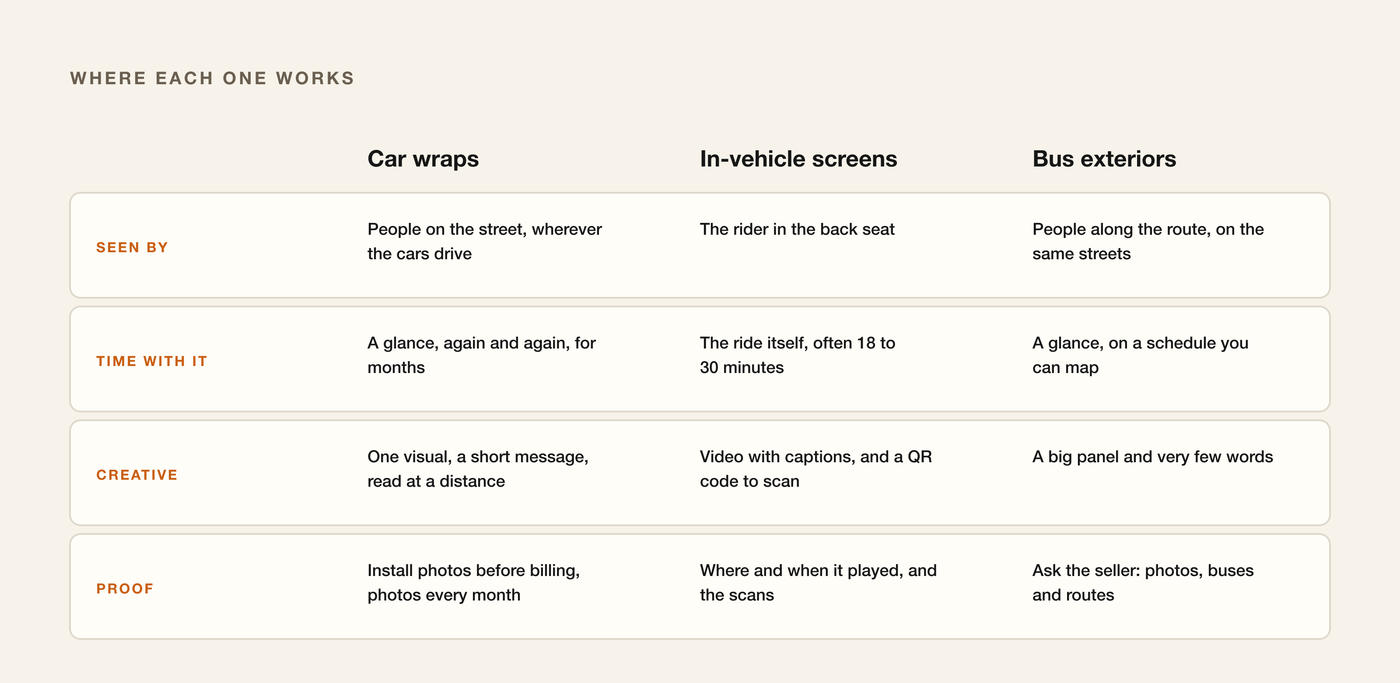
A wrap or a bus side is a glance, a few seconds at a time. Its power is repetition: the same people see it again and again, on the commute and around town, over weeks and months. That's why wrap campaigns run for at least two months, and most run two to six.
A screen is different. A typical rideshare ride lasts 18 to 30 minutes, depending on the city, and the rider is a few feet from the screen for the whole of it. That's long enough for a video to make its point and for someone to pull out a phone. The audience is real and growing: the federal government's 2022 National Household Travel Survey found that 17.2% of Americans 16 and older used rideshare, up from 9.8% in 2017.
What the creative looks like
Wraps have to read at a distance and on the move: one strong visual, a short message, a web address or QR code people can remember. The Standard Wrap covers both sides and the rear window on one layout fitted to every car; custom wraps, full or partial, are designed with Vugo for your campaign.
Screens play a video up to 60 seconds long, with a QR code built from your landing page. Sound is optional, and captions carry the message, so put the brand and the offer on screen in the first few seconds. You can limit where it plays to the metros you choose or a radius around an address, and TripIntent® can put your ad first in cars whose surroundings fit it, without shrinking where it can play.
Bus exteriors are the billboard of the group: the biggest panel, and room for very few words.
Taxis: the middle ground
Taxis carry both kinds of media. They can be wrapped, and some carry passenger screens, so a taxi campaign can reach both the street and the back seat. Taxis also tend to work where people hail or book them: downtowns, hotels, airports and convention districts. For a brand that wants business travelers and visitors, that concentration helps. Vugo's screens run in taxicabs as well as rideshare cars, and taxi drivers and fleets can carry wraps on Vugo campaigns.
How delivery is proven
Whatever you buy, ask what proof comes with it, and when you'll see it.
- Wraps on Vugo: every installed car is checked from install photos before billing starts, and wrapped cars send photo proof each month. On a swarm, you see which drivers confirmed the session.
- Screens on Vugo: the campaign report shows where and when your ad played, and the QR scans it brought in.
- Buses: ask the seller for photos of the posted buses and which routes and garages they ran from, for how long.
Which one fits
- For reach across a whole metro, for months, choose wraps, and add a swarm for the dates that matter.
- For a next step people can take right away, choose screens: a captioned video and a QR code in the back seat.
- For travelers and downtown, look at taxis, inside and out.
- For the same streets every day, a bus route puts your brand on a schedule you can map.
- For both sides of the car door, pair them. A wrap outside and a screen inside means the person who noticed your brand on the street meets it again when they get in.
Some formats sit outside all three, like mobile billboard trucks and rooftop screens. We compared those in Car Wraps, Mobile Billboard Trucks or Rooftop Screens: Which Moving Format Fits?
Sources
- Nielsen, Out-of-Home Advertising Study, 2019 edition: 999 online surveys of U.S. residents 16 and older, March 27 to April 5, 2019; wrapped vehicles 64%, bus sides 55% and taxis 31% noticed in the past month. Released by the OAAA on May 21, 2019 (oaaa.org); the report itself (archived copy).
- Morning Consult for the OAAA's research foundation, OOH Advertising Study, March 2023: 1,461 U.S. adults 18 to 64, November 10 to 15, 2022; 22% noticed ads on or in a ride-share vehicle and 21% on taxicabs in the past 30 days (PDF on oaaa.org).
- U.S. Department of Transportation, Federal Highway Administration, Summary of Travel Trends: 2022 National Household Travel Survey, January 2024 (FHWA-HPL-24-009): 17.2% of people 16 and older used rideshare, up from 9.8% in 2017 (PDF).
See vehicle wraps, see in-vehicle screens, or talk to Vugo about your market and your dates.