
Every media plan eventually comes down to one question: what does it cost to reach a thousand people? Cost per thousand impressions, or CPM, is the one number that lets you set a car wrap beside a TV spot, a podcast read or a billboard.
Here's what Vugo's formats typically cost per thousand, how that compares with every major medium, and why the cheapest CPM is only part of the story.
The short version
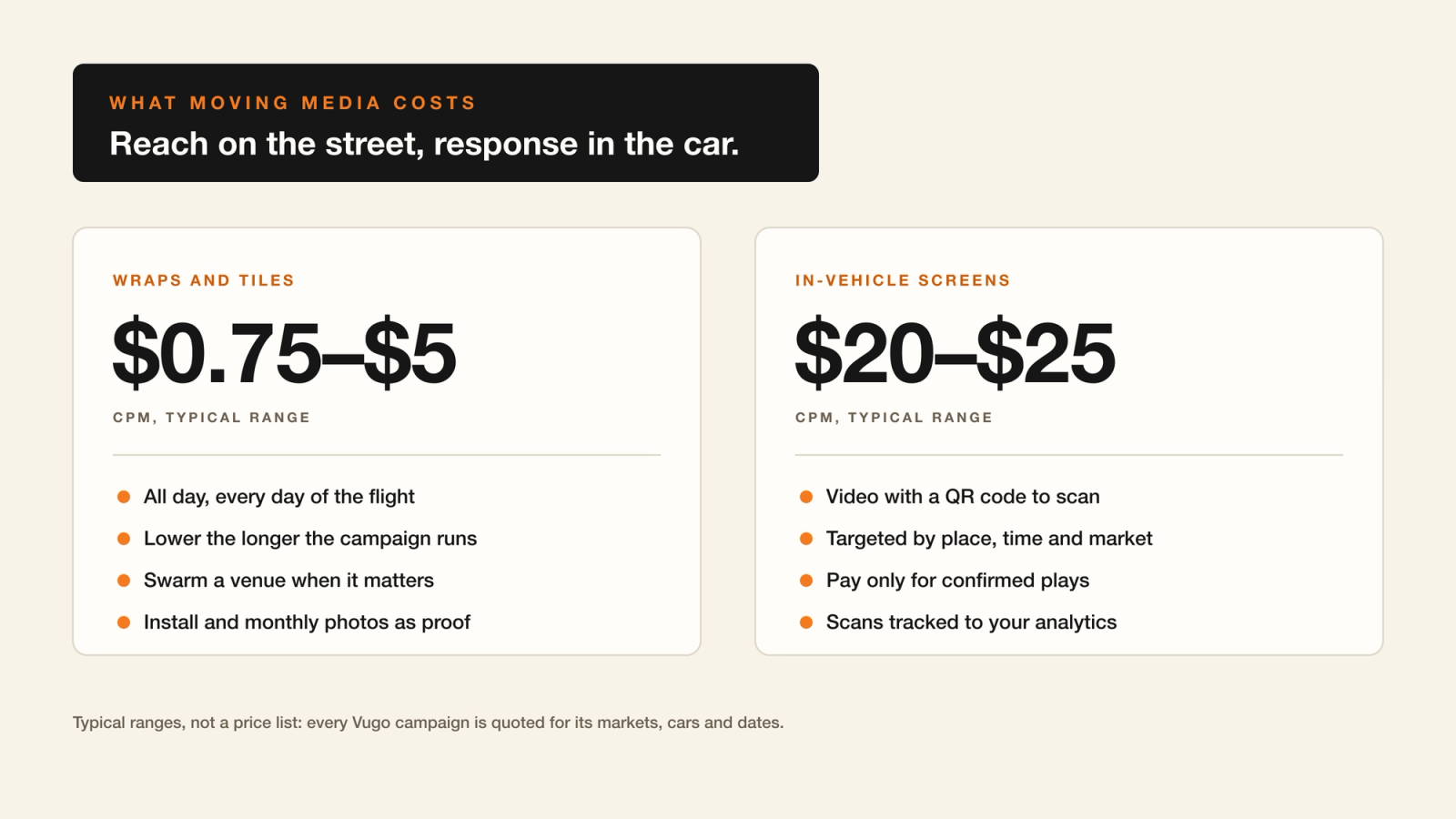
- Wraps and Tiles: typically $0.75 to $5 CPM, and the longer the campaign runs, the lower it goes. That starts below every medium in Solomon Partners' comparison of U.S. major media.
- In-vehicle screens: typically $20 to $25 CPM, in the range of primetime cable, broadcast TV outside primetime and connected TV (CTV), but interactive and targetable: a QR code to scan, ads aimed by place, time and market, and only confirmed plays billed.
- On a real campaign: American Career College's Standard Wraps in Los Angeles delivered more than 100 million impressions in their first 10 months, at a CPM under $1.
How Vugo compares with other media
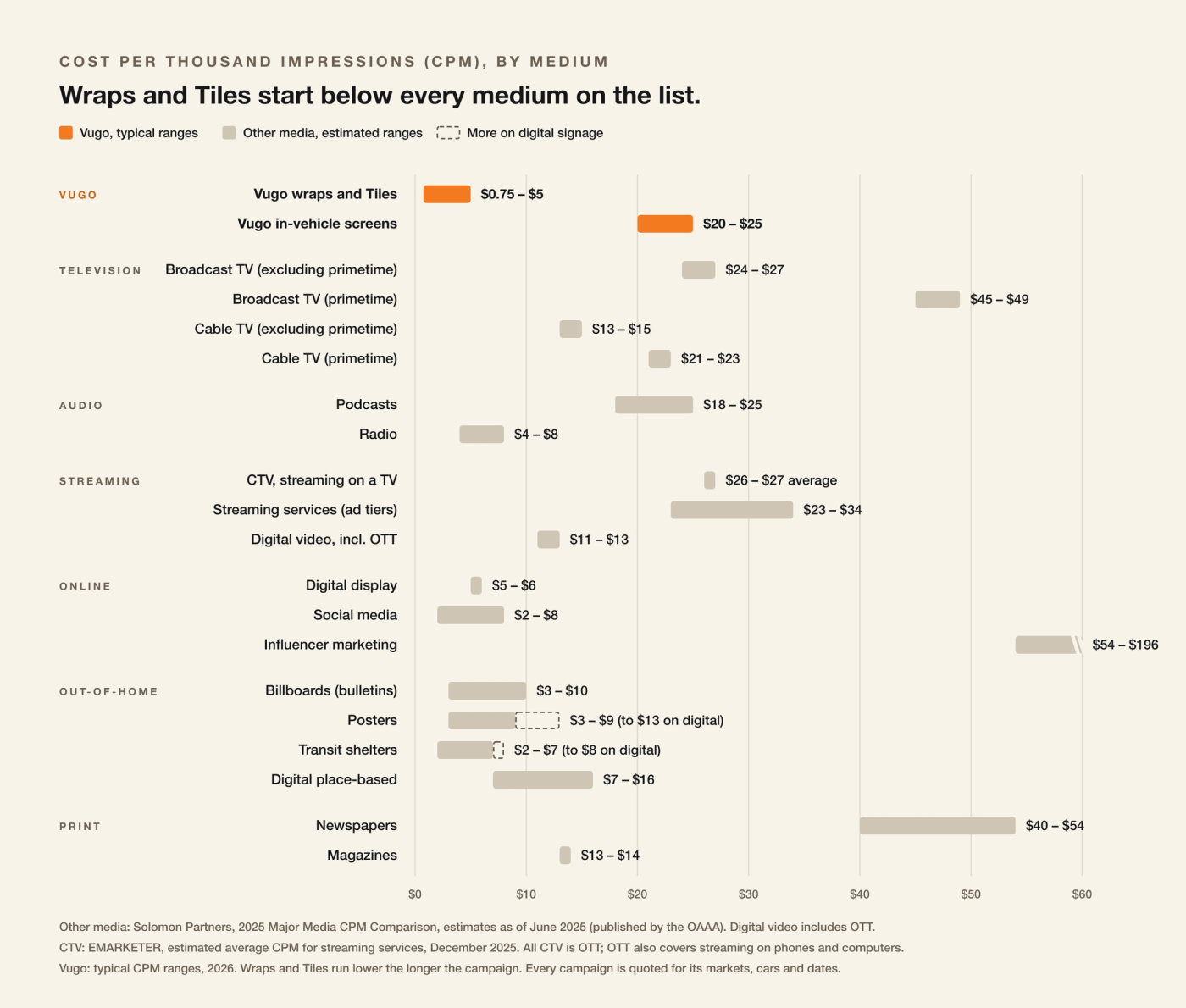
Solomon Partners, an investment bank that follows the media industry, publishes estimated CPM ranges for the major U.S. media, from broadcast TV to magazines. The out-of-home industry's association, the OAAA, shares it; the latest edition has estimates as of June 2025. We've put Vugo's typical ranges beside it. Solomon's chart doesn't list connected TV, so we've added EMARKETER's estimate for it.
Four things stand out:
- Wraps and Tiles sit with the lowest-cost media there are. At $0.75 to $5, they start below social media ($2 to $8), digital display ($5 to $6), transit shelters ($2 to $7), posters ($3 to $9) and billboards ($3 to $10), and far below TV, streaming and print.
- Screens cost about what TV does. At $20 to $25, in-vehicle screens sit alongside primetime cable ($21 to $23) and podcasts ($18 to $25), just below broadcast outside primetime ($24 to $27) and connected TV, which EMARKETER estimates averages about $26 to $27, at the low end of ad-supported streaming services ($23 to $34), and about half the price of primetime broadcast ($45 to $49).
- CTV and OTT aren't the same thing. Connected TV (CTV) is streaming on a TV set: a smart TV, a streaming stick or a game console. OTT covers all streaming, on TVs, phones and computers. Every CTV ad is an OTT ad, but not every OTT ad is CTV, and the prices differ: Solomon counts OTT inside digital video ($11 to $13), while the big screen in the living room costs more, about $26 to $27 per thousand for CTV.
- The most expensive ways to reach a thousand people are newspapers and influencers. Newspapers run $40 to $54, and influencer marketing $54 to $196.
A fair warning about any CPM chart: the figures for other media are Solomon's estimates as of June 2025, the CTV average is EMARKETER's estimate from December 2025, Vugo's are our typical ranges in 2026, and every medium counts an impression its own way. Use the chart to see where each medium sits, not to settle a decision to the cent.
Why online CPMs cost more than they look
An online CPM is paid on impressions served, and a served impression isn't the same as a person seeing your ad. Three industry studies show how wide that gap can be:
- Half the web isn't human. Thales' 2026 Bad Bot Report found that bots made up 53% of all web traffic in 2025, outnumbering people for the second year running. Ad platforms filter out the bots they can detect, but the most sophisticated ones are built to look human.
- Many ads are never on screen. In Integral Ad Science's 21st Media Quality Report (July 2026), 67.9% of display ad impressions and 79.7% of video ad impressions met the industry's viewability standard, which for display means at least half the ad on screen for one second. About one display ad in three didn't.
- Much of the money never reaches a person. In the ANA's study of programmatic buying (December 2023), only 36 cents of every dollar that entered a demand-side platform effectively reached a consumer. Made-for-advertising sites alone took 21% of the impressions studied.
The math adds up quickly. A $5 display CPM where 67.9% of impressions are viewable is really about $7.36 per thousand viewable impressions, and that's before any of the remaining bot traffic is taken out. How many of those viewable impressions reached a human isn't something most campaigns measure, but every impression a bot absorbs pushes the real cost per person higher than the rate on the invoice.
Physical media doesn't have that problem. A bot can load a web page, but it can't drive past a car. Wraps and Tiles are seen on the street, by the people on it. And Vugo's in-vehicle screens are billed on plays confirmed in a working car out on the road, not on page loads. Out-of-home impressions are estimates too, so no medium's CPM is perfect, but the gap between an impression and a person is widest online.
Why wraps and Tiles cost so little per thousand
One production cost, months on the road. A wrap is priced per car for the flight, with production and installation as their own lines. Once it's on, it carries your brand all day, every day: on the commute, at lunch, in the parking lot, on the way home. Every extra week spreads the same production cost over more impressions.
The longer the flight, the lower the CPM. Wraps and Tiles run two months or more, and most wrap campaigns run two to six. That's why the range is wide: a short flight sits toward $5, and a long one heads toward $0.75. American Career College's campaign was under $1 per thousand after 10 months, and still falling.
Tiles take out the install. Tiles are printed door panels, two or four to a car, with printing and shipping included. Drivers apply them, so there's no shop install to pay for, and the same budget puts your brand on more cars.
Low cost doesn't mean low attention. In Nielsen's 2019 Out-of-Home Advertising Study, 64% of U.S. residents 16 and older had noticed a wrapped-vehicle ad in the past month, second only to roadside billboards among 15 out-of-home formats. A low CPM buys impressions people actually notice. See the research.
You can concentrate it. Wrapped cars go where the trips go, and when one place matters more than the rest, a swarm brings the campaign's wrapped cars into a zone you choose for the hours you schedule: around a store, a venue or a competitor's address.
Why screens are worth a TV-level CPM
A screen in the back seat costs about what TV does per thousand, a little less than connected TV. What you get for it is different. A CTV ad plays on a TV across the room; a Vugo screen sits in the back seat, where a rider can scan its QR code on the spot.
It's interactive. Every ad is a video with a QR code built from your landing page, so a rider can go from the screen to your site, offer or app in a scan. With UTM tags, those scans show up in your own analytics. In Nielsen's 2019 study, 20% of smartphone owners had already scanned a QR code, tapped an NFC tag or sent a text in response to an out-of-home ad, and that was before QR codes became an everyday habit.
It's targetable. You choose the metros, a radius around your locations and the days the ad runs. TripIntent® and time of day then put your ad first where and when it fits best, without shrinking its reach.
You pay for plays that count. Screens are billed on validated impressions: plays confirmed in a working car out on the road. Plays that can't be confirmed are free.
What the money buys
Cost is only half of cost-effectiveness. The other half is what happens after people see the ad, and that's where the research on moving media is strongest.
- They notice: 64% had noticed a wrapped-vehicle ad in the past month (Nielsen, 2019).
- They remember: C4 Energy's campaign around Knicks game days at Madison Square Garden lifted ad recall 59%, four times the category benchmark, in MOOHA's 2025 study.
- They consider and buy: the same campaign brought a 31% higher likelihood of purchase and an 11.6% in-store sales lift. In MOOHA's study of Xumo's campaign in Atlanta, consideration rose 26%.
- They act: people exposed to Xumo's campaign were 61% more likely to visit its website.
Those are industry studies, not Vugo results: C4's campaign ran across nine MOOHA member companies, Vugo among them, and Vugo wasn't on Xumo's. Read how each was done on the Research page, or the full roundup in What the Research Says About Car Wrap and Rideshare Advertising.
On Vugo campaigns, the same pattern holds. Dash's rooftop displays across Miami delivered 10,140,243 impressions against a plan of 7.5 million, for an effective CPM of about $5.92 against $8 planned (read the case study). American Career College's wraps passed 100 million impressions at under $1 per thousand (read the case study).
Putting the two together
The two price points do two different jobs, and they work best on the same plan:
- Wraps or Tiles for reach. The lowest CPM in the mix, building familiarity across a market for months.
- Screens for response. A higher CPM that buys video in the back seat, a QR code and scans you can count.
- A swarm for the moments that matter. Concentrate wrapped cars around a venue, a store or an event for the hours you choose.
- A follow-up online. As part of a campaign, Vugo, your agency or your own team can run a programmatic mobile buy that follows up with people who visited your scan page, in the same areas. The Street to Feed play shows how.
Comparing quotes
A CPM is only comparable when the impressions behind it are. When you compare vendors, ask whether you pay for every play or only confirmed ones, how many cars will actually carry your ad, what's included (production, installation, removal, design, reporting), and what proof you'll see. Our guide to what car advertising really costs walks through each, and our six questions to ask any vendor cover the rest.
These are typical ranges, not a price list. Every Vugo campaign is quoted for its markets, cars and dates, with rates and what's included spelled out. Get a quote for your campaign.