
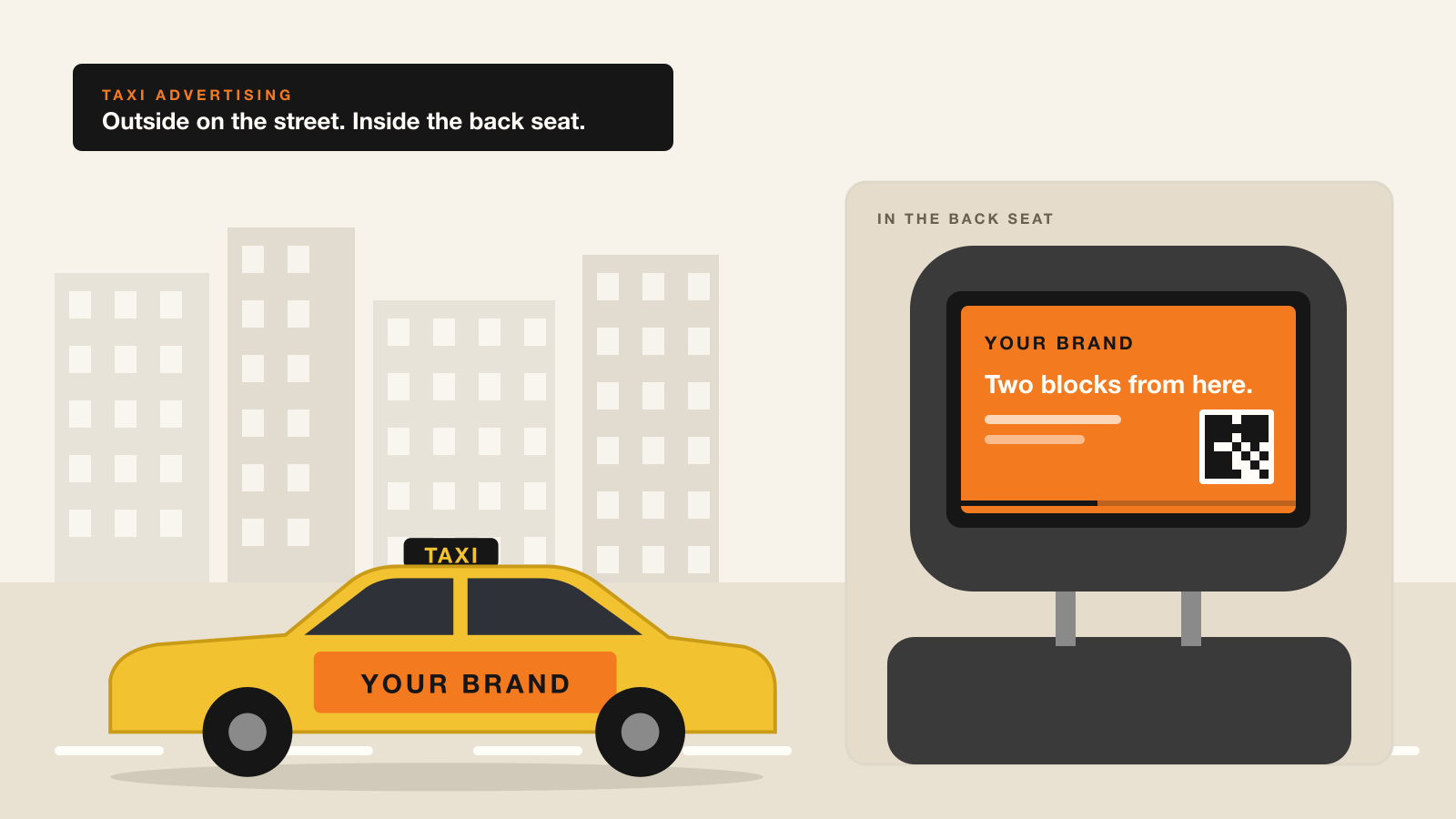
A taxi is two kinds of advertising in one. Outside, it's a moving sign that crosses downtowns, airports and hotel districts all day. Inside, it's a back seat where someone sits for a while with little else to look at. Taxi advertising is the business of using one or both.
This guide covers what taxi advertising is today, the formats you can buy, how cab ads are targeted and proven, what they typically cost, and how to start.
What is taxi advertising?
Taxi advertising is any ad that runs on or in a cab: a wrap or panel on the outside, or a screen facing the back seat. It's part of out-of-home advertising, alongside billboards and transit. What makes it different is that it moves.
Today the same media runs on rideshare cars too. People hail a cab on the street or book an Uber or Lyft in an app, and both cars carry the same kinds of media. That's why most campaigns buy taxi and rideshare advertising together. At Vugo, wraps and screens run on rideshare cars, taxicabs and other fleets across the U.S.
Which formats can you buy?
There are four, and most campaigns use one or two.
- In-vehicle screens. A screen on the headrest or partition, facing the back seat. Your ad is a video of up to 60 seconds, with captions so it works whether or not the sound is on, and a QR code that takes riders to your page. See in-vehicle screens.
- Vehicle wraps. Your design on the outside of the car. The Standard Wrap covers both sides and the rear window, and custom wraps go further, up to a full wrap. See vehicle wraps.
- Tiles. Smaller door panels, 20 by 18 inches, two or four per car. Drivers apply them, so they reach the road quickly and in large numbers. See Tiles.
- Rooftop displays. Digital signs on the roof, by inquiry, quoted for each campaign.
How do screens and wraps differ?
Screens reach the person in the back seat. Wraps reach everyone on the street.
A screen ad is seen up close by someone with a few minutes to spare. Rides commonly take 18 to 30 minutes, so a short video can play more than once, and a QR code turns interest into a visit right away. Screens run where drivers and fleets already carry them, in many U.S. markets.
A wrap is seen by pedestrians, drivers and everyone at the curb, over and over, for months. Wrapped cars are recruited and installed for your campaign, in the metro you choose, so a wrap campaign can go almost anywhere. Wraps run for at least two months, and typically two to six.
Many brands use both: wraps for reach across the city, and screens for a next step people can take on the spot. Here's how rideshare, taxi and bus advertising compare.
Do people notice taxi ads?
Yes, and vehicles are among the most noticed outdoor formats. In Nielsen's 2019 out-of-home study, 64% of U.S. residents had noticed a wrapped vehicle in the past month, second of the 15 formats in the study. 31% had noticed ads on taxis. In a 2023 survey for the OAAA by Morning Consult, 21% of adults had noticed ads on taxicabs in the past 30 days, and 22% ads on or in a ride-share vehicle. Read the studies on our research page.
Being noticed isn't the same as being remembered, and neither study measured sales. Plan how you'll measure results before you launch (more on that below).
How is a taxi campaign targeted?
By market, by place and by time, depending on the format.
- Screens: you choose the metros, and you can narrow a campaign to a radius around a place. TripIntent® then gives priority to the ads that fit the moment, based on the places around the car and where it's headed when the driver has set a destination. It never stops an ad from playing; it decides what comes first.
- Wraps: you choose the metro, and drivers who work there are recruited for your campaign. For a game, a festival or a store opening, a swarm pays wrapped drivers to bring their cars into a zone you choose, on the dates and times you set.
- Timing: campaigns can be planned around your season and local dates.
How do you know your ads ran?
Ask every seller what proof comes with the buy. With Vugo, it comes in your reports.
- Screens: you pay for validated impressions, plays confirmed in a working car out on the road. Plays that can't be confirmed are free. Your report shows where and when your ad played, and the QR scans it brought in.
- Wraps and Tiles: each car is checked from install photos before billing starts, and wrapped cars send photo proof every month. On a swarm, you see which drivers confirmed.
How do you measure results?
Plan it before launch, and use more than one signal:
- A QR code and a tagged link show visits from the screen in your own analytics. Here's how to set them up.
- Visits near your location: add your store or venue to a screen campaign to see how many working cars passed nearby or were headed there. How visit measurement works.
- A promo code or a web address used only on the cab counts the people who acted on it.
- A test market: run in one city, hold back a similar one, and compare sales or sign-ups over the same weeks.
How much does taxi advertising cost?
Every campaign is quoted, but there are typical ranges. In-vehicle screens typically cost $20 to $25 per thousand impressions (CPM). Wraps and Tiles typically cost $0.75 to $5 CPM, and the longer the campaign runs, the lower it goes. What drives a quote is the format, the number of cars or markets, and how long you run. See how those costs compare with TV, streaming, digital and billboards.
How do you buy taxi advertising?
- Pick the goal. Awareness across a city, traffic to a location, or response you can count.
- Pick the markets and dates. Start with one city if you want to test, or several at once.
- Pick the formats. Screens for a next step in the back seat, wraps or Tiles for the street, or both.
- Make the creative. For screens, a short captioned video with your brand up front and one clear next step. For wraps, a proof you approve before anything is printed.
- Launch and watch the reports. Screen campaigns report where and when ads played, and wraps send photo proof each month.
Plan a campaign by city, or tell us your market and your dates.
Common questions
Is taxi advertising the same as rideshare advertising? Close. The media is the same, and the cars differ: a taxi is hailed or dispatched, a rideshare is booked in an app. Most campaigns run on both.
Which cities can I advertise in? Wraps and Tiles can be recruited in nearly any U.S. metro. Screens run in many markets across the U.S.; tell us your city and we'll confirm coverage.
How long does a campaign run? Wraps and Tiles run for at least two months, and typically two to six. Screen campaigns run on the dates you set.
Do I need to make a video for the screens? Yes: a video of up to 60 seconds, MP4 or MOV at 16:9, with captions carrying the message and your brand in the first seconds.
Can I see where my ad played? Yes. Screen reports show where and when your ad played and the scans it brought in. Wrapped cars send photo proof every month.
Do screens count who's watching? No. Validated impressions confirm that the screen played your ad in a working car out on the road. They don't count people, and no one can promise that every play was watched.
Sources
- Nielsen, Out-of-Home Advertising Study, 2019 edition: 999 online surveys of U.S. residents 16 and older, March 27 to April 5, 2019; wrapped vehicles 64% and taxis 31% noticed in the past month. Released by the OAAA on May 21, 2019 (oaaa.org); Vugo's summary.
- Morning Consult for the OAAA's research foundation, OOH Advertising Study, March 2023: 1,461 U.S. adults 18 to 64, November 10 to 15, 2022; 21% noticed ads on taxicabs and 22% on or in a ride-share vehicle in the past 30 days (PDF on oaaa.org); Vugo's summary.
Update, November 2026: for Uber and Lyft cars in particular, read our companion guide, Rideshare Advertising in 2026: Uber and Lyft Ads for Brands.