
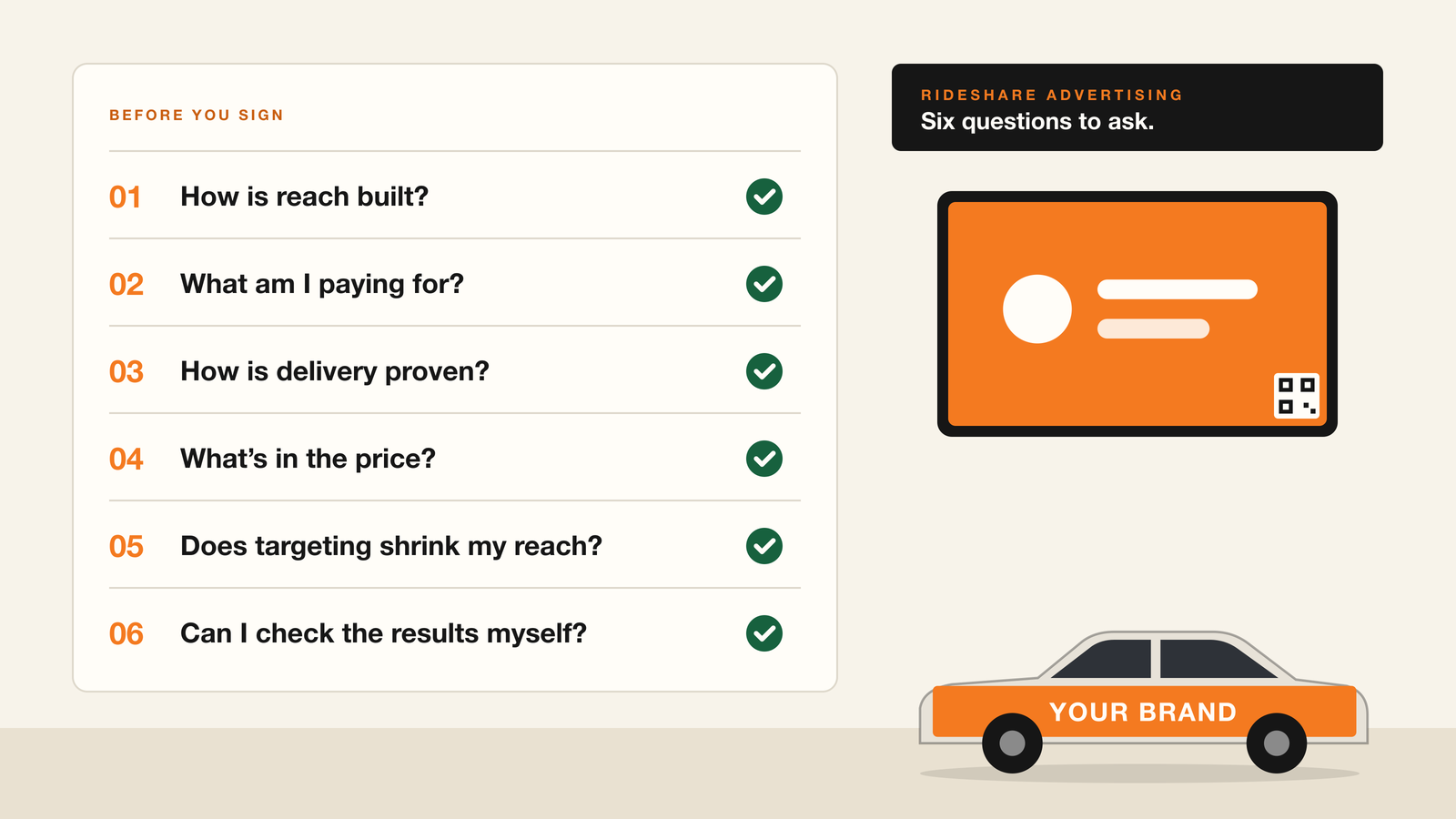
Every company that sells advertising on cars will show you a map of a city covered in dots and a big number to go with it. Neither tells you much on its own. What matters is what you'll actually get for your money, and how you'll know you got it.
These are the six questions we'd ask any vendor before signing, including us. Each one comes with what a good answer sounds like, and how Vugo answers it.
1. How is reach built?
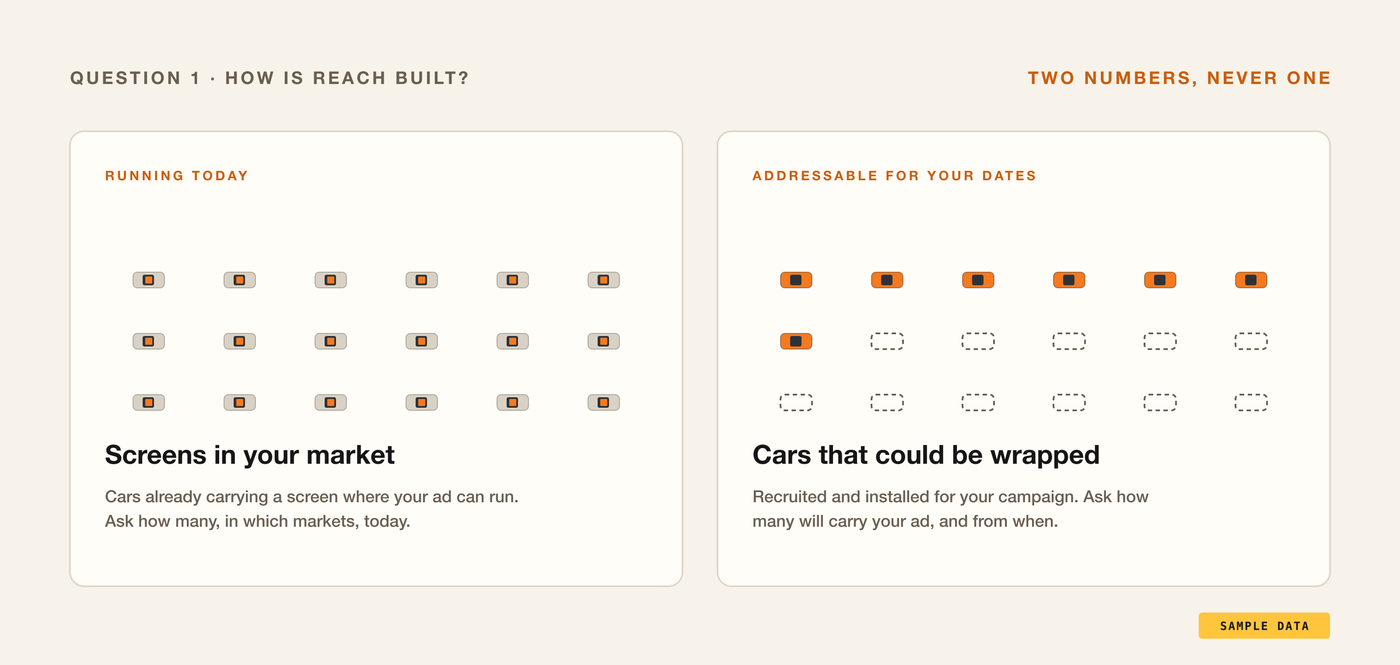
Ask this first, because the answer changes how to read every other number. Moving media reaches people in two very different ways:
- Running today. In-vehicle screens are in cars already on the road. Ask how many screens are running in your market now, not in total and not across every city.
- Addressable for your dates. Wraps aren't sitting on cars waiting for an advertiser. They're recruited and installed for each campaign. Ask how many cars will actually carry your wrap, in which market, and from what date.
A good answer keeps those two apart. A single "network" figure that adds them together, or that counts cars that could be recruited as if they were already on the road, makes it hard to know what you're buying.
How Vugo answers: screens are available by market, in working rideshare and taxi cars whose drivers and fleets already carry them. Wraps are recruited per campaign, in the market you choose, from rideshare, delivery, taxi and fleet drivers, and installed before the flight starts. We report the two separately and never blend them into one number.
2. What am I paying for?
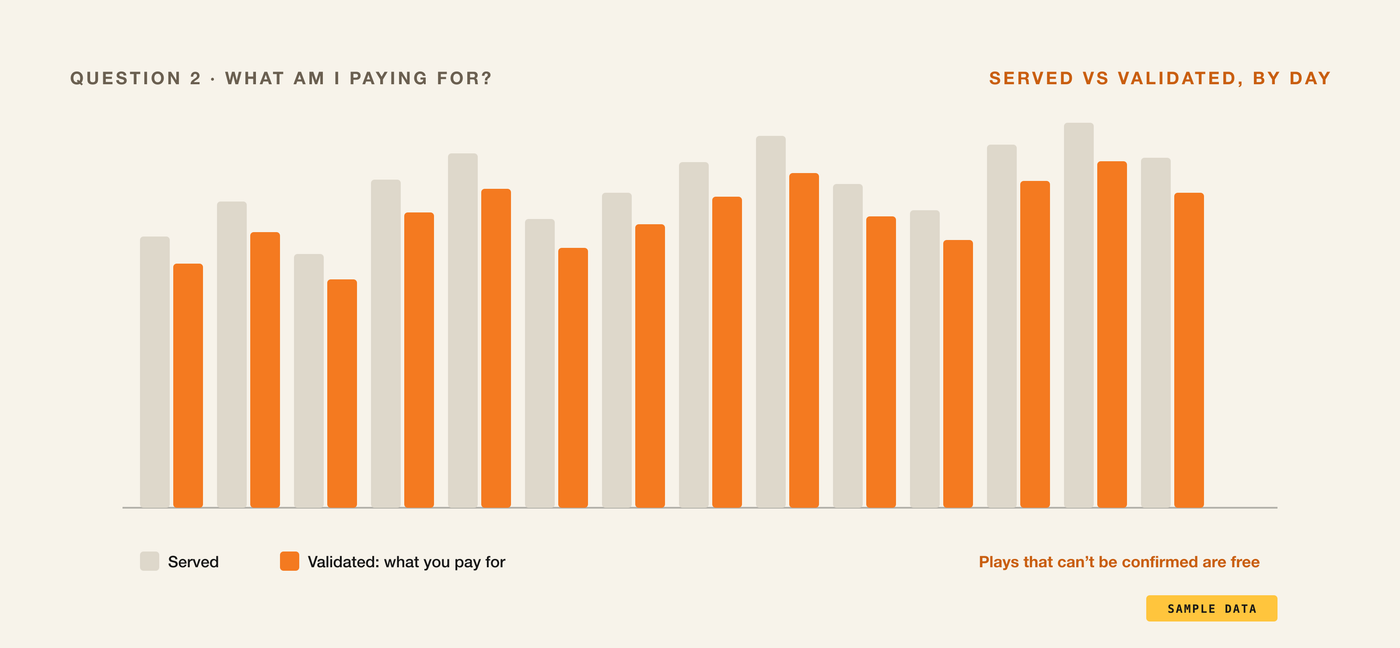
On screens, the big question is what counts as an impression. Is it every time the file plays, or only plays the vendor can confirm happened in a working car out on the road? The difference can be large, and it's the difference between paying for delivery and paying for a file that ran somewhere.
On wraps, ask what the monthly rate covers and when billing starts: on the day the campaign was supposed to start, or once each car is actually wrapped and on the road.
How Vugo answers: screens are billed on validated impressions: plays confirmed in a working car out on the road. Plays that can't be confirmed are free, and everything served is shown beside what was validated, so you can see the difference. Wraps are priced per car for the flight, and billing starts only after each car is checked from its install photos.
3. How is delivery proven?
"Trust us" isn't proof. Ask what evidence you'll see, how often, and whether it comes from the cars on your campaign.
How Vugo answers:
- Wraps: every installed car is verified from install photos before billing starts, and wrapped cars send photo proof each month of the flight.
- Swarms: you see which drivers confirmed a session before it starts, and the coverage map highlights the zone and the time cars spent inside it.
- Screens: each play is validated as described above, and with Proof of Play you can ask drivers enrolled in your campaign for photos of your ad on their screens.
4. What's in the price?
Two quotes with the same headline number can buy very different things. Line them up and check each of these:
- Production and installation. On wraps, are printing and installation included, or separate lines? What about removal at the end?
- Design. Do you bring finished files, or is design help available, and is it extra?
- Reporting. Is the campaign report included, or an add-on?
- Minimums. The shortest flight, the fewest cars, the smallest budget.
- Lead time. How long between approving the plan and the first car on the road.
How Vugo answers: every campaign is quoted for its markets, cars and dates, with rates, minimums and what's included spelled out. On a wrap quote, production and installation are their own lines. Wraps run for at least two months, and most run two to six. A Standard Wrap can start 14 days after you submit it; a full custom wrap takes about four weeks, since the design is fitted to each car. Screen creative is reviewed against Vugo's Content Guidelines, usually within one or two business days, and campaign reporting is included. Our guide to what car advertising really costs walks through the rest.
5. Does targeting shrink my reach?
Targeting sounds like a pure win, but some targeting works by filtering: your ad only plays when a condition is met, so the more you target, the fewer plays you get. Ask which settings limit where your ad can play and which only change how often it plays first.
Then ask what the targeting uses. Are there cameras or sensors in the car? Does the vendor count passengers or build profiles of riders? Which places are off limits?
How Vugo answers: the metros you choose, a radius around an address and any active days are the only settings that limit where your screen ad plays. TripIntent® reads the context around the car, and the destination when the driver enters one, and puts your ad first where it fits, without shrinking where it can play. It never uses medical, religious or legal places. Vugo's screens don't sense who is in the car, and Vugo doesn't count passengers or build rider profiles.
6. Can I check the results myself?
The best reporting is the kind you don't have to take on faith. Ask what the report shows, how often, and whether you can tie it to results in your own data.
How Vugo answers: the screen report shows validated impressions beside everything served, where and when your ad played, and the QR scans it brought in. Every screen ad carries a QR code to the landing page you choose, so tag that page's address and every scan shows up in your own analytics, next to your other channels. Wrap campaigns come with install photos, monthly photo proof and, for swarms, the coverage map.
Bring the questions to us
These questions work for any vendor, and you should ask all of them. If you're comparing in-vehicle media companies, our page on how Vugo compares has the short version, and Rideshare, Taxi or Bus? helps you decide which kind of moving media fits before you start.
Then bring them to a call. Talk to Vugo, and we'll answer each one for your market and your dates.