
"How much does a car wrap campaign cost?" is the first question most advertisers ask, and the honest answer is that it depends. Not on anything mysterious, though. The cost comes down to a handful of choices you make, and once you know what they are, you can shape the quote to fit your budget instead of the other way around.
Here's what goes into it.
Why there's no rate card
Vugo doesn't publish a price list for wraps, because a list price would fit almost nobody. The same number of cars costs different amounts in different cities, for different amounts of coverage and different lengths of flight. Instead, every campaign is quoted for its format, markets and dates, with rates, minimums and what's included spelled out.
That doesn't mean you have to go in blind. These are the five choices that set the number.
1. How many cars
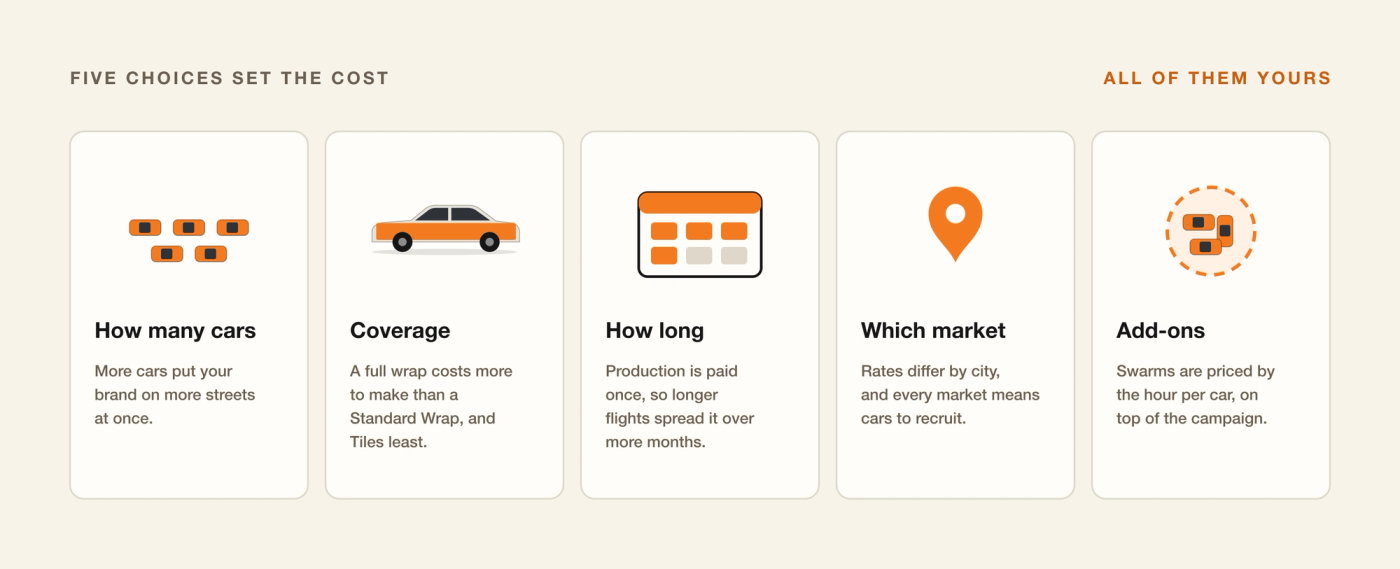
Wrap campaigns are priced per car, so the number of cars is the biggest lever. More cars put your brand on more streets at the same time; fewer cars over a longer flight build familiarity in the places they drive.
Every car on a Vugo wrap campaign is recruited for that campaign, from rideshare, delivery, taxi and fleet drivers in the market you choose, and installed before the flight starts. So the number in your quote is the number of cars that will actually carry your brand, not a share of a bigger network.
2. How much of each car
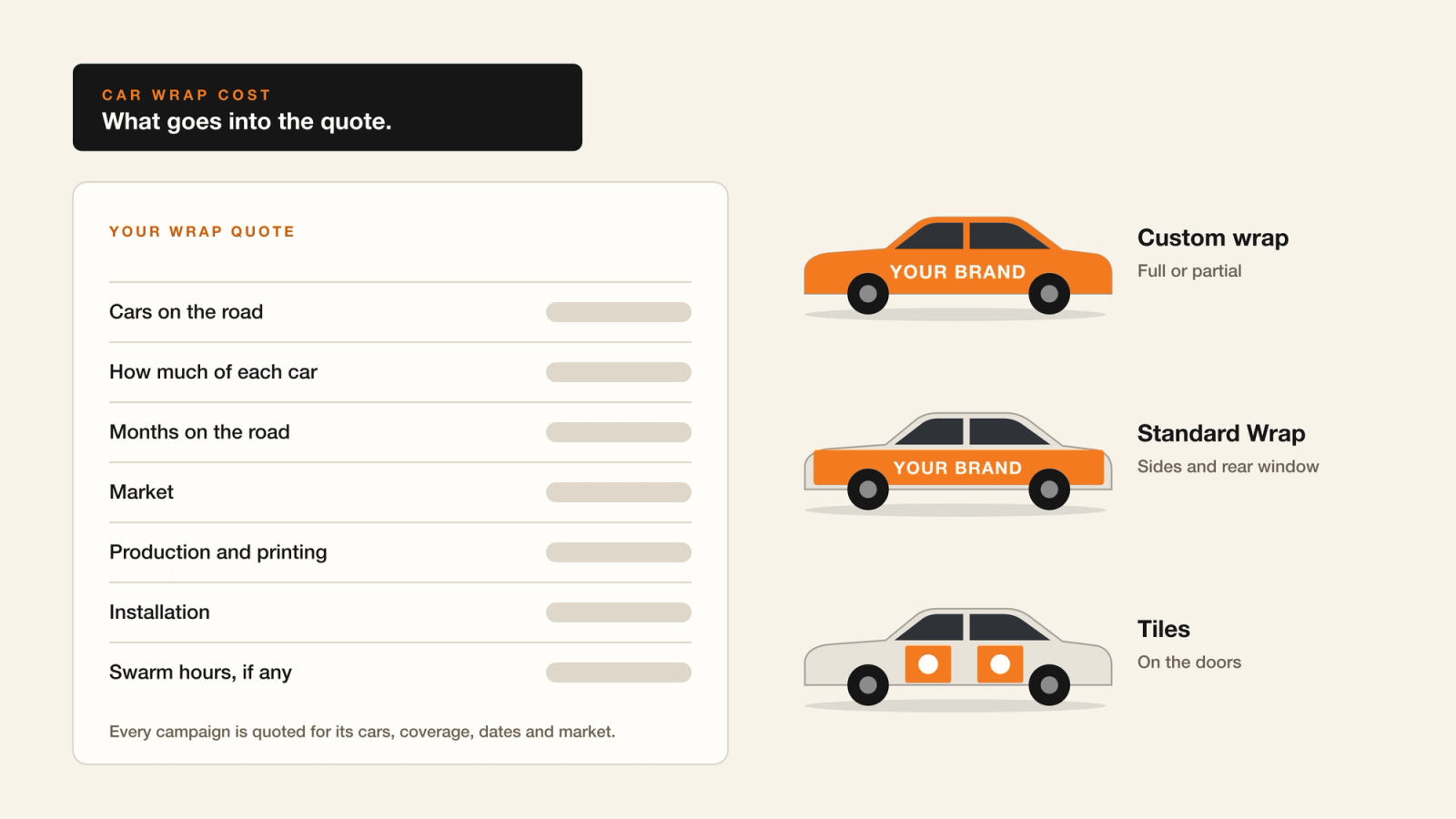
There are three ways onto the car, and each one costs a different amount to make and put on:
- Custom wraps, full or partial. A full wrap turns the whole car into your brand; 270° and 360° wraps and partial wraps sit in between. They're designed with Vugo for the cars on your campaign and quoted per request. Plan about four weeks.
- The Standard Wrap: both sides of the car and the rear window, on one layout fitted by the shop to each make and model, and bought in Vugo Platform. It can start 14 days after you submit. Here's what it covers.
- Tiles: a 20 × 18-inch panel on the door, two or four to a car. Vugo prints them and ships them to the drivers, who apply them, so there's no shop appointment to book, and printing and shipping are included. A Tiles campaign can start as soon as seven days after you submit. Meet Tiles.
A full wrap costs more to produce and install than a partial wrap, a Standard Wrap more than Tiles. Less coverage per car means the same budget covers more cars, so the choice is a trade between statement and spread.
3. How long the campaign runs
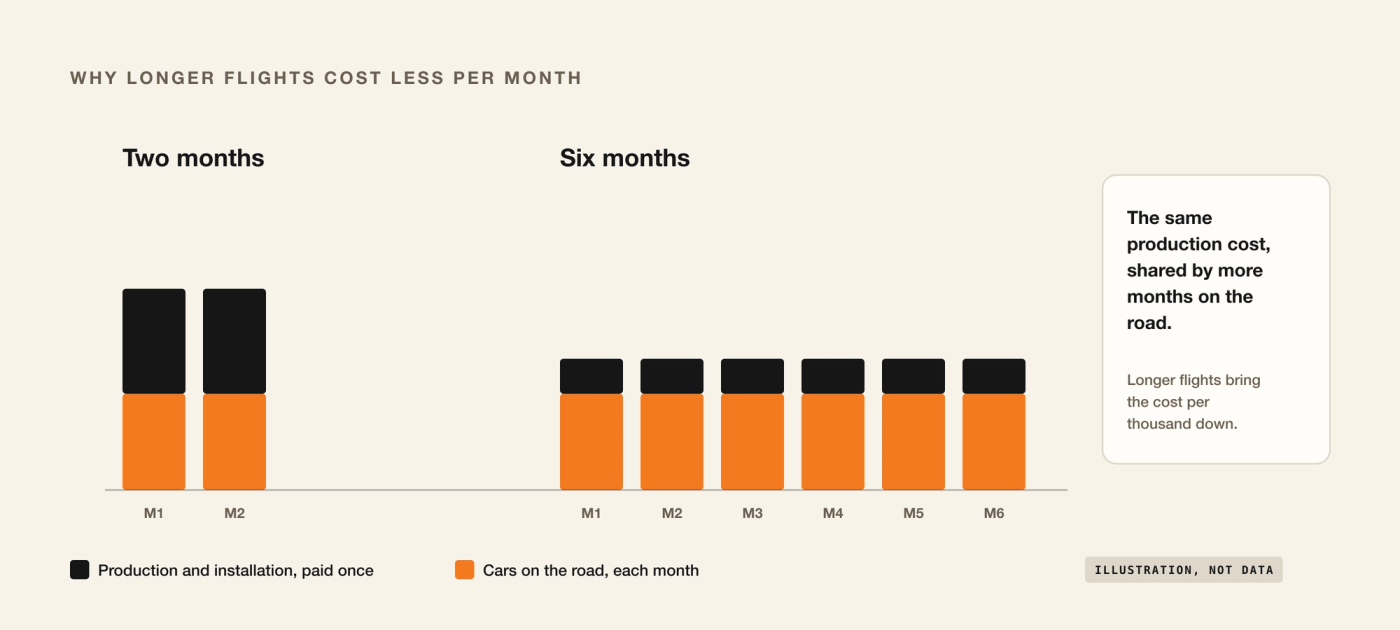
Wraps and Tiles run for at least two months, and most wrap campaigns run two to six. Length matters for cost in a way that surprises people: the longer a campaign runs, the less it costs per month and per thousand people reached.
That's because the biggest one-time costs, designing, printing and installing, happen once whether the car carries your brand for two months or six. A longer flight spreads that cost over more days on the road. It's the same reason a wrap builds familiarity the longer it runs, which we wrote about in How Long Should a Car Wrap Campaign Run?
4. Which market
Rates differ by city, and each market on the plan means cars to recruit and installs to book there. A campaign in one metro is simpler than the same number of cars spread over five. Within a market, the neighborhoods, venues and dates you care about shape the plan too: tell us where your customers are, and we'll recruit for it.
5. What you add
Swarms are the add-on most wrap campaigns consider. A swarm brings the campaign's wrapped cars into a zone you choose, around a venue, a store or along a route, for a window you schedule. Swarms are priced by the hour per car, for the hours a session runs, on top of the wrap campaign, and the hours are charged when the session is performed. Here's how swarms work.
Design is the other. Bring finished files built on Vugo's 1:10 templates, or use Vugo's design service, which is priced separately. Simple designs often work best on a car anyway: one visual, a short message, a clear brand. See Designing a Car Wrap People Remember.
What's in the quote
A Vugo wrap quote lays out each part, so nothing is hidden in one number:
- Cars and months: the monthly rate per car, for the flight.
- Production and printing: their own line on wraps; included in Tiles.
- Installation: its own line on wraps, by professional shops; none on Tiles, since drivers apply them.
- Swarm hours, if you add any.
- Reporting: included. Every installed car is checked from install photos before billing starts, and wrapped cars send photo proof each month.
What it typically works out to
Per thousand impressions, wraps and Tiles typically come out between $0.75 and $5 CPM, depending mostly on how long the campaign runs: a short flight sits toward the top of that range, and a long one heads toward the bottom. That's a typical range, not a price. Every campaign is quoted for its own cars, coverage, markets and dates.
The low cost doesn't mean low attention. In Nielsen's 2019 Out-of-Home Advertising Study, 64% of people had noticed an ad on a wrapped vehicle in the past month, second only to roadside billboards among 15 formats. Here's what that study means for ads on cars.
Comparing quotes
If you're comparing wrap companies, make sure you're comparing the same thing. Ask how many cars will actually carry your ad and from when, whether production, installation and removal are included, what proof you'll see, and what the minimums are. Our guide to what car advertising really costs walks through each, and Six Questions to Ask Before You Buy Rideshare Advertising covers the rest. Weighing a wrap against a mobile billboard truck? Start with Car Wraps, Mobile Billboard Trucks or Rooftop Screens.
Sources
- Nielsen, Out-of-Home Advertising Study, 2019 edition: 999 online surveys of U.S. residents 16 and older, March 27 to April 5, 2019; 64% had noticed an ad on a wrapped vehicle in the past month, second of 15 formats. Released by the OAAA on May 21, 2019 (oaaa.org); the report itself (archived copy).
- Vugo's ranges and pricing model: typical ranges from Vugo campaigns, not a price list; how each format is priced is on What car advertising really costs.
Bring your cars, markets and dates, and get a quote for your campaign.