
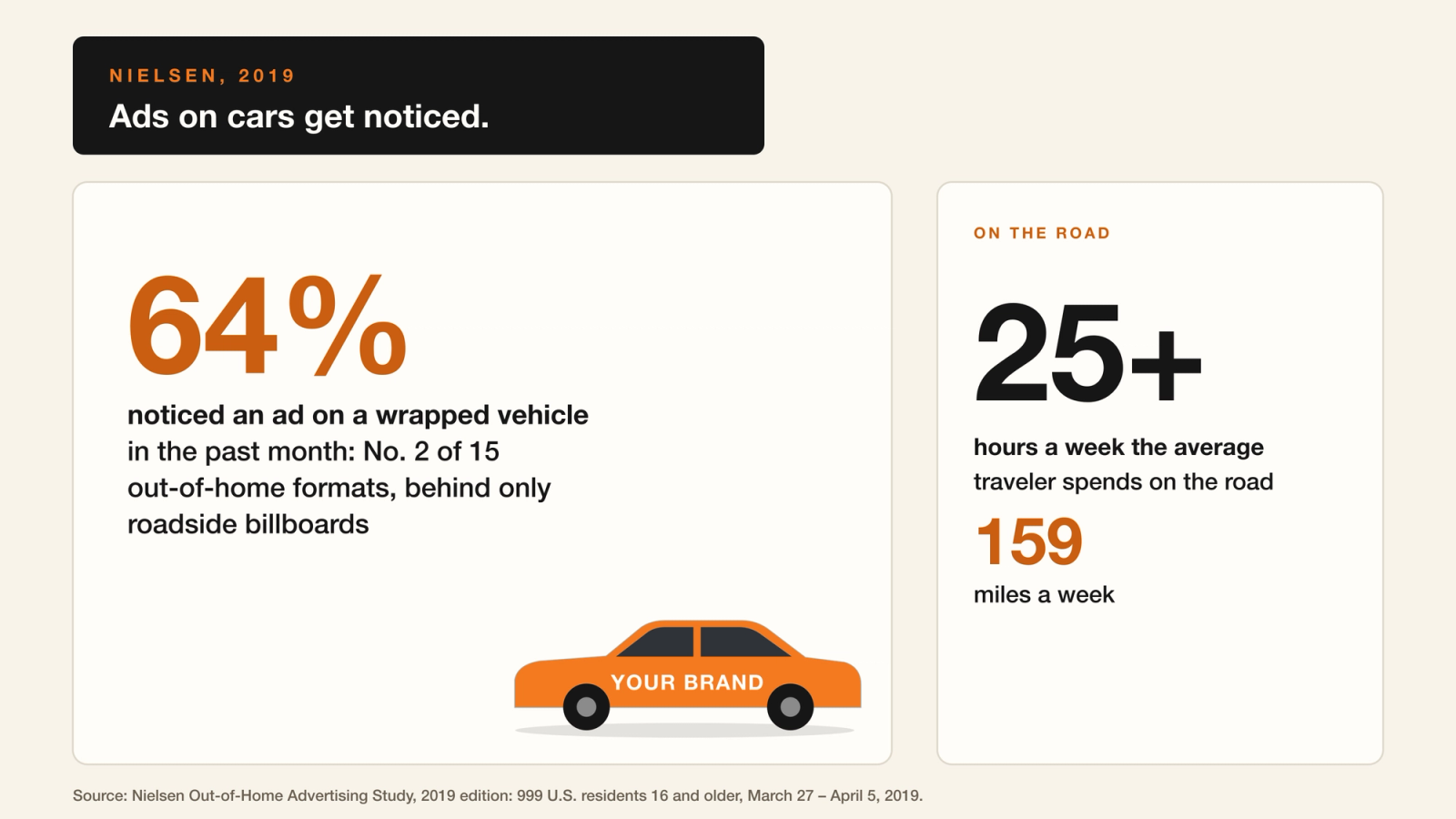
Last month, Nielsen and the Out of Home Advertising Association of America (OAAA) released the 2019 Out-of-Home Advertising Study, which the OAAA calls its most in-depth analysis of out-of-home formats yet. It looks at how Americans travel and what they notice along the way, and it has good news for anyone who advertises on, or inside, a car.
What Nielsen asked
Between March 27 and April 5, 2019, Nielsen surveyed 999 Americans aged 16 and older who had been out and about in the past month: walking around town, in a car, or riding a bus, taxi, train or subway. They were shown sample images of 15 kinds of out-of-home advertising, from roadside billboards to airport displays, and asked when they had last noticed each one.
Ads on cars get noticed
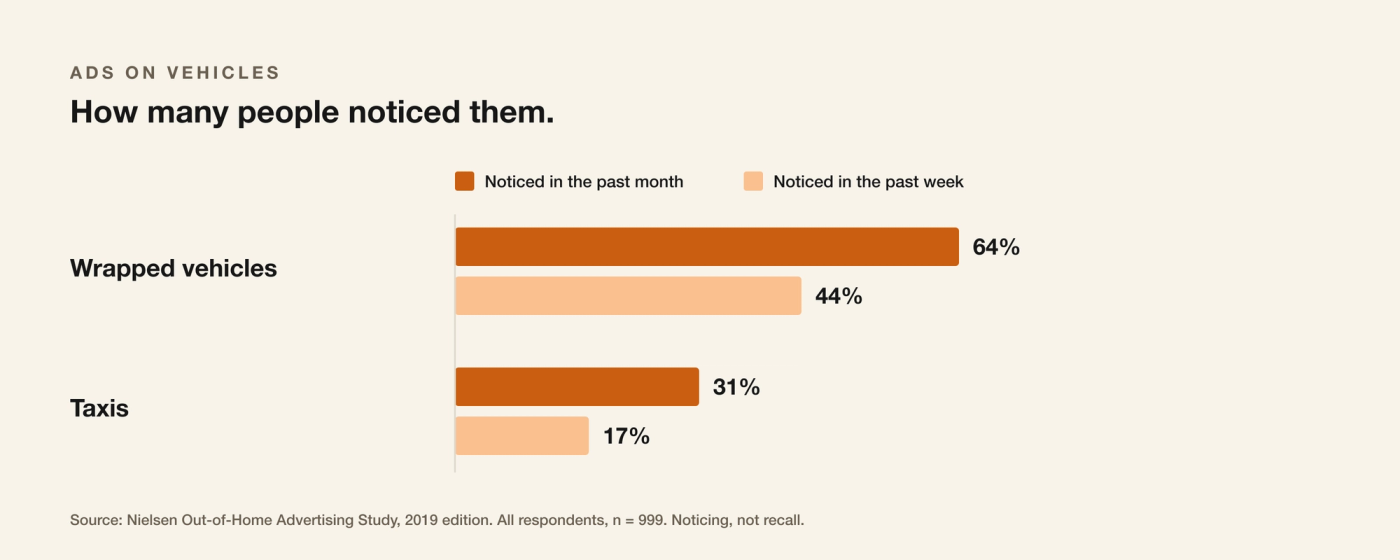
The headline for vehicle advertising: 64% of people had noticed an ad on a wrapped vehicle in the past month, and 44% in the past week. Of the 15 formats in the study, only roadside billboards were noticed by more people. Wrapped vehicles came ahead of digital billboards, bus sides, bus shelters and posters.
Taxi advertising showed up too: 31% had noticed ads on taxis in the past month, and 17% in the past week.
Why: we spend a day a week on the road
Part of the reason is time. The average traveler in Nielsen's survey spent more than 25 hours a week on the road and covered 159 miles. That's more than a full day every week spent beside, behind and across from other cars.
A billboard gets that traveler for a few seconds, once, on one stretch of road. A car moves with the traffic. It's at the next light, in the next lane, parked outside the restaurant. It goes to the neighborhoods, the business districts and the venues where people actually spend their time.
People act on what they see
The study also asked what people did after noticing an out-of-home ad. These answers cover out-of-home advertising in general, not only ads on vehicles, but they show where attention goes next.
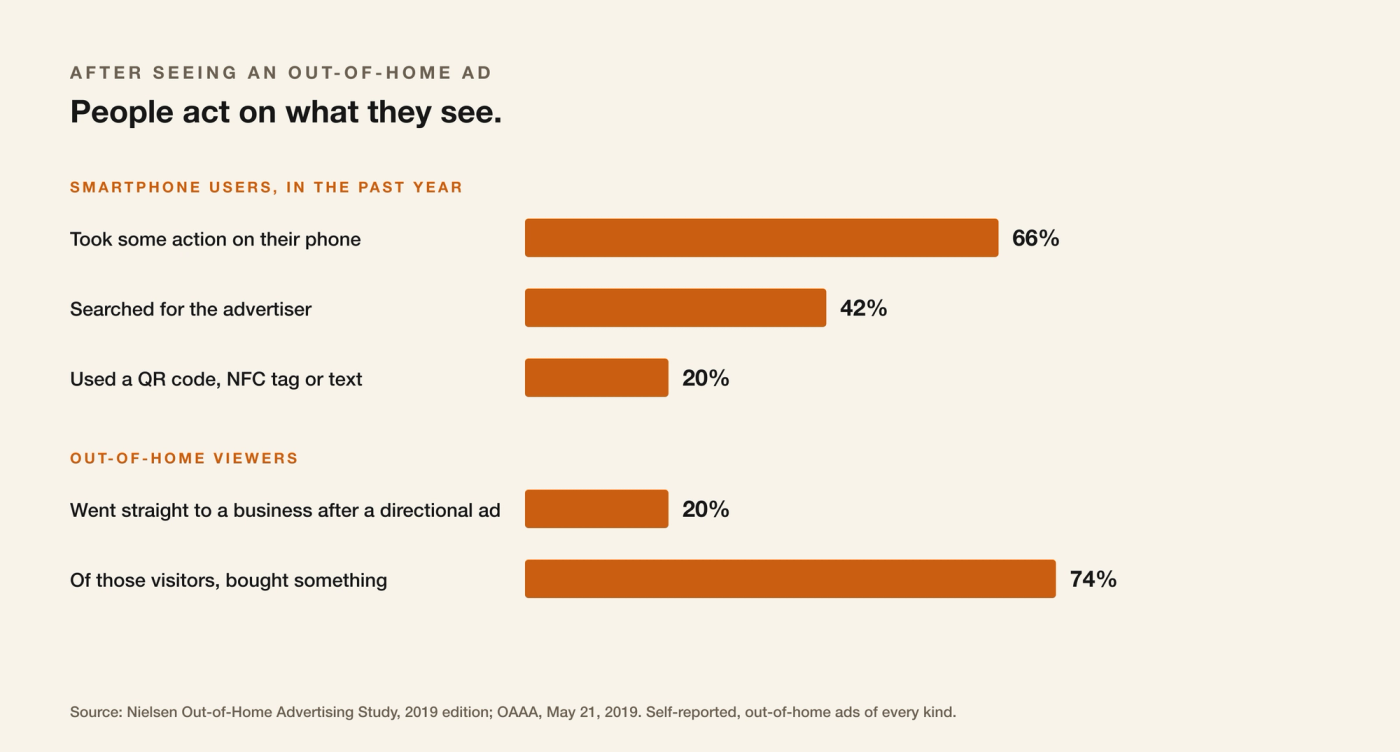
- 66% of smartphone users had taken some action on their phone after seeing an out-of-home ad.
- 42% had searched for the advertiser.
- 20% had used a QR code, an NFC tag or a text message in response to one.
- 20% had gone straight to a business after seeing an ad that gave directions to it, and 74% of those visitors bought something.
The OAAA also noted that adults aged 16 to 34 were the most engaged with out-of-home ads of any age group. That's the same group that fills the back seat of a rideshare: in Vugo's own beta, 57% of rideshare riders were aged 25 to 34. Here's what else we learned from that beta.
What it means for advertisers
Vehicles belong in the out-of-home plan. When people are asked what they notice, ads on cars rank with the biggest formats in the medium. They're not a novelty to try once.
Give people a next step. Two-thirds of smartphone users act on their phones after seeing an out-of-home ad. A short, memorable web address, a brand name that's easy to search or a promo code turns noticing into a visit.
Go where the decision gets made. One in five people went straight to a business after a directional ad. A car near your store, your venue or your event is the most directional ad there is: it's already on the block.
Inside and out work together. A car can carry an ad on the outside for the street, and inside for the back seat. The street sees the brand; the rider has a few minutes with it.
Read it right
Nielsen asked when people last noticed each kind of ad, not whether they remembered a particular brand. These are figures for noticing, not recall, and they cover ads on vehicles from every advertiser, not any one campaign. They tell you the format gets seen. Whether a campaign works still depends on the creative, the markets and the plan, and on measuring it: a promo code, a web address used only on the campaign, or a test market against a similar one without it.
The study is a strong case for something we've believed since we started Vugo: the car is one of the best places in a city to meet people, and it's only getting more valuable as people spend more of their day on the road.
See the figures from the study, learn about in-vehicle screens, or talk to Vugo about your city.