
A wrapped car gets noticed. In Nielsen's 2019 Out-of-Home Advertising Study, 64% of U.S. residents 16 and older had noticed a wrapped-vehicle ad in the past month, more than any out-of-home format except roadside billboards.
But noticed isn't the same as remembered. Most people see a wrap for a few seconds, from the sidewalk, a crosswalk or the next lane, often while they're moving too. The design decides whether those seconds turn into your name in their head.
The three-second test
Here's a simple way to judge any wrap design: what does someone take in, in order, in the first three seconds?
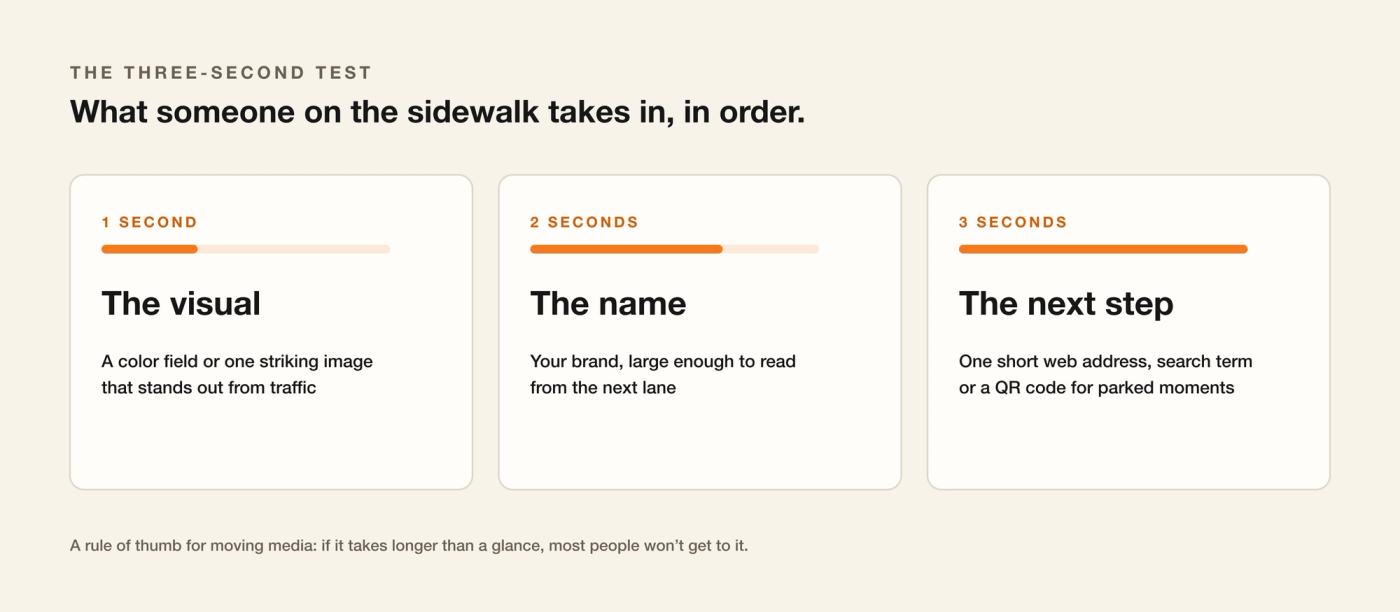
- The visual. A bold color field or one striking image that stands out from the gray and silver of everyday traffic.
- The name. Your brand, large enough to read from across an intersection.
- The next step. A short web address or a word to search, or a QR code for the moments the car is parked and people are close.
If a design asks for more than that, most people won't get to it. Everything else on the car is competing with your name.
One message, not a brochure
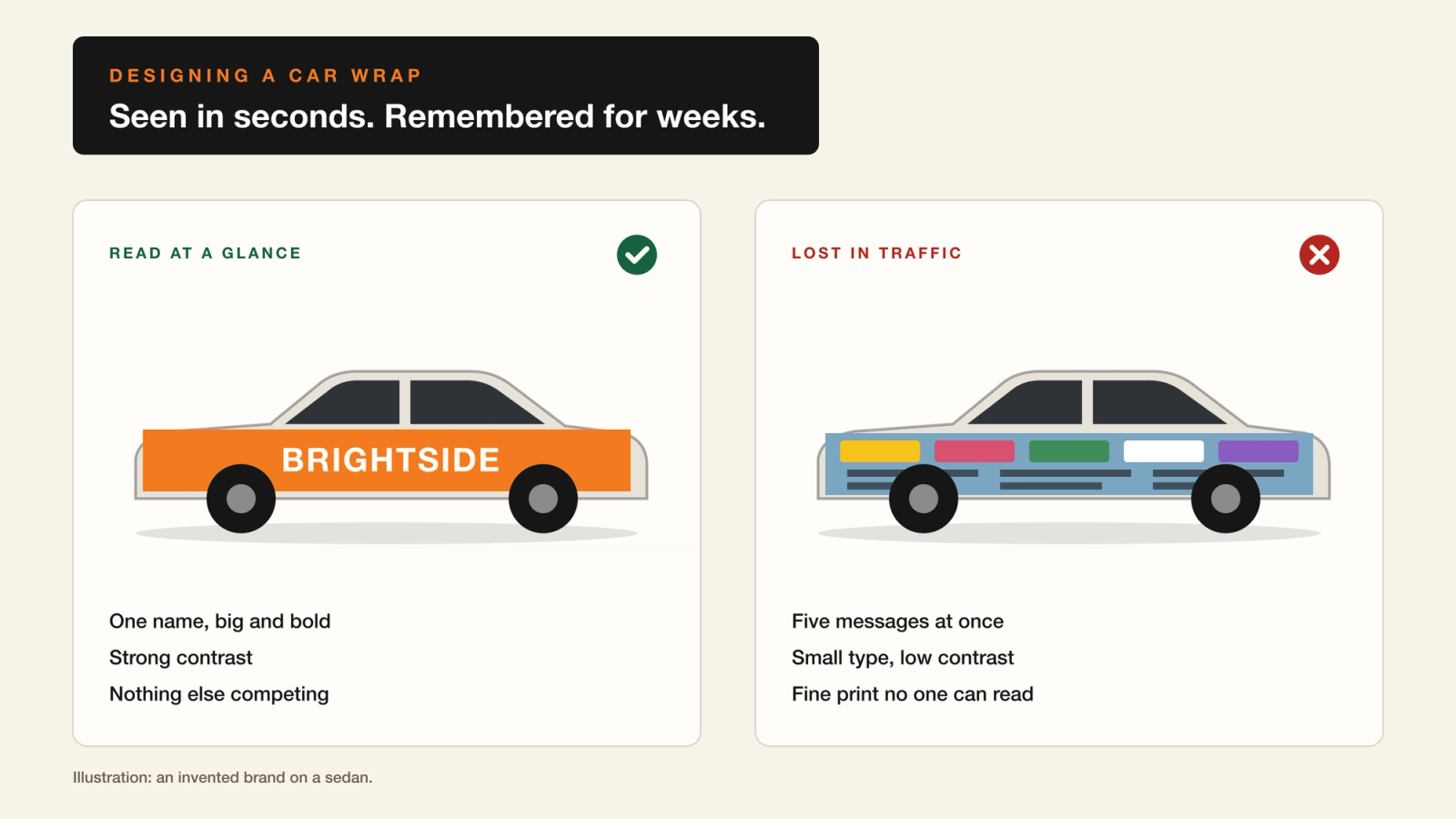
The most common mistake in wrap design is treating the car like a flyer: a list of services, three phone numbers, hours, a price and a tagline. On paper it's all useful. On the street, it's noise.
Pick the one thing you want someone to remember, and let everything else go. A restaurant's wrap might be the name and one dish. A law firm's might be the name and what it does. A launch might be the product and the date.
Big type, strong contrast
Distance, glare, motion and dirt all work against a wrap. Large letters and high contrast survive them.
- Go bigger than feels right. Your name should be the largest thing on the car, and readable from the next lane.
- Pick contrast over subtlety. Dark on light or light on dark. Pale-on-pale and thin script fonts disappear at a distance.
- Leave space. Empty space around the name is what makes it readable. Fill every inch and nothing stands out.
Design for the car, not a flat sheet
A car isn't a rectangle. It has doors, handles, curves, windows, lamps and seams, and the design has to live with all of them.
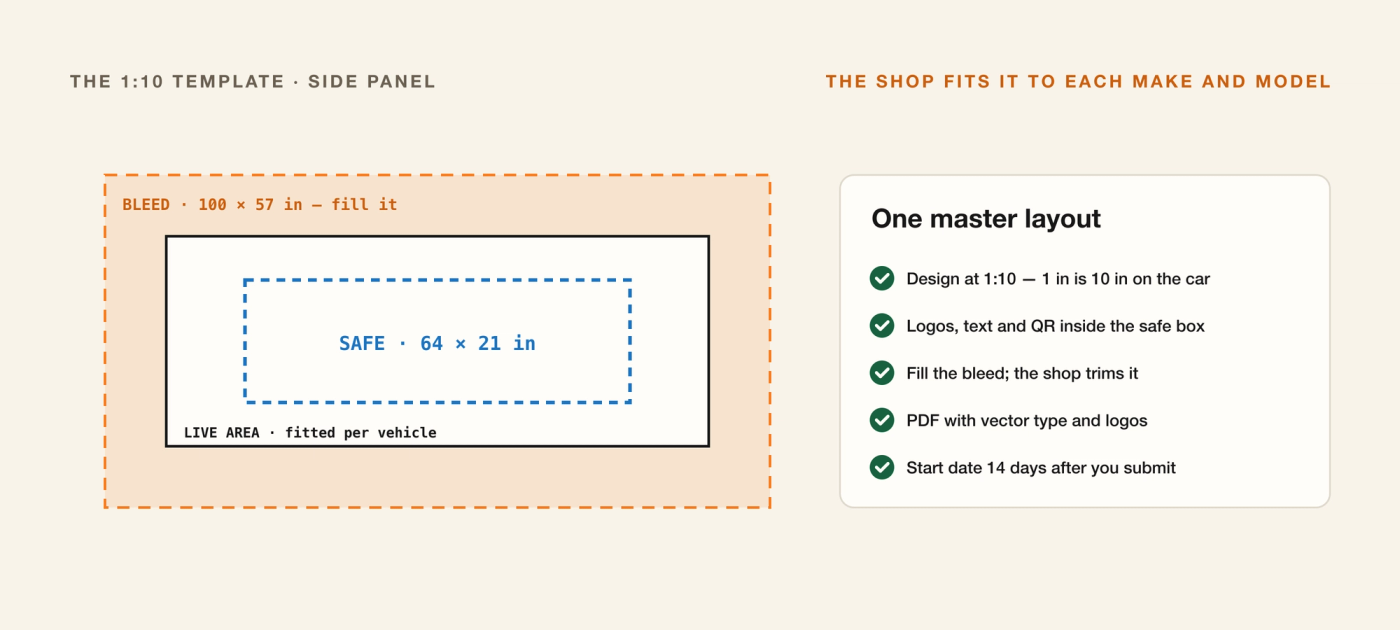
Vugo's Standard Wrap, both sides of the car and the rear window, is designed once on templates at 1:10 scale, where 1 inch on the template is 10 inches on the car. The wrap shop fits that artwork to each make and model on your campaign. A few rules make that work:
- Keep what matters inside the safe box. Logos, text, web addresses and QR codes go inside each panel's safe box, so nothing important lands on a handle, a seam or a curve.
- Fill the bleed. Run backgrounds all the way to the edge of the bleed box. The shop trims what it doesn't need.
- Expect some parts to stay bare. The shop never covers lamps, mirrors, the grille, the license plate, the rear camera, sensors, door handles, locks or the front side windows. Design so the message still reads around them.
Full and partial custom wraps are designed with Vugo and the wrap shop for the cars on your campaign, and Vugo's design service can build the artwork with you from your brand files.
Build print files that print
A wrap is printed several feet wide, so problems that are invisible on a laptop show up on the car.
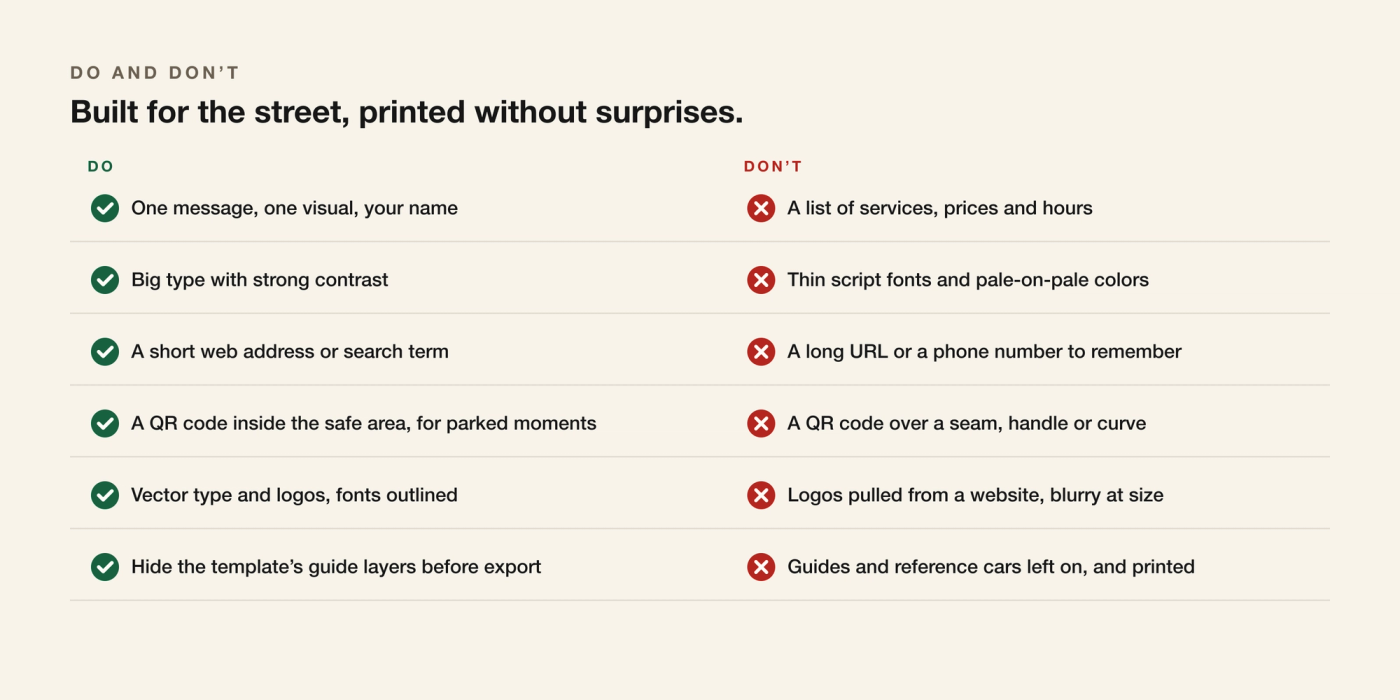
- Use vector type and logos. Outline or embed your fonts and keep logos vector, so nothing softens or swaps at print size.
- Use high-resolution images. For a Standard Wrap, placed images need 1,500 DPI on the 1:10 template, which is 150 DPI on the car.
- Send a print file. A PDF (AI and EPS are accepted too). Picture files like PNG and JPEG are kept as previews only and never sent to a shop.
- Hide the guides. The Vugo templates come with guide and reference-car layers. Hide them before you export, or they'll print.
Every print file is checked by Vugo before a shop prints it, and a Standard Wrap's start date is at least 14 days after you submit, so there's time to fix anything that needs it.
A quick checklist
Before you send your design, ask:
- Can someone tell what it is in one second?
- Is your name the biggest thing on the car?
- Is there one message, not five?
- Would it still read from across an intersection, in the rain?
- Is there one simple next step?
- Is everything important inside the safe box?
See the full ad specs, learn about vehicle wraps, or talk to Vugo about putting your design on the road.