
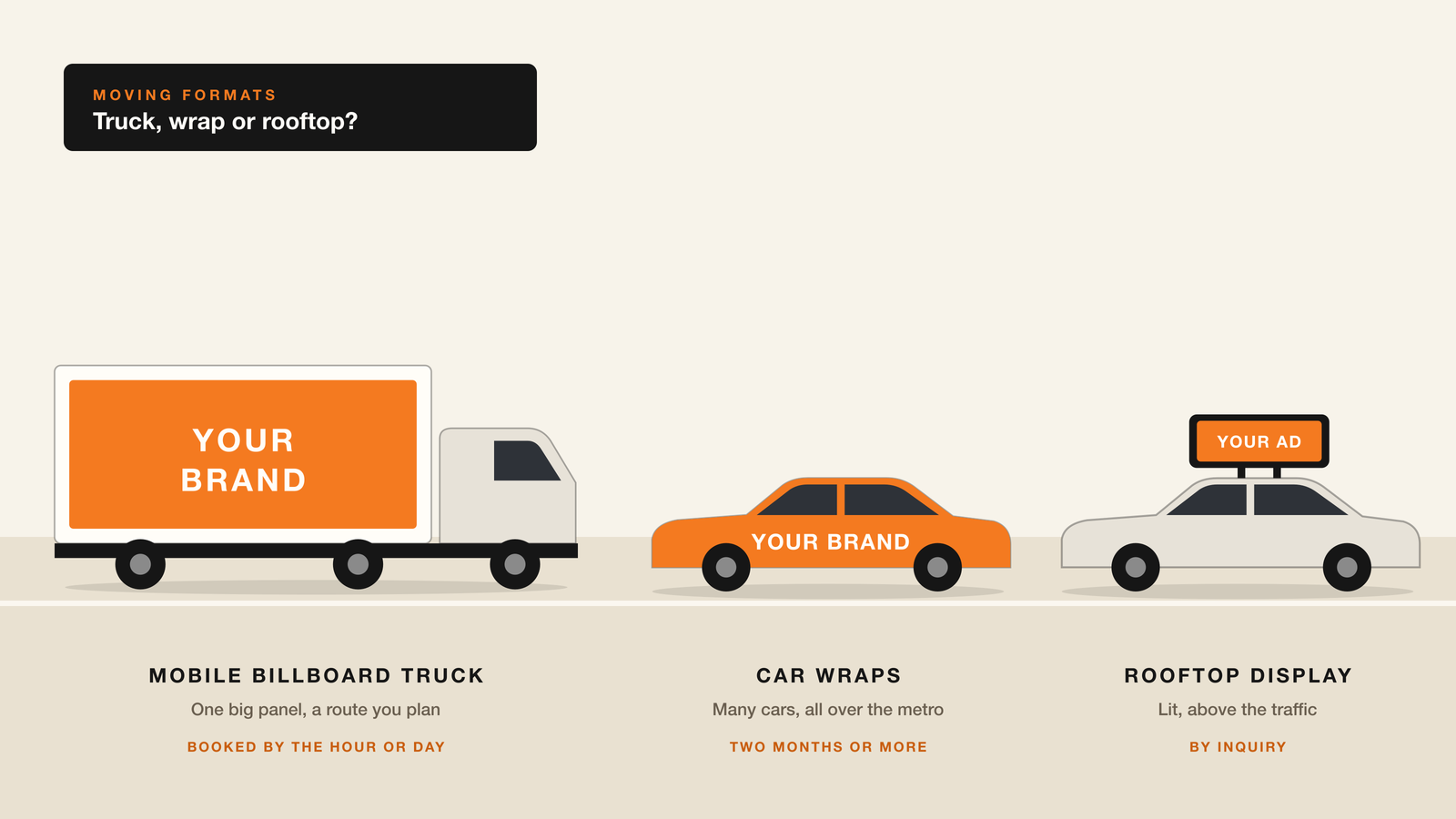
If you want your ad to move, there are three common ways to put it on wheels. A mobile billboard truck carries one big panel down a route you plan. A wrap turns everyday cars into your brand for months. A rooftop display puts a lit screen on top of a car, above the traffic.
They all count as moving media, and people often weigh them against each other. But they do different jobs. The right one depends less on the vehicle than on what the campaign has to do: own one day, or own a city for a season.
The short version
- Mobile billboard truck: one or a few large vehicles, typically booked by the hour or the day, driven on a route you plan. Best for a single event, a launch day or a stunt.
- Car wraps: many cars carrying your brand for two months or more, wherever their day takes them. Best for staying in front of a whole metro, with the option to bring the cars together for a big date.
- Rooftop displays: a lit screen on top of participating cars. A specialty format, available by inquiry in some markets.
How many vehicles
A truck is a big canvas, and there's usually only one of it, or a handful. Its strength is size: a panel the height of a delivery van that no one on the sidewalk can miss.
Wraps work the other way. Each car carries a smaller canvas, but a campaign puts your brand on many cars at once. Vugo recruits drivers for each campaign in the market you choose, from rideshare, delivery, taxi and fleet drivers, and has thousands of cars in its driver database available for wraps. So the question isn't only how big the ad is, but how many places it shows up in a single day.
How long it runs
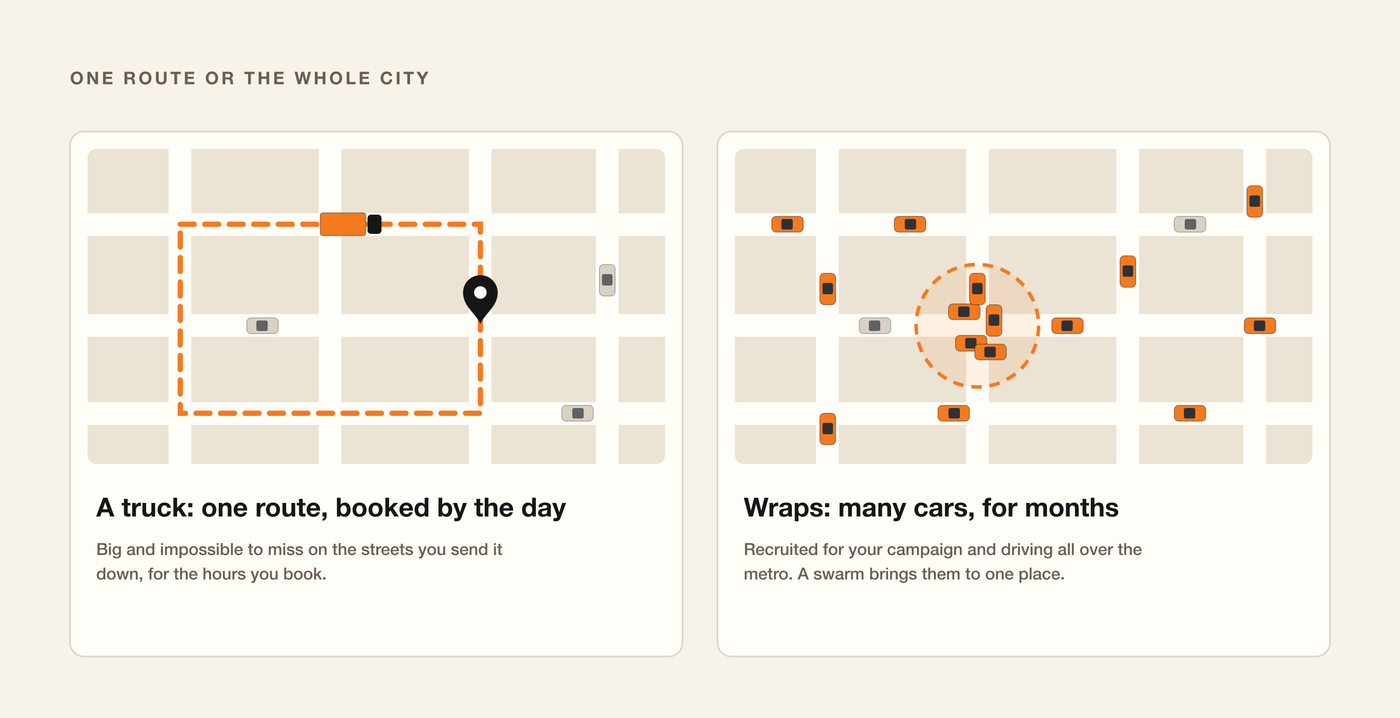
A truck is usually bought for hours or days. That makes it easy to try and easy to time: the morning of a launch, the weekend of a festival, the afternoon of a big game.
A wrap is a longer commitment. The artwork is fitted to each car, a professional shop installs every wrap, and install photos are checked before billing starts. Because that work happens once, wraps run for at least two months, and most campaigns run two to six. The payoff is repetition: the same people see your brand on the commute, outside the grocery store and in the parking lot at work, week after week. We wrote about picking a length in How Long Should a Car Wrap Campaign Run?
Rooftop displays are quoted per campaign. When Dash ran its DashDirect app on Vugo rooftop displays across greater Miami in November and December 2021, through Art Basel, the campaign ran for two months.
Where they go
A truck goes where you send it. You plan the route and the hours, and the driver's whole job is to drive that loop. It's the most controllable option, and the most concentrated: one set of streets, at the times you chose.
Wrapped cars go where their drivers' work takes them: across neighborhoods, business districts, campuses and airports, all day. That spread is the point of a wrap, since it reaches people in places a route planner might never think of. When one place matters more than the rest, a swarm concentrates the cars: you choose an address with a radius from a tenth of a mile to 10 miles, or a route, and a window of hours, and the campaign's wrapped drivers are paid to bring their cars into that zone. The rest of the time, they keep covering the city.
Rooftop displays ride on participating cars, so they go where those cars drive.
What people notice
Two national studies asked people which kinds of out-of-home advertising they had noticed in the past month, and both put ads on cars ahead of mobile billboard trucks:
- In Nielsen's 2019 Out-of-Home Advertising Study, 64% had noticed an ad on a wrapped vehicle in the past month, second only to roadside billboards among 15 formats. 27% had noticed a mobile billboard.
- In Morning Consult's March 2023 study for the OAAA, 49% of adults had noticed advertising on wrapped vehicles or other signs on vehicles in the past 30 days, and 36% had noticed ads on mobile billboards.
Read them for what they are. Both measured noticing, not whether people remembered a particular brand, and both cover every advertiser and vendor. Morning Consult's "signs on vehicles" also includes ordinary fleet lettering. But the pattern makes sense: there are far more cars on the road than billboard trucks, and people see them everywhere. We looked at the Nielsen figures in more detail in Nielsen's 2019 Out-of-Home Study: What It Means for Ads on Cars.
Creative
Trucks give you the biggest flat panel of the three. A printed panel holds one message for the whole booking; a digital panel can rotate several. Either way, the rules of a billboard apply: one visual, very few words, readable from across the street.
Wraps are a brand canvas that has to read on a moving car, from the next lane or across a parking lot. One strong visual, a short message and a web address or QR code people can remember. Vugo sells two kinds: the Standard Wrap, covering both sides and the rear window, designed once on Vugo's 1:10 templates and fitted by the shop to each make and model; and custom wraps, full or partial, designed with Vugo for the cars on your campaign. Plan at least 14 days for a Standard Wrap and about four weeks for a full wrap.
Rooftop displays are lit screens, so they hold up at night and in the evening crowds when a printed panel fades into the dark.
What drives the cost
We don't publish prices for any of these, and every campaign is quoted. But the things that move the number are different for each.
- Trucks: the hours or days you book, how many trucks, a printed or digital panel, the city, the route and any permits it needs.
- Wraps: how many cars, how much of each car you cover, how many months the campaign runs and which markets. Wraps are priced per car for the flight, with production and installation as their own lines, and a longer flight spreads that one-time production cost over more months on the road. Swarms are priced by the hour per car, on top of the campaign.
- Rooftop displays: quoted per campaign, by inquiry.
Our guide to what car advertising really costs walks through how to line up quotes from different companies so you're comparing the same thing.
When each one makes sense
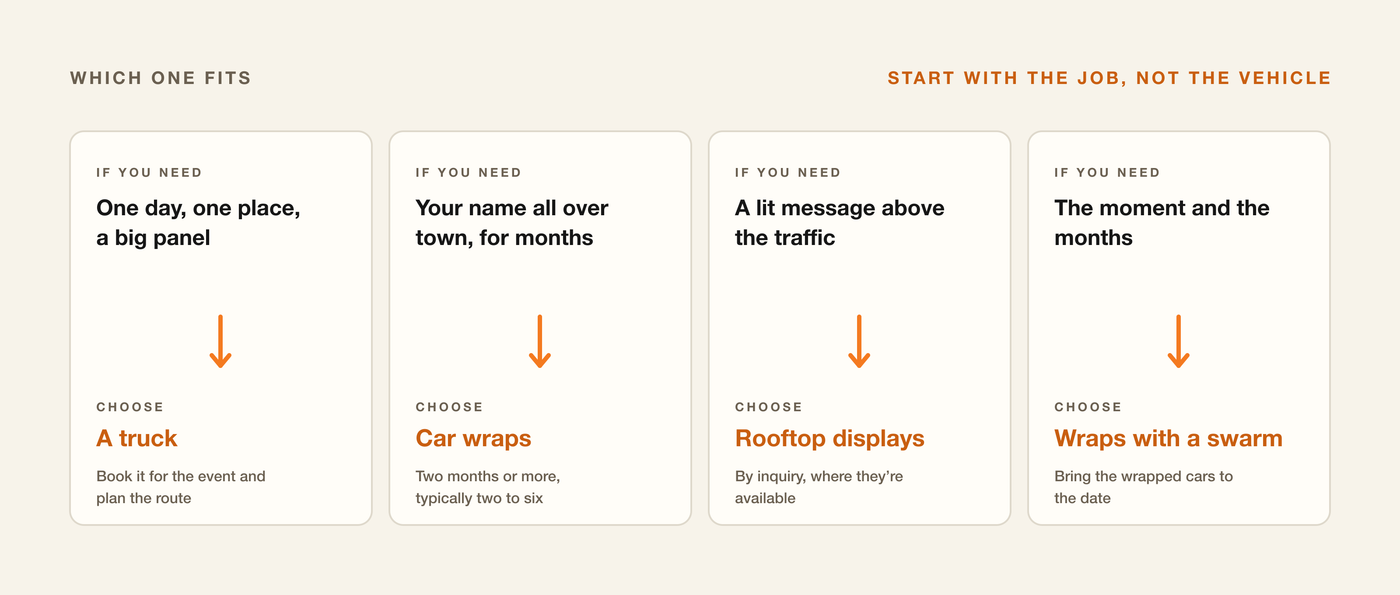
- Choose a truck for a single day that has to land: a launch, a sale weekend, a stunt outside a venue. Book it for the hours that matter and plan the route around them.
- Choose wraps when you want a whole metro to know your name, for a season or longer. They're the steady, everywhere option.
- Choose rooftop displays when a lit message on the street, at night or in a crowd, is the goal, and they're available in your market.
- Choose wraps with a swarm when you want both: months of everyday reach, and every car outside the door on the day that matters most.
Some campaigns use more than one. Bitcoin 2022 in Miami ran wraps, rooftop displays and in-vehicle screens together, with wrapped cars swarming the area around the convention center. Read the case study.
Sources
- Nielsen, Out-of-Home Advertising Study, 2019 edition: 999 online surveys of U.S. residents 16 and older, March 27 to April 5, 2019; wrapped vehicles 64% and mobile billboards 27% noticed in the past month. Released by the OAAA on May 21, 2019 (oaaa.org); the report itself, PDF dated May 2019 (archived copy).
- Morning Consult for the OAAA's research foundation, OOH Advertising Study, March 2023: 1,461 U.S. adults 18 to 64, November 10 to 15, 2022; 49% noticed advertising on wrapped vehicles or other signs on vehicles and 36% ads on mobile billboards in the past 30 days (PDF on oaaa.org).
- Dash: Vugo's rooftop campaign in Miami, November and December 2021 (case study).
See vehicle wraps, see every format, or talk to Vugo about your market and your dates.