
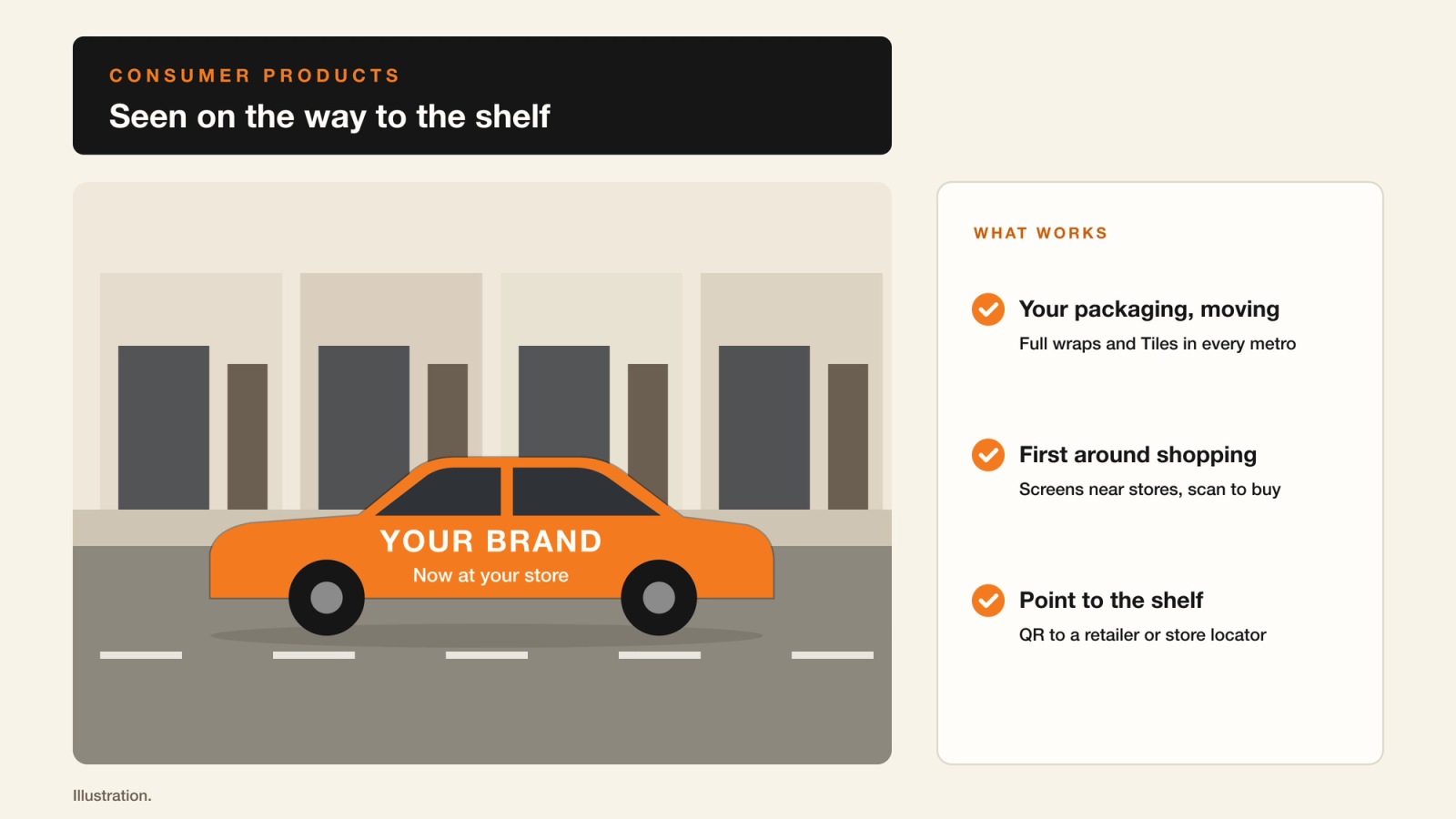
A consumer product gets a few seconds at the shelf. In that moment, shoppers reach for the name they already know, and the decision about which name that is often gets made on the way to the store.
Shoppers say as much. In an OAAA and Harris Poll survey published in September, half of consumers said retail out-of-home ads affect what they buy when they see them in the days before shopping, and 59% said so when they see them just outside a store. Seventy-three percent said they'd visit a nearby store the same day if an out-of-home ad told them a specific product was in stock. Those are intentions, not measured behavior, but they point the same way: the street is part of the path to the shelf.
Cars are the out-of-home that drives that path with your shoppers.
Why cars fit consumer products
- National plans, local streets. Wraps are recruited per campaign in most U.S. metros, so one flight can cover every market on your plan and stay local in each one.
- Close to the shelf. Rideshare and delivery cars spend the day around shopping districts and grocery stores, and every delivery pickup is outside a store or a restaurant.
- The car becomes the package. A full wrap in your colors, with your product on the side, is your packaging at the size of a car.
- The calendar decides. A launch, a retail reset, a holiday push: each has a date, and each format can be lined up with it.
What each format does for a brand
Vehicle wraps. A full or partial custom wrap, designed with Vugo and the wrap shop, turns a car into your packaging. A Standard Wrap covers both sides and the rear window, is bought in Vugo Platform and starts at least 14 days after you submit.
Tiles. Your logo and one line on the doors, 20 by 18 inches, two or four to a car, printed and shipped to drivers who apply them. Tiles start seven days after you submit, which makes them the fastest way to put a brand on cars in many markets at once. Here's how the wrap formats compare.
Wraps and Tiles run two months or more, and typical CPMs run from $0.75 to $5, depending on the length of the campaign. Every campaign is quoted.
Swarms. Schedule a window and a place, and the campaign's wrapped cars are paid to bring your brand into that zone: outside a launch event, a flagship store or a sampling stop.
In-vehicle screens. Screens are available by market and running in market today. Your ad plays with captions to carry the message, and a QR code to any page you choose: your site, a store locator or a retailer's product listing, with UTM tags so every scan shows up in your own analytics. TripIntent® puts your ad first in cars around shopping, and when the driver's destination is a store, without shrinking where your ad can play. You pay only for validated impressions, plays confirmed in a working car out on the road, and typical screen CPMs run $20 to $25.
What it looks like in practice
In 2025, the Moving Out of Home Association (MOOHA) ran an eight-week campaign for C4 Energy in New York City, centered on New York Knicks game days at Madison Square Garden, with the rest of the week spent across the boroughs. The goal was the shelf: the campaign was measured on recall, purchase intent and in-store sales. MOOHA's figures for the whole campaign, across every partner, were 52 million impressions among adults 18 and older, a 59% lift in ad recall, four times the category benchmark, a 31% higher likelihood of purchase and an 11.6% in-store sales lift. Vugo took part as a member of MOOHA. Read the case study.
Five plays for consumer products
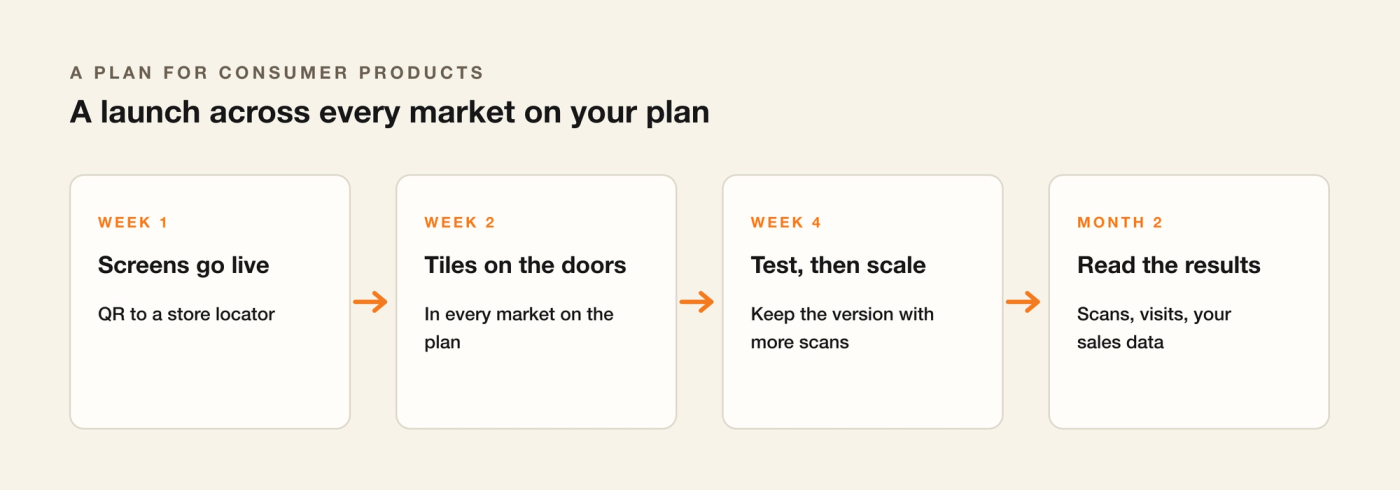
- Launch everywhere at once. Tiles in every metro where the product ships, full wraps in the lead markets, and screens with a QR code to a store locator. Lay the flight out against the launch date on the Vugo Planning board. See the Market Launch play.
- Intercept the shopper. Run screens first around shopping, and add a radius around the stores that carry you. Make the message specific: "Now in stock at your grocery store" gives people a reason to look for it. Add those stores to the campaign, and Vugo counts the working cars in its network that passed nearby, were headed there or arrived. It's a signal of your campaign around the shelf, not a count of customers. See the Shopper Intercept play.
- Test, then scale. Run two to four versions of your screen ad, a flavor, a price point, a benefit, split evenly across the cars. Keep the one that earns more scans, then put it on the wraps. See the Test, Then Scale play.
- Show up in force. Swarm the blocks around a sampling stop, a pop-up or a flagship store for the hours it's open. A dozen cars in your colors on the same few blocks is a takeover.
- Catch the holidays. It's not too late for this season. Screens can go live within days of approval, and Tiles submitted by November 20 are on the doors for Black Friday. Here's the full holiday calendar.
Before you start
- The product or line to lead with. One message per car, one per ad.
- The markets on your plan, and any retailer you want to point people to.
- The dates. A launch, a reset or a season, on the same timeline as your flights.
- A page that works on a phone. A product page, a store locator or a retailer's listing.
- How you'll judge it. Scans, visits near the stores that carry you, and sales in your own data.
See consumer products on Vugo, learn about vehicle wraps, Tiles, swarms and in-vehicle screens, or talk to Vugo about your next launch.