
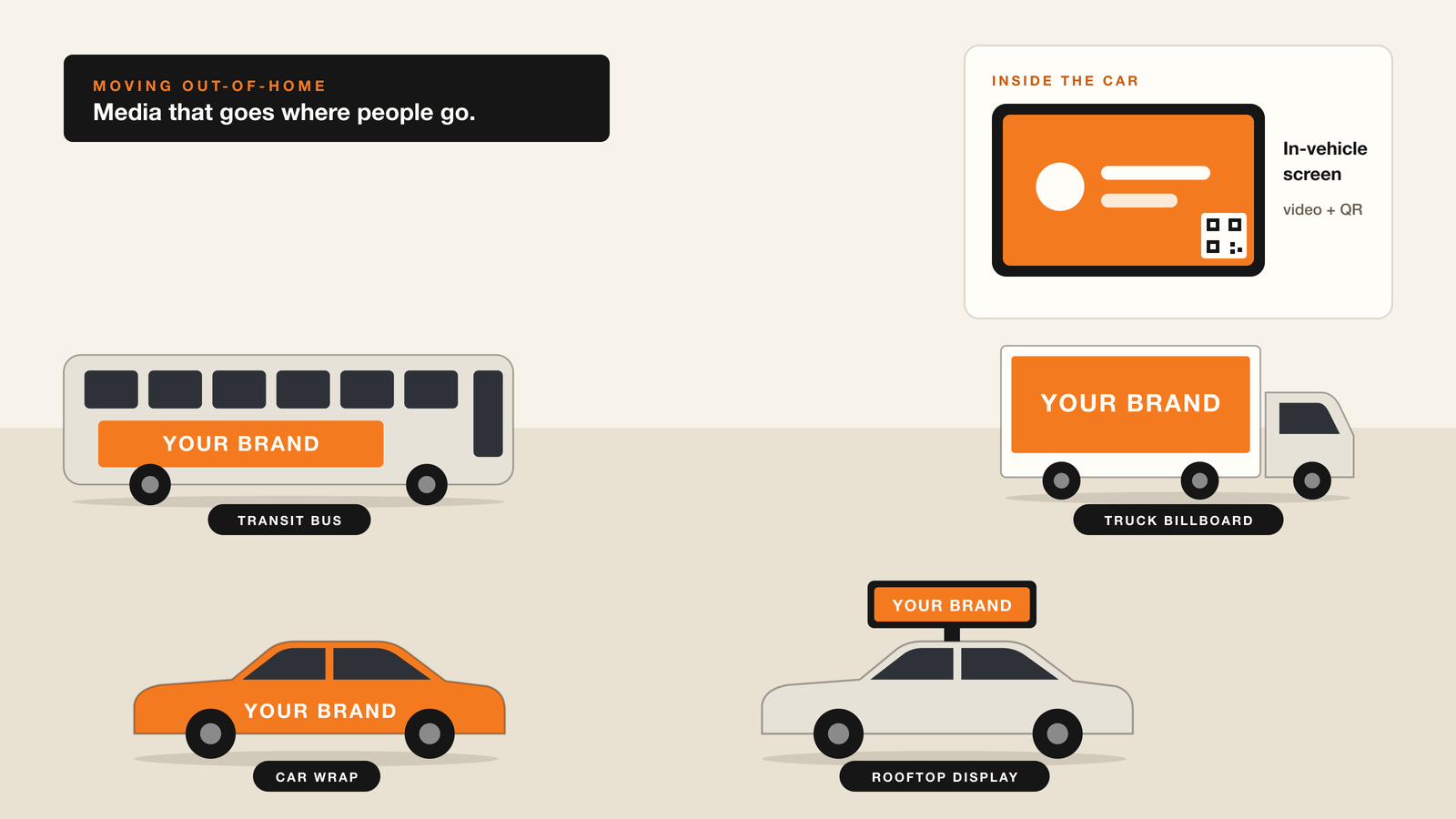
Out-of-home advertising used to mean billboards, bus shelters and posters: media that stays in one place and waits for people to pass. Moving out-of-home is the part of it that goes to the people instead. The ad rides on, or inside, a vehicle that's already out on the street.
If you plan media and moving out-of-home is new to your plans, the formats can blur together. They're bought in different ways, they're proven in different ways, and they do different jobs. This guide sorts them out.
Why it's worth a look
People notice ads on vehicles. In Nielsen's 2019 Out-of-Home Advertising Study, 64% of U.S. residents 16 and older had noticed a wrapped-vehicle ad in the past month, second of 15 formats, behind only roadside billboards. In Morning Consult's 2023 study for the out-of-home industry's research foundation, 49% of adults had noticed ads on wrapped or signed vehicles in the past 30 days, and 36% had noticed a mobile billboard.
Both measure what people said they noticed, not whether they remembered a brand. Our Research page has each study's method and its caveats, and What the Research Says About Car Wrap and Rideshare Advertising puts them together with brand-lift studies.
The five formats
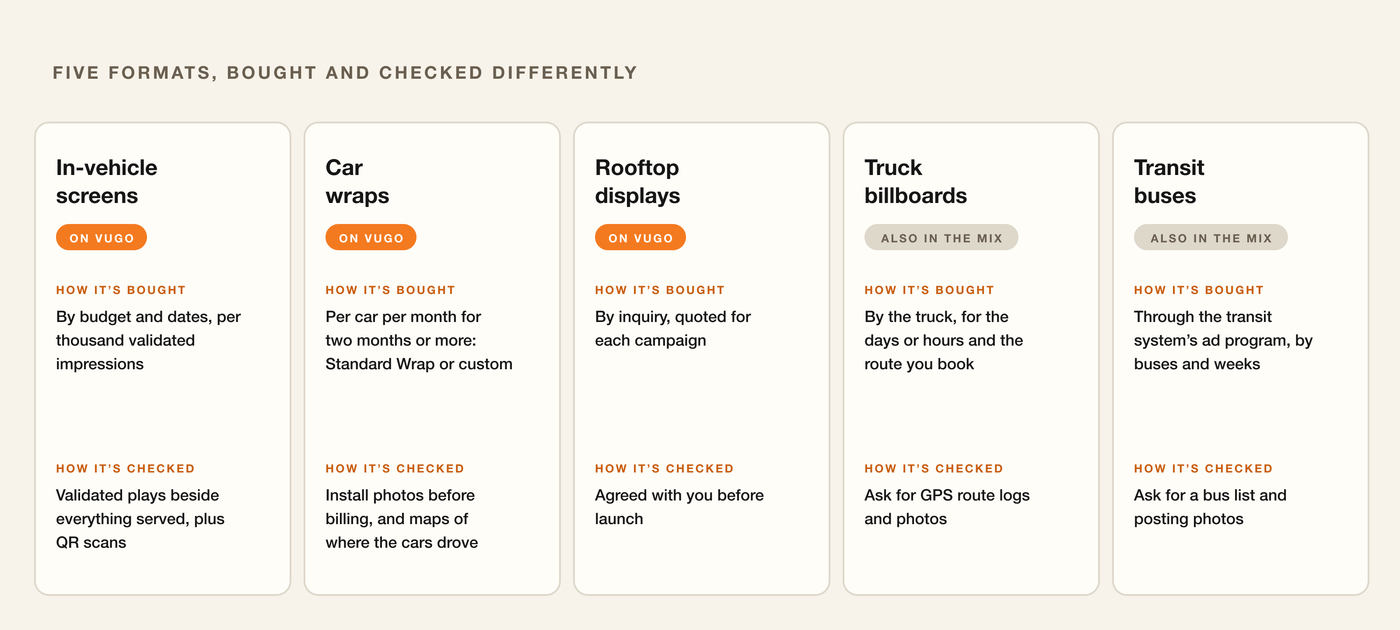
1. In-vehicle screens. Passenger-facing screens in rideshare, taxi and fleet cars play a short video with a QR code to the advertiser's landing page. They're the one format here that reaches people inside the vehicle, with time to look and a phone in hand. On Vugo, screens are available by market, in working cars where drivers and fleets already carry them. A campaign is set by budget and dates, limited by metro and, if you like, a radius around an address, and billed per thousand validated impressions.
2. Car wraps. Vinyl on the outside of rideshare, delivery, taxi and fleet cars, seen by everyone on the street. On Vugo there are two ways to buy: the Standard Wrap, both sides and the rear window on one layout that fits every car, bought in Vugo Platform; and custom wraps, full or partial, designed for the campaign by inquiry. Drivers are recruited for each campaign in the markets you choose, shops install the wraps, and flights run two months or more, priced per car per month. With a swarm, the campaign's wrapped cars come to one place, or drive one route, for a window you schedule.
3. Rooftop displays. A display on the roof of a car, readable by the whole street, often digital. Vugo has offered them since 2021, by inquiry, and availability varies by market. The Dash campaign in Miami shows what one looks like across a market.
4. Truck billboards. Large printed or digital panels on the sides of a truck that drives a route you book. They're usually bought by the truck, for the days or hours you book, on a route you plan with the seller.
5. Transit buses. Ads on the outside of buses, from side panels to full wraps, and on some systems screens inside. They're bought through each transit system's advertising program, usually by the number of buses and the weeks they run.
Vugo's own formats are the first three. Trucks and buses are here because planners weigh them in the same plan.
How each one is checked
The most useful question to ask any moving-media seller is simple: how will I know it ran? The answer is different for each format.
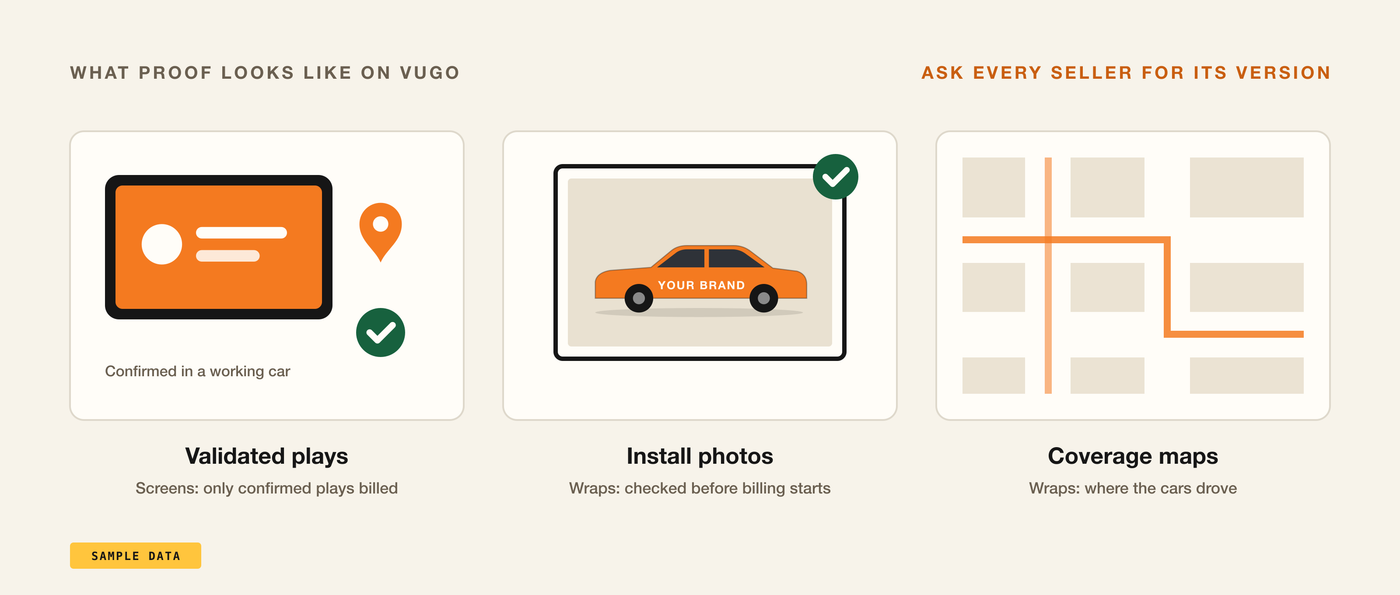
Screens: validated impressions. On Vugo, a play counts as a validated impression when Vugo can confirm it happened on a screen in a working car out on the road. Plays that can't be confirmed aren't billed. The report shows validated plays beside everything served, QR scans, and venue proximity: cars that passed near your location, or were headed there.
Wraps: install photos and maps. Every wrapped car is checked from install photos before billing starts, and reports show where the cars drove. For a swarm, the coverage map highlights the zone and the time cars spent inside it.
Rooftop displays: the reporting is agreed with you before launch, as part of the quote.
Trucks and buses: ask the seller before you sign. For trucks, ask for GPS logs of the route each truck drove and dated photos. For buses, ask for the list of buses carrying your ad and posting photos of them.
Whatever the format, three questions cover most of it: what exactly is counted, who counted it, and what happens to the bill when something didn't run.
Where it fits in a plan
- Reach where static boards aren't. Cars go into neighborhoods, side streets and venue districts that have few fixed boards, and they move with the traffic instead of waiting for it.
- Repetition over weeks. A wrap campaign keeps the same cars in the same city for months, so people see the brand again and again. Here's how long a wrap campaign should run.
- Moments. A swarm puts your cars outside the venue on the days that matter.
- Action. A screen gives a rider a QR code to scan right there. TripIntent® can put your ad first in cars whose surroundings match it, without shrinking where it can play.
A short glossary
- Moving out-of-home: out-of-home advertising on or inside vehicles, as opposed to fixed sites like billboards and shelters.
- In-vehicle screen: a passenger-facing screen in a car, a seat-back tablet or a screen built into the headrest.
- Served play: a play the system sent to a screen.
- Validated impression: on Vugo, a play confirmed in a working car out on the road. Only these are billed.
- CPM: cost per thousand impressions, the common yardstick across media. Always ask what counts as an impression.
- Flight: the dates a campaign runs.
- Standard Wrap: Vugo's wrap covering both sides and the rear window, on one layout fitted to each car.
- Full, partial, 270° and 360° wraps: custom wraps, by how much of the car they cover.
- Swarm: a scheduled session that brings a wrap campaign's cars into one zone, from a tenth of a mile to 10 miles across, or along a route, for a window you choose.
- Rooftop display: a sign, often digital, mounted on a car's roof.
- Mobile billboard: a truck carrying a large printed or digital panel on a route.
- Proof of posting: photos showing an ad was installed where and when it was bought.
- TripIntent: Vugo's way of putting an ad first in cars whose surroundings fit it. A priority, never a filter, and it never uses medical, religious or legal places.
- Venue proximity: on a Vugo screen report, the cars that passed near a location you name, or were headed there.
Start with one question
The easiest way into moving out-of-home is to start with the job: presence on the street, a moment at a venue, or an action inside the car. That picks the format, and the format tells you how to check it.
See every format, read about in-vehicle screens and vehicle wraps, or talk to Vugo about where moving media fits in your next plan.