
It's the first question we hear on most calls: "How many cars do you have in Chicago?" Or Phoenix, or Dallas. Sometimes it's "How many screens are installed in my market?"
It's a fair question to start with. It's also the wrong one to buy on. A car count tells you very little about how many people will see your ad, and planning around it can lead you to pay more for less. Here's why, and what to ask instead.
What the question is really asking
Nobody actually wants cars. A buyer asks about cars because they're trying to build a unit of measurement: if there are 500 cars in my market, my ad must reach roughly so many people. The car count is a stand-in for reach.
So skip the stand-in and ask for reach directly. How many people in my target audience can this campaign reach, where, and when? That's the number the car count was supposed to estimate, and a good vendor should be able to answer it.
Cars aren't billboards
The car question comes from billboards. With a billboard, "how many do you have, and where?" makes sense. A board stands on the same corner every hour of every day of the contract. Count the boards, map them, and you know your inventory.
A car doesn't work that way. It moves, and that's the point of it. It also:
- Goes in for service. Oil changes, tires, repairs and inspections take cars off the road.
- Has a driver with a life. Rideshare and delivery drivers are independent contractors. They choose their own hours, take vacations, get sick and change schedules.
- Drives where the work is. A rideshare car follows demand around a metro: the airport in the morning, downtown at lunch, the nightlife districts on Saturday.
A car that's "in your market" on a list may spend one hour on the road this week or fifty. The count can't tell you which. That's why we don't publish screen counts by market: any single number would misstate what's actually on the road.
It's also why in-vehicle screen ads aren't sold car by car. A billboard ad is stuck to its board. A screen ad is sold across the network in a region and plays on whichever screens are on the road. If one car goes in for service or its driver takes the week off, your ad isn't stuck on it: it keeps playing in the cars that are out working. You buy the delivery, not the vehicle.
More cars doesn't mean more reach
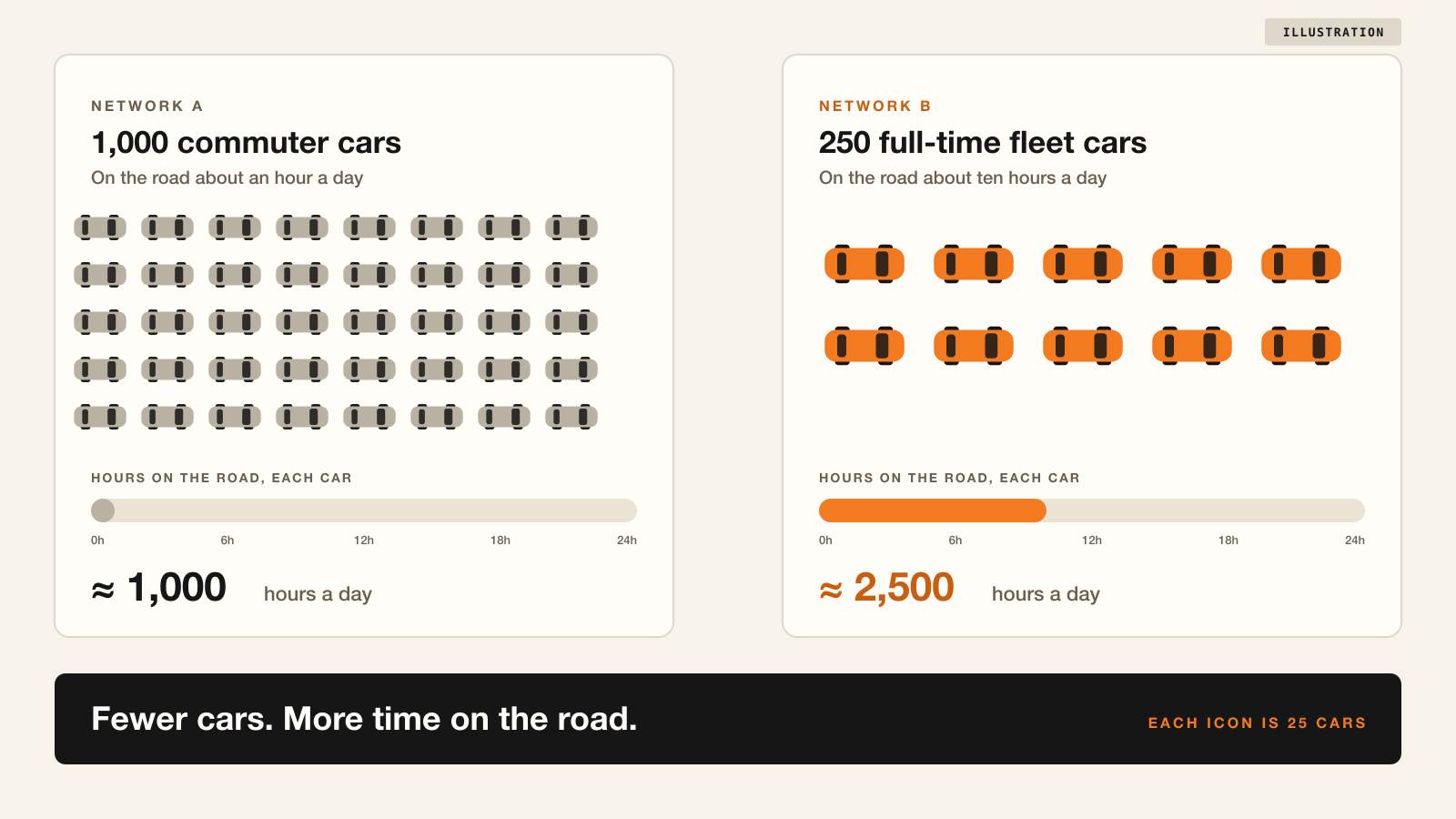
Here's the part that surprises most buyers. Take two networks in the same city:
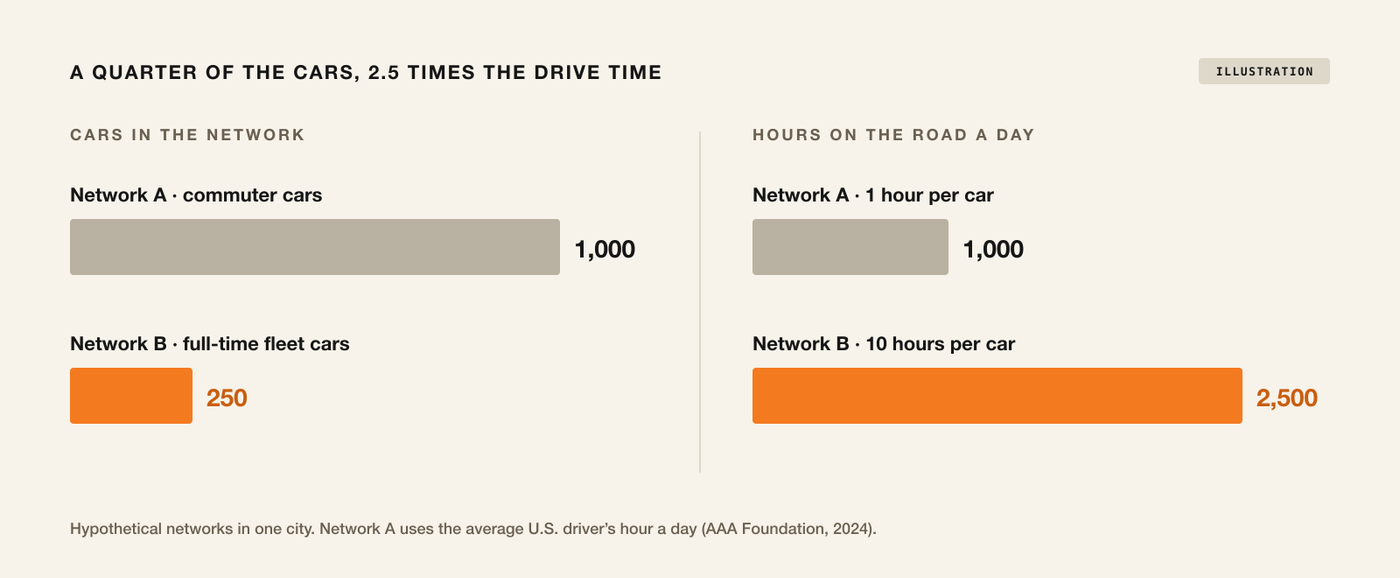
- Network A: 1,000 cars, driven to and from work. The average U.S. driver drives about an hour a day: 60.4 minutes, in the AAA Foundation's American Driving Survey. That's about 1,000 hours on the road a day.
- Network B: 250 cars, driven full time by a fleet. A taxi or fleet car on shift can be on the road ten hours a day. New York City's taxi regulator has reported a typical driver shift of 9.5 hours. That's about 2,500 hours on the road a day.
Network B has a quarter of the cars and two and a half times the drive time. If you'd bought on car count, you'd have picked the wrong network.
Real networks fall in between. Gridwise, which tracks drivers' earnings, found the average Uber driver spent 21.2 hours a week on trips in 2025, and the average Lyft driver 14.7. Some drivers do a few hours on a weekend; others drive full time. Car counts treat them all the same. Hours on the road don't.
That's why Vugo favors full-time drivers and fleets over the average driver. A fleet car on shift, or a driver who does it for a living, is on the road far longer than someone driving a few hours a week, so each car carrying your ad works more hours.
And hours are only the start. An hour downtown at 5 p.m. puts your ad in front of far more people than an hour on an empty road at 3 a.m. Where and when the cars drive matters as much as how long.
No other medium sells by device count
Nobody asks a programmatic ad exchange how many phones are connected to it. You don't buy phones. You buy impressions, a thousand at a time, at a cost per thousand (CPM), aimed at the audience you want.
Even billboards are bought on audience now, not just on count. The out-of-home industry's measurement body, Geopath, describes its audience measurement in terms of impressions, audience composition, and reach and frequency for each unit. Two boards on the same road can be worth very different amounts, and the audience numbers show it.
Moving media should be held to the same standard. The question isn't how many vehicles exist. It's what your budget buys: how many impressions, in which places, at what cost per thousand. Our post on what car wrap and rideshare advertising costs puts those CPMs beside TV, streaming, digital and billboards.
The better question
"How many people in my target audience can I reach?" It's a better question because it makes you, and the vendor, think about the things that actually decide reach:
- Who you're trying to reach. Downtown office workers, college students, travelers, families in the suburbs, nightlife crowds.
- Where they are. The neighborhoods, venues, airports, campuses and corridors they pass through.
- When they're there. Rush hour, lunch, game days, weekends, the season you're selling into.
Answer those first, and the right mix of formats, markets and dates follows. Our post on who rides shows who's in the back seat of a rideshare, from the federal government's National Household Travel Survey.
Five questions to ask instead
- How many impressions will my budget deliver, and how is an impression counted? On screens, ask whether you pay for every play or only plays that can be confirmed.
- Where and when will my ad be on the road? Ask for the hours and the places, not the fleet size.
- How does that match my audience? Ask how the plan puts your ad where your customers are: by neighborhood, radius, venue or time of day.
- What's my cost per thousand? It's the one number that lets you compare cars with every other medium on your plan.
- What will I see afterward? Ask what proof comes with the buy: where and when your ad ran, and what it delivered.
How Vugo answers them
- In-vehicle screens are bought by the thousand. You set a budget, dates, markets and, if you like, a radius around a place. You pay for validated impressions: plays confirmed in a working car out on the road. Plays that can't be confirmed are free. Your ad runs across the screens in your market, so a car that's off the road doesn't hold it back. Screens run in many U.S. markets, and we'll confirm coverage for yours. You don't need a screen count to buy, any more than you need a phone count to buy mobile.
- TripIntent® puts your ad where it fits. It gives priority to your ad when the places around the car, or where it's headed, match your campaign: airports, nightlife, campuses and more. See TripIntent.
- For wraps, cars are what you buy, so ask what they'll do. Wraps are priced per car, so the number of cars carrying your wrap matters. We recruit them for each campaign from working rideshare, delivery, taxi and fleet drivers in your market, and we favor full-time drivers and fleets, so your wrap is on cars that spend their day on the road, not parked in a driveway. Each car is checked from install photos before billing starts, and you see where the cars drove.
- Swarms put cars where your audience is. For a game, a festival or a store opening, a swarm pays wrapped drivers to bring their cars into the zone you choose, at the times you set.
- Reports show where and when. Screen reports show where and when your ad played and the QR scans it brought in. Wrap campaigns send photo proof every month.
Tell us your audience, your market and your dates, and we'll build the plan around the people you want to reach, not a car count.
Sources
- AAA Foundation for Traffic Safety, American Driving Survey: 2024 (published December 2025): the average U.S. driver drove 60.4 minutes a day. Vugo's summary.
- Gridwise, "How Much Do Uber Drivers Make in 2026? (Data from 500k+ Drivers)", from its 2026 Annual Gig Mobility Report: in 2025 the average Uber driver worked 21.2 active hours a week and the average Lyft driver 14.7; active hours are time on a trip. Published April 1, 2026. gridwise.io
- New York City Taxi & Limousine Commission, 2014 TLC Factbook: a typical driver shift is 9.5 hours. nyc.gov
- Geopath, Media Measurement Methodology Overview (May 31, 2023): Geopath's own description of its out-of-home audience measurement. geopath.atlassian.net
- The two-network example is an illustration, not Vugo data: 1,000 cars × 1 hour and 250 cars × 10 hours.