
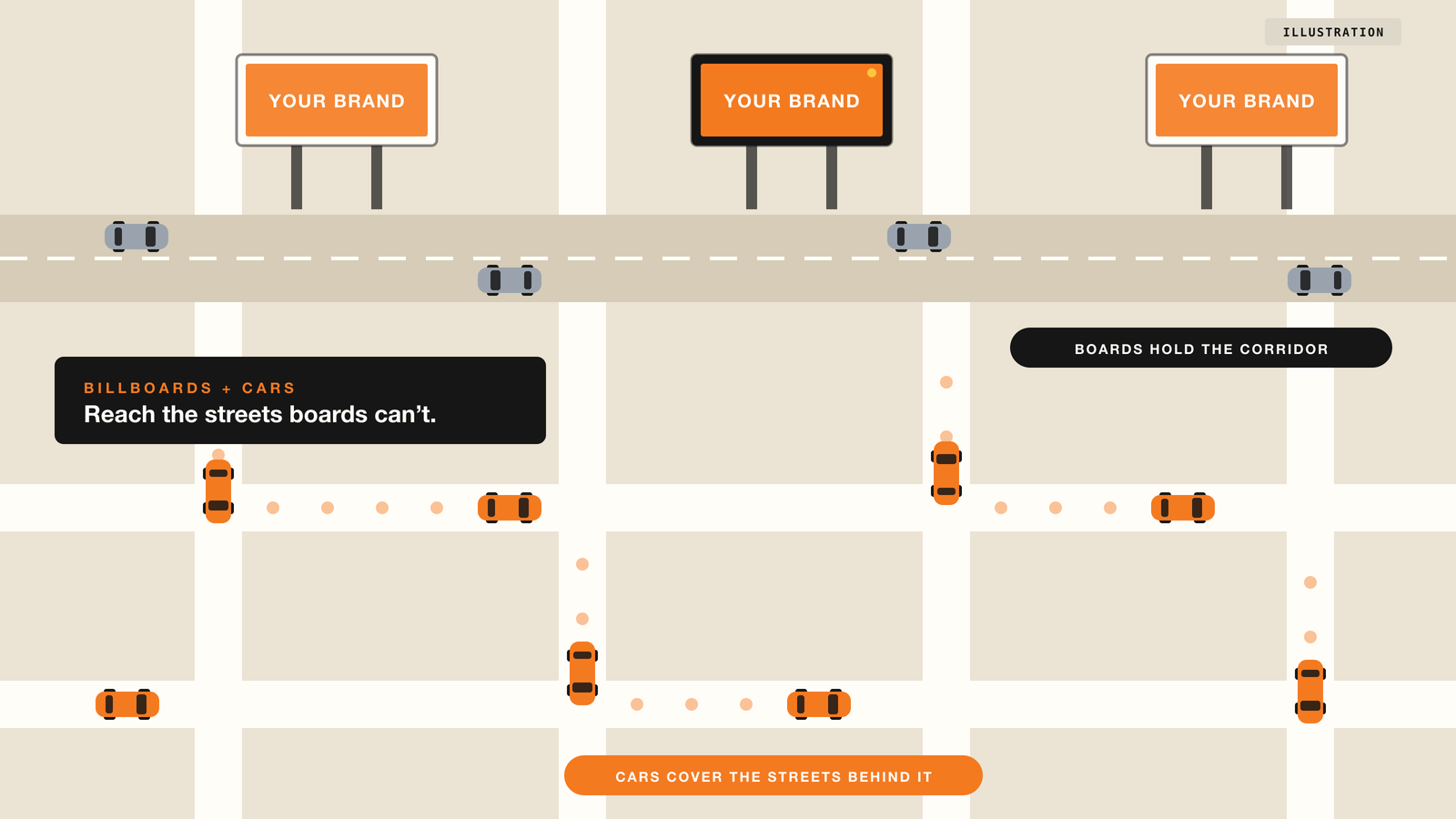
Most out-of-home plans start with billboards, and for good reason. A board on the right corridor is seen by a lot of people, every day, for as long as you hold it. In Nielsen's 2019 Out-of-Home Advertising Study, roadside billboards were the most-noticed of 15 out-of-home formats: 76% of U.S. residents 16 and older had noticed one in the past month.
The format in second place was wrapped vehicles, at 64%. That's the opening for agencies: the media that ranked just behind billboards doesn't compete with them for the same corners. It goes where the boards aren't.
What billboards do best, and where they stop
A billboard is fixed. That's its strength: you choose the corridor, and the board is there every hour of every day of the contract. Digital boards add timing, with different messages by time of day on the same face.
It's also the limit. Boards cluster along highways and big roads, and a lot of daily life happens on the streets behind them: the neighborhood a store serves, the blocks around a campus, the streets people walk to a game. And people spend a lot of time on the road. The AAA Foundation's American Driving Survey found the average U.S. driver drives 60.4 minutes a day. Not all of that hour is spent on the roads with boards.
Where moving media fits
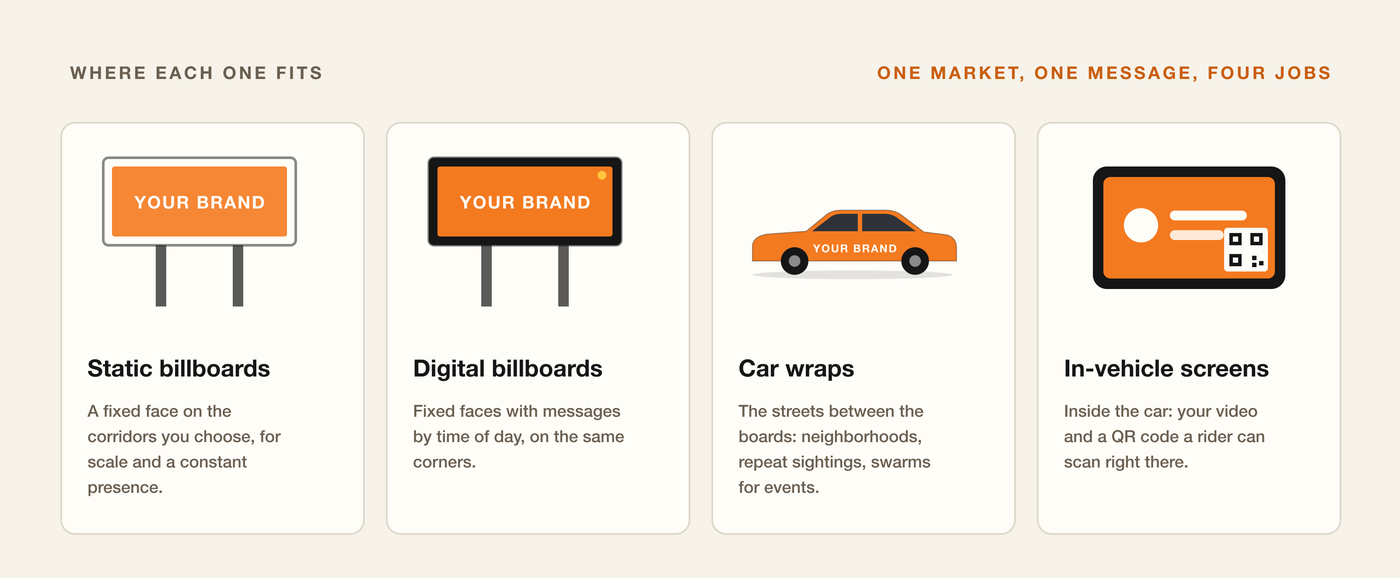
Reach where the boards aren't. Wrapped rideshare, delivery, taxi and fleet cars drive the neighborhoods, side streets and business districts your board map leaves out. Vugo recruits drivers for each campaign in the markets you choose, so the cars carrying your client's brand are cars that work there.
The same streets, again and again. A wrap campaign runs two months or more, and most run two to six, so the same people see the brand on their commute, at lunch and on the way home. Paired with a board on the main corridor, the wrap carries the same message onto the side streets. Here's how to pick a length.
Local, on purpose. In Morning Consult's 2023 study for the out-of-home industry's research foundation, 54% of adults said they notice out-of-home ads more when they're tailored to the location they're in. Cars recruited in the neighborhoods your client serves, with creative that names them, make that easy.
Events, with swarms. A billboard can't move for game day. A swarm can: you schedule a window at a place, with a radius from a tenth of a mile to 10 miles, or along a route, and the campaign's wrapped drivers are paid to bring their cars into that zone. The coverage map shows the zone and the time cars spent inside it.
Inside the car. Wraps and boards are seen from outside. In-vehicle screens reach the rider in the back seat with a short video and a QR code to scan right there. Screens are available by market, where drivers and fleets already carry them, and a campaign can be kept inside a radius around an address. TripIntent® can put the ad first in cars whose surroundings match it, as a priority, never a filter. Screen campaigns are set by budget and dates.
Plan the mix
A simple way to build the plan, one market at a time:
- Start with the boards you have. Map the corridors the client already holds, or plans to.
- Mark the gaps. The neighborhoods, store trade areas, campuses and venue districts the boards don't reach. That's where the wraps go.
- Mark the moments. Openings, game days, conferences and festivals in the flight. Those are the swarms.
- Decide if you want action inside. If the goal includes a visit, a download or a sign-up, add screens with a QR code to a page built for the campaign.
- Keep one message. The board, the wrap and the screen should look like the same campaign: one visual, one short line, the same brand. On a car, design for recognition at a distance. Here's how to design a wrap people remember.
- Line up the flights. Recruiting, production and installation all happen before day one. A Standard Wrap starts at least 14 days after the artwork is submitted; custom wraps take longer. Vugo confirms the lead time for each market, so start the wraps alongside the board contract, not after it.
Measure the mix
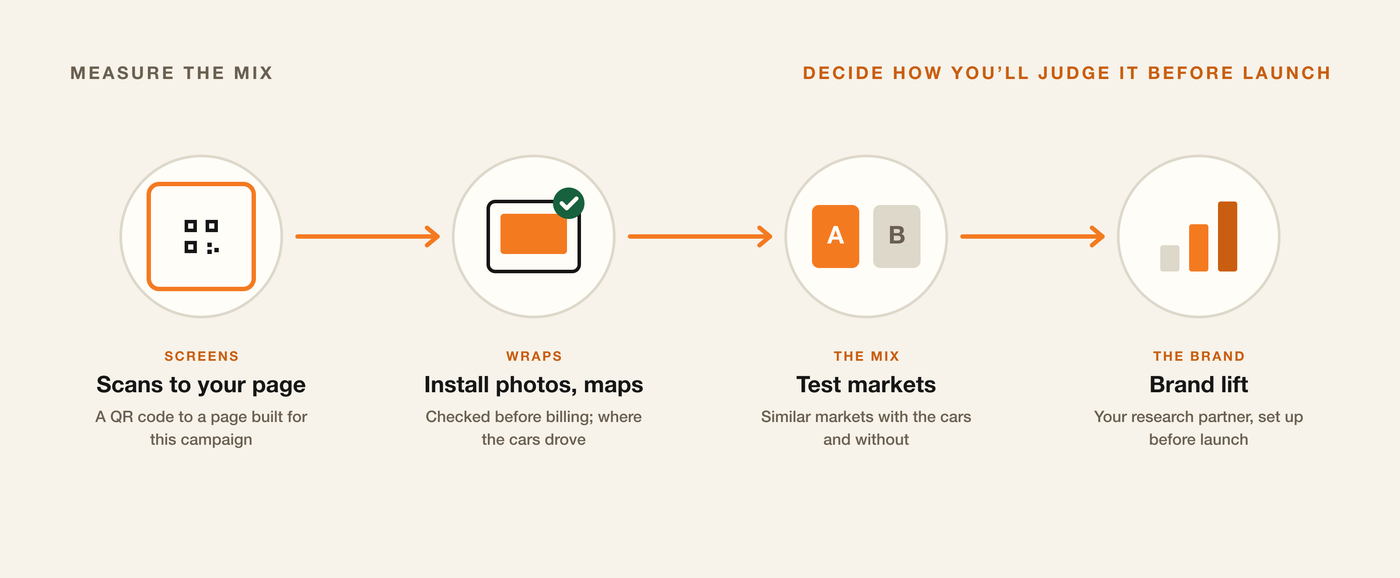
Out-of-home has always been harder to measure than a click, and a mixed plan is harder still. Decide how you'll judge it before the first car is wrapped.
- Screens: scans to a landing page. Give the QR code its own page, and add your own tracking tags to the link, so every scan shows up in your client's analytics, separate from the boards.
- Wraps: proof it ran. Every wrapped car is checked from install photos before billing starts, and reports show where the cars drove. Put a short web address or a vanity URL on the wrap so street visits can be counted too.
- The mix: test markets. Run the cars in some markets and not in similar ones, with the same boards in both, and compare store visits, sales or sign-ups. It's the cleanest way to see what the moving media added.
- The brand: lift studies. If awareness or consideration matters, choose a research partner before launch, so a control group is in place from day one.
Read the research right
Two cautions for the client deck. First, the Nielsen and Morning Consult figures measure what people said they noticed, not whether they remembered a brand, and Morning Consult's vehicle figure includes fleet lettering, not only advertising wraps. Second, they describe the formats, not any one seller's campaigns. They show that ads on cars get noticed alongside billboards; your own test markets show what they do for your client. Our look at Nielsen's 2019 study and the Research page have the methods.
Billboards hold the corridor. Cars cover the streets behind it, show up for the moments, and put a next step in a rider's hand. Planned together, they're one campaign people see everywhere they go.
See how Vugo works with agencies, learn about vehicle wraps, swarms and in-vehicle screens, or bring us your next brief.