
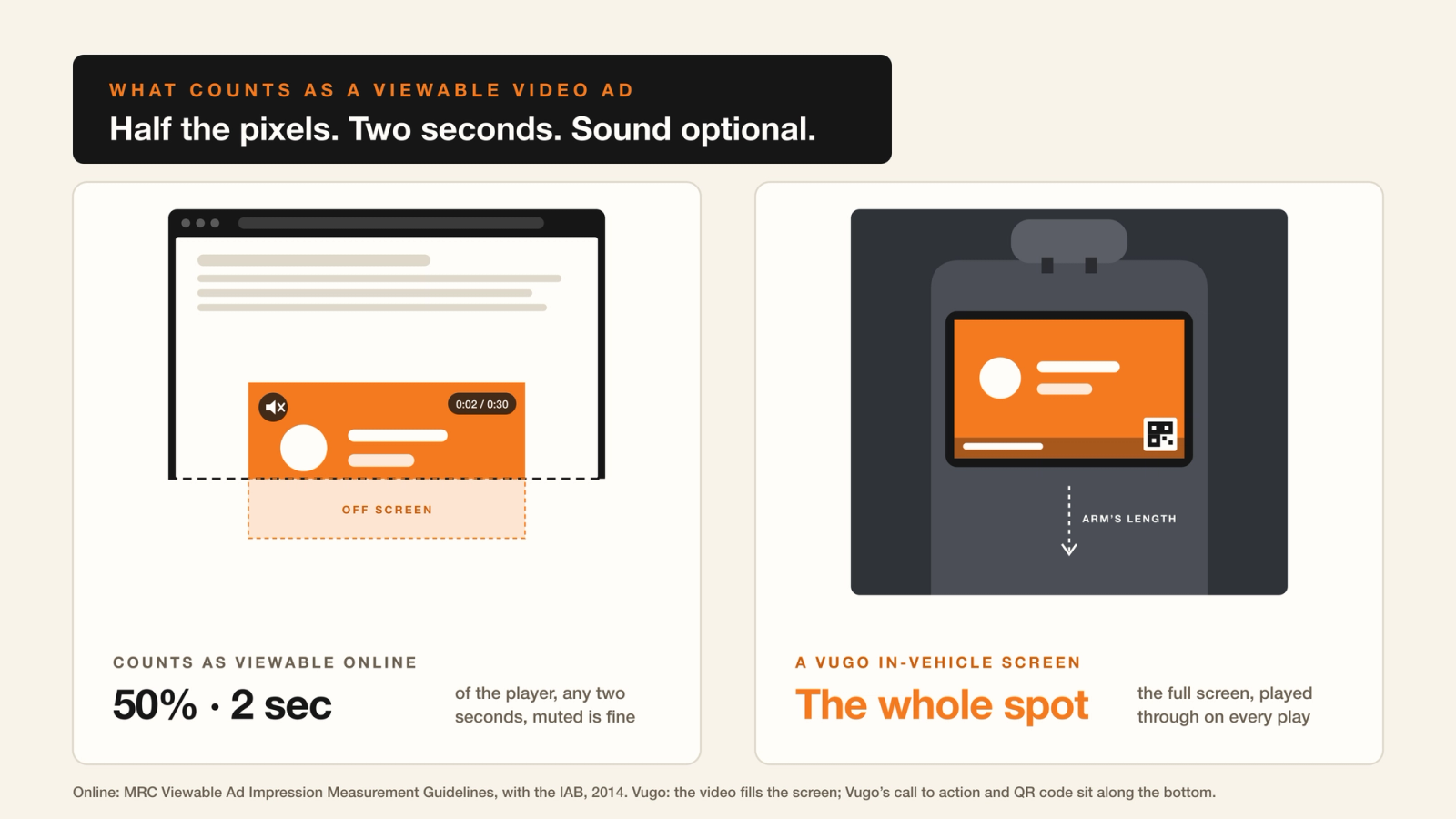
Every digital video buy comes with a viewability number. It's on the dashboard, in the insertion order, sometimes in the contract. A campaign that's 80% viewable sounds like a campaign where 80% of the ads were seen.
It isn't. "Viewable" has a precise industry definition, and the bar it sets is much lower than most people assume: half of the ad, on screen, for two seconds. Here's what the standard actually says, what it lets count, and how it compares with a screen in the back of a car.
The short version
- The standard is half the pixels for two seconds. Under the guidelines the Media Rating Council wrote with the IAB, a video ad is viewable once 50% of its pixels are on screen while two continuous seconds of it play. Sound isn't required.
- That can be about 3% of a 30-second ad. Half the picture for two seconds of thirty is one-thirtieth of what the advertiser made. It counts the same as a full view.
- Plenty of ads don't clear even that. Integral Ad Science's July 2026 report found 79.7% of video ad impressions met the standard. About one in five didn't.
- An in-vehicle screen starts from the other end. On a Vugo screen, your video fills the whole screen, faces the back seat at arm's length, and plays through every time. There's nothing to scroll, skip, close or block.
- Neither one proves a person watched. Viewability measures the opportunity to see an ad. What the screen removes is the reasons an ad can't be seen.
What the viewability standard actually says
The definition comes from the MRC Viewable Ad Impression Measurement Guidelines, written by the Media Rating Council with the IAB's Emerging Innovations Task Force in 2014 and updated in 2015. The current version, 2.0, keeps the same thresholds, and it's still the standard that verification companies, ad platforms and most media contracts use. It sets three thresholds:
- Display ads: at least 50% of the ad's pixels on screen, on a browser tab that's in focus, for at least one continuous second.
- Large display ads, 242,500 pixels or more (the size of a 970 × 250 banner): 30% of the pixels for one continuous second counts.
- Video ads: at least 50% of the pixels on screen while at least two continuous seconds of the video play. The guidelines say they don't have to be the first two seconds; any two in a row will do.
Two details matter as much as the numbers. First, sound isn't part of it. The guidelines say detecting audio "is not currently a requirement," because measurers can't reliably tell whether a player is muted. A silent autoplay video in a feed qualifies the same way a video someone pressed play on does. Second, the guidelines are candid about what the metric means: a viewable impression is an "opportunity to see" the ad, not evidence that anyone did.
How low the bar is
Put the numbers against a real ad. A 30-second video is 30 seconds of the full picture. The standard asks for half the picture for two of those seconds: one-thirtieth of the ad, about 3%. For a 15-second spot it's about 7%.
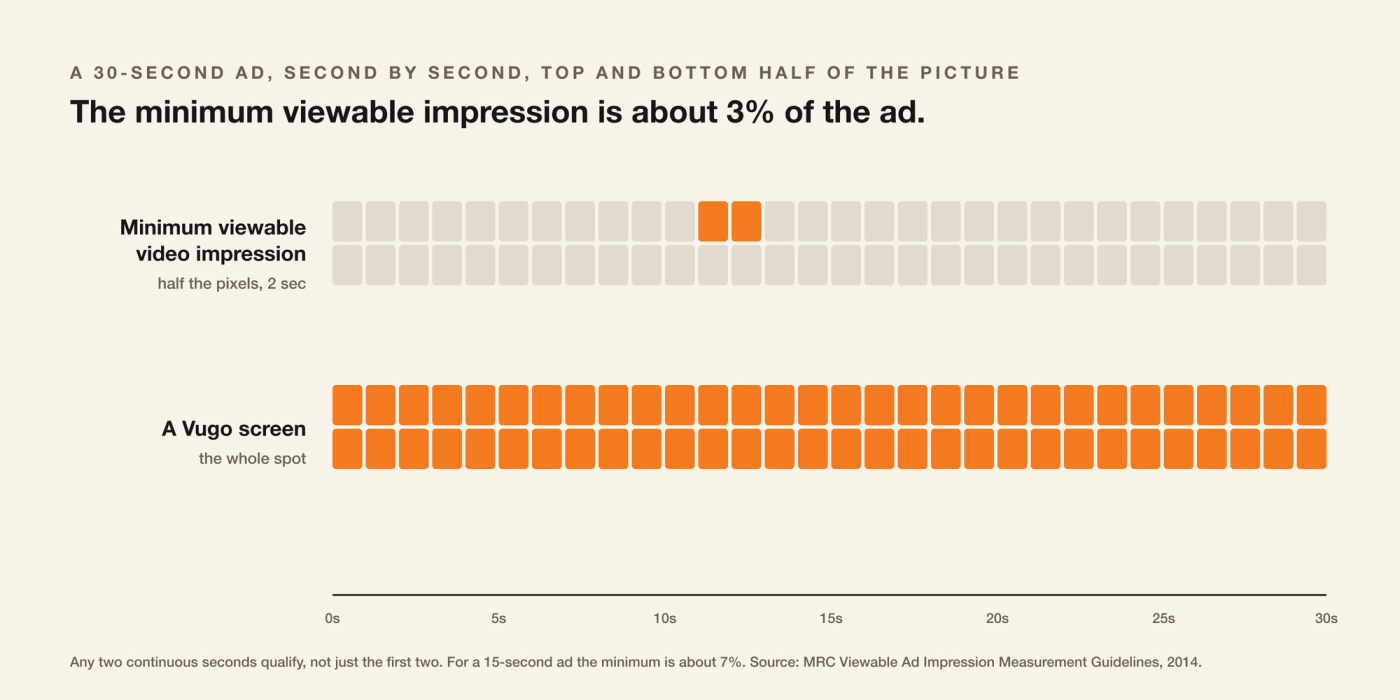
So all of these count as a viewable video impression:
- A video in a news feed that autoplays muted while someone scrolls, and stays half on screen for two seconds before it's gone.
- A player in the corner of a page, half below the fold, that runs two seconds while the reader looks at the article.
- A 30-second pre-roll where the viewer moves to another part of the page, leaving half the player in view, after the first few seconds.
Each is reported exactly like a viewer who watched the whole spot, with the sound up, full screen.
None of this is a secret, and it isn't an accident. The thresholds were set in 2014 as a minimum the whole industry could measure across millions of pages and players, not as a definition of a good impression. Some buyers hold a higher bar. GroupM, WPP's media investment group (now WPP Media), set its own standards in 2017: 100% of a display ad in view for one second, and for pre-roll and mid-roll video, 100% in view, half the video played, started by the viewer with the sound on. Standards like that are the exception in a contract, not the rule.
And plenty of video doesn't reach even the minimum. In Integral Ad Science's 21st Media Quality Report, published in July 2026, 79.7% of video ad impressions met the viewability standard. One in five didn't get half the ad's pixels on screen for two seconds.
What a screen in the back seat delivers
A Vugo in-vehicle screen works the other way around. It isn't a page the ad has to share, or a feed that keeps moving. The whole device exists to show the ad.
- The ad fills the screen. Your video plays edge to edge. Vugo adds your campaign name, call to action and a QR code along the bottom, and nothing else shares the screen while it plays.
- It's placed to be seen. The screen sits on the back of the front seat or in the headrest, facing the back seat, about arm's length away. There's no fold to sit below and no corner of a page to sit in.
- It plays through, every time. Each spot is played from the first frame to the last, whatever its length. There's no skip button, no scrolling past it, no other tab to switch to.
- Nothing blocks it. There's no ad blocker on a Vugo screen, and no browser deciding what loads.
- You pay for plays that happened. Vugo bills screens on validated impressions: plays confirmed in a working car out on the road. Plays it can't confirm are free, and a video that failed to play never counts.
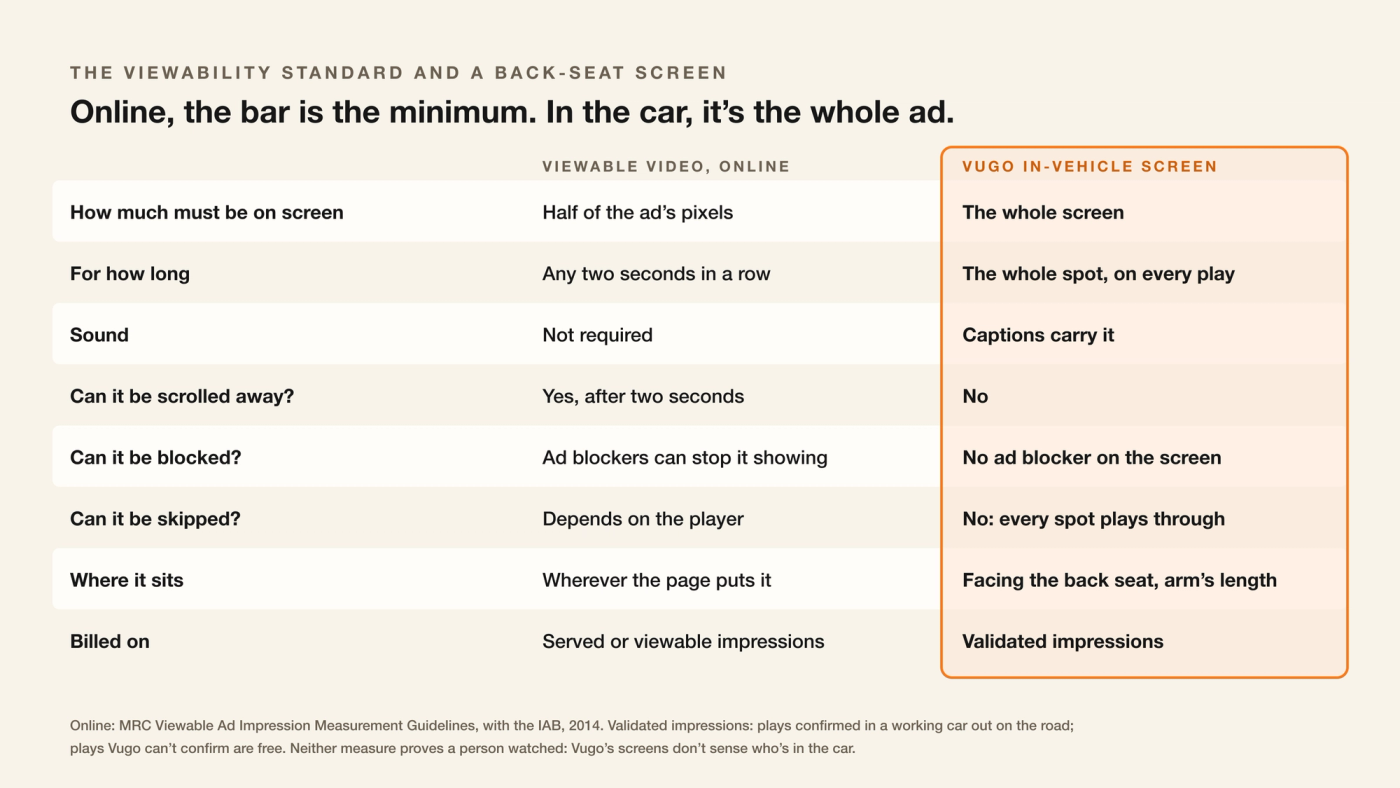
Vugo videos can play with sound, but the winning move is captions: they carry the message whether or not anyone hears it. Say it on screen, caption anything that matters, and hold your call to action for the last few seconds.
Read it right
A full-screen play isn't proof that someone watched, and neither is a viewable impression. Vugo's screens don't sense who's in the car or where they're looking, and no screen anywhere can promise a person's attention. What's different is everything around the ad. Online, the standard counts an ad as viewable even when half of it is off screen and it's gone after two seconds. In the back seat, the screen never gets in the ad's way: whoever is sitting there has the whole spot in front of them, and looking away is their choice, not the page's.
That's also why the most useful number on a Vugo report is the one a person makes happen: QR scans. A scan is someone in the car deciding to act on what they saw.
How to compare them
- Ask what "viewable" means in the proposal. If it's the MRC standard, it means half the pixels for two seconds. Ask for completed views, or views with the whole player on screen, if the seller can report them.
- Price the whole ad, not the minimum. Divide what you pay by the impressions where the whole spot played fully in view. That's the number to set beside an in-vehicle screen's CPM.
- Design for captions on both. Captions and on-screen copy work in a feed and in the back seat, with or without sound.
- Judge them by what people do. Put UTM tags on both, and compare visits, scans and sales, not viewability rates.
Vugo's in-vehicle screens typically run $20 to $25 per thousand impressions, and every campaign is quoted for its market and dates. For how that compares with other media, see what car and rideshare advertising costs and in-vehicle screens vs. streaming TV ads. To plan a screen campaign, see how in-vehicle screens work or talk to Vugo.
Sources
- Media Rating Council, Viewable Ad Impression Measurement Guidelines (Desktop), Version 2.0, August 18, 2015, first prepared with the IAB Emerging Innovations Task Force (PDF). See its Pixel Requirement and Time Requirement (display: 50% of pixels, one continuous second), the large-ad rule (242,500 pixels or more: 30%), the Video Time Requirement (two continuous seconds, "not necessarily the first 2 seconds"), Audio Considerations ("detection of audio is not currently a requirement") and its description of a viewable impression as an "opportunity to see". Version 1.0, June 30, 2014, set the same thresholds (PDF on iab.com).
- GroupM's standards: Ginny Marvin, "GroupM sheds light on its updated viewability standards for display & video ads," MarTech, August 30, 2017 (martech.org): pre-roll and mid-roll "100 percent in view, 50 percent complete, played at the user's initiation with sound on."
- Integral Ad Science, Media Quality Report: 21st Edition, July 9, 2026 (integralads.com; the report itself is behind a sign-up form). Global video viewability 79.7%, display 67.9%, as reported by Advanced Television (July 9, 2026).
- The arithmetic: half the picture for two seconds of a 30-second ad is 0.5 × 2 ÷ 30 = 3.3% of the ad's pixel-seconds; of a 15-second ad, 6.7%.
- Vugo's screens: how Vugo plays and bills screen ads is from Vugo's own platform. The creative specs are on Vugo's ad specs page.