
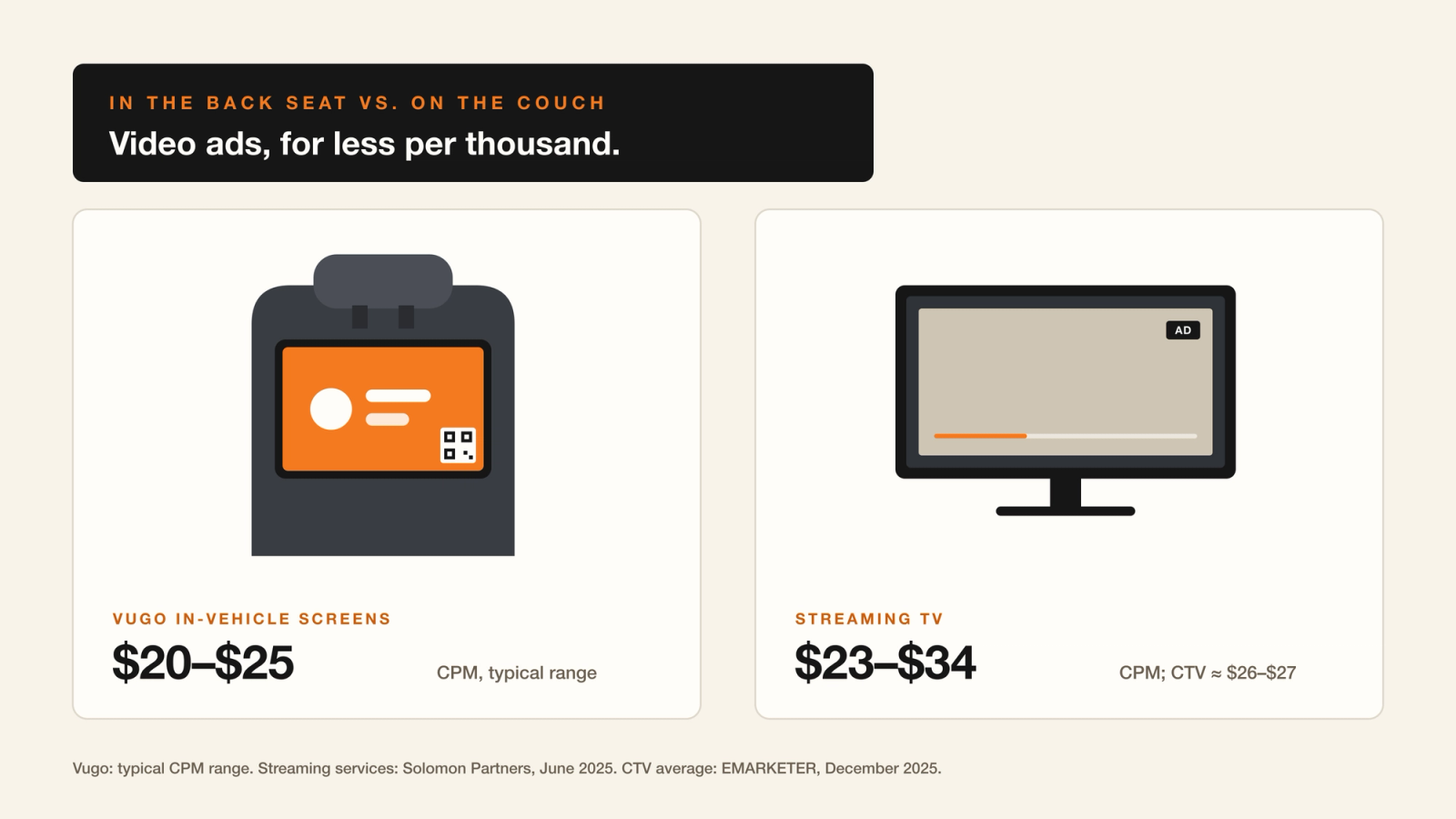
Streaming TV is where video budgets are going. Connected TV gets the upfront headlines, most of the big streaming services now sell an ad tier, and nearly every media plan has a line for it.
There's another video screen worth a line on that plan: the one in the back seat. Here's how Vugo's in-vehicle screens compare with streaming TV on the three things a buyer cares about most: what it costs, who it reaches, and whether the impressions are real.
The short version
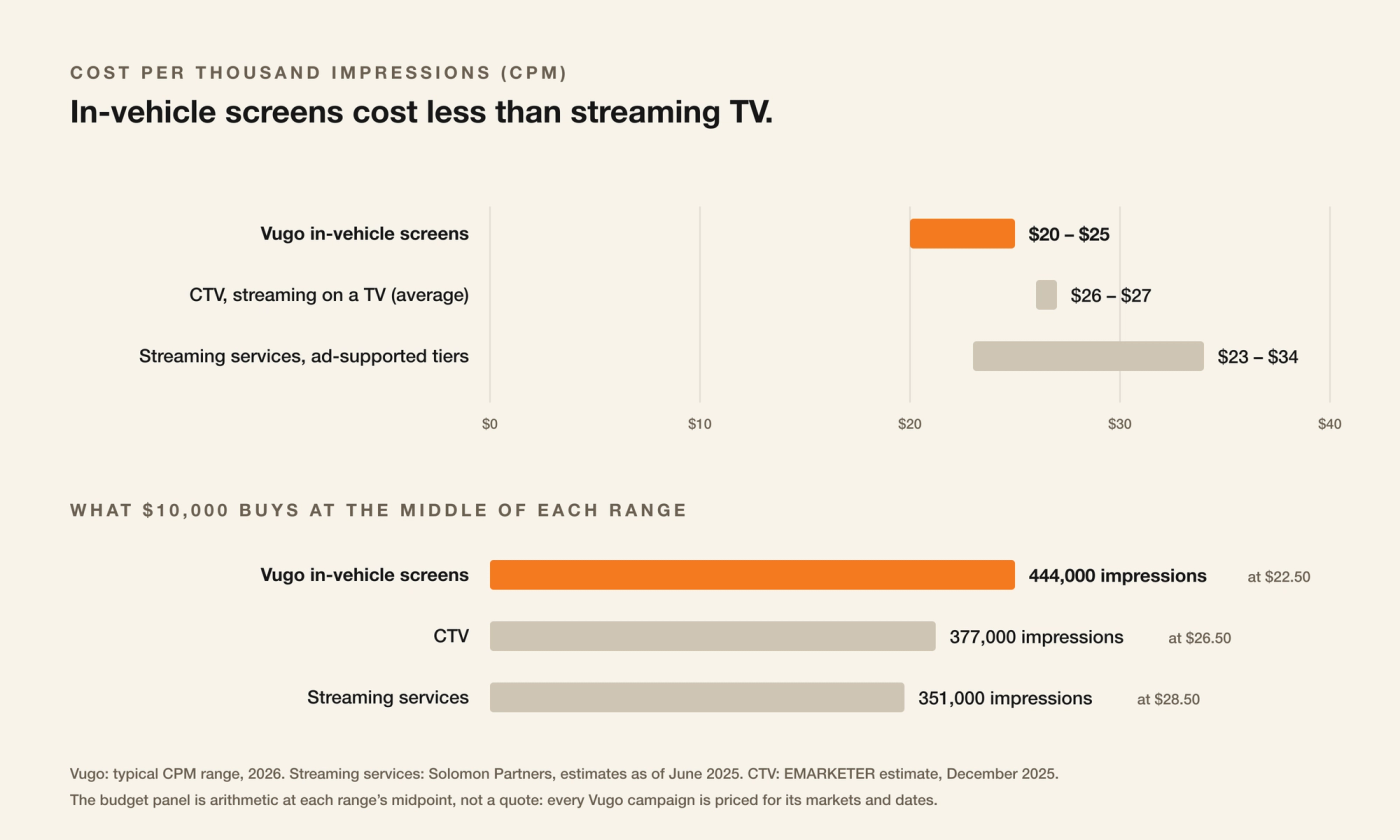
- It costs less. Vugo's in-vehicle screens typically run $20 to $25 per thousand impressions. Ad-supported streaming services run $23 to $34, and connected TV averages about $26 to $27.
- It goes further. At the middle of each range, $10,000 buys about 444,000 impressions on Vugo screens, against about 377,000 on CTV and 351,000 on streaming services: roughly 18% and 27% more.
- It's targeted by the moment. Streaming targets the household. Vugo targets where and when: your metro, a radius around your stores, the hours that matter, and what's around the car right now.
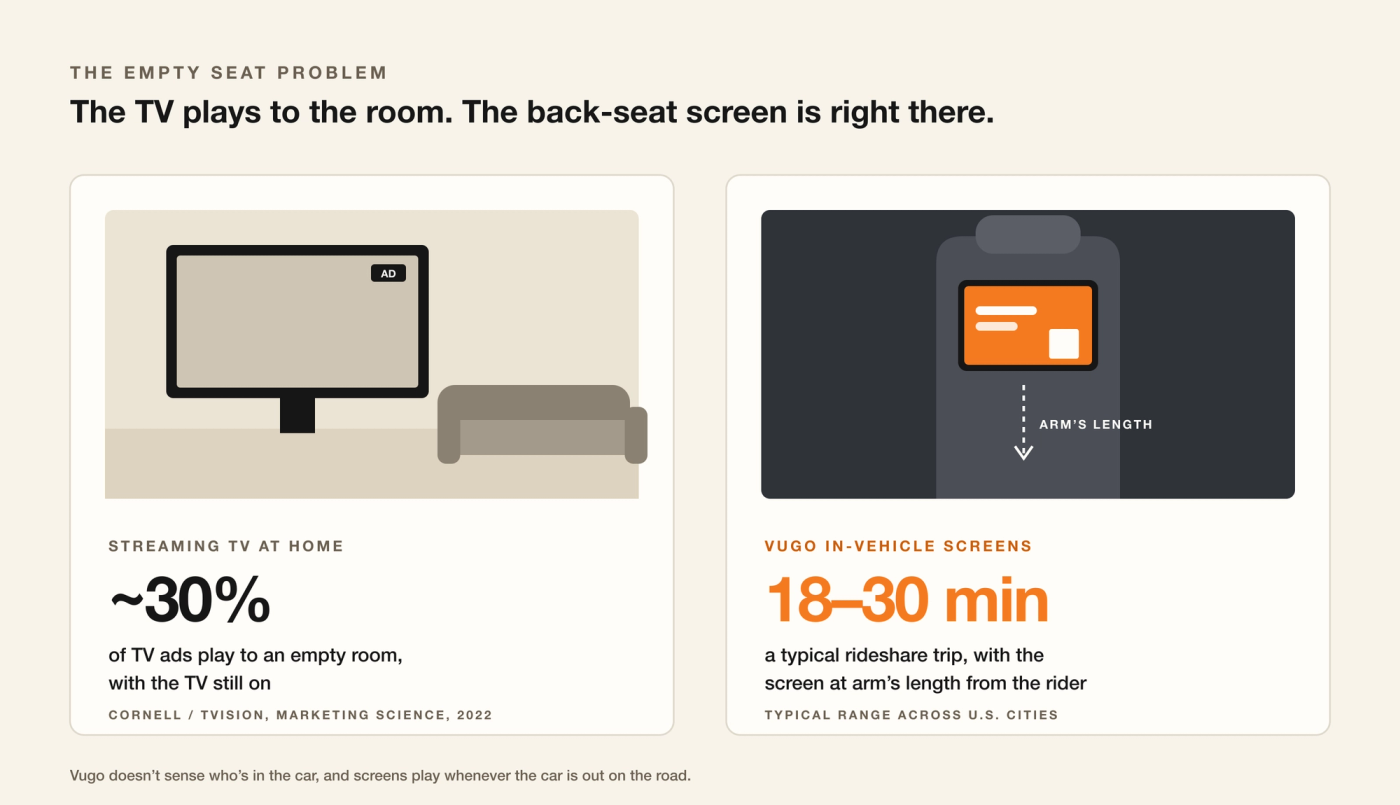
- There's nothing for a bot to fake, and no room to walk out of. Bot fraud is a growing problem in streaming, and many TV ads play to an empty room. Vugo's ads play on physical screens in working cars out on the road, at arm's length from the back seat.
- It's close enough to act on. Every Vugo ad carries a QR code within arm's reach, not across the living room.
The price, side by side
Two sources set the benchmark for streaming. Solomon Partners, an investment bank that follows the media industry, estimates CPMs for the major U.S. media every year; its June 2025 edition, published by the OAAA, puts the ad-supported tiers of the streaming services at $23 to $34 per thousand. EMARKETER estimated in December 2025 that streaming-service CPMs on connected TV would average about $26 to $27.
A note on terms: connected TV (CTV) means streaming on a TV set, through a smart TV, a streaming stick or a game console. It's the part of OTT that plays on a TV; OTT covers streaming on any device, phones and computers included. Both are what most buyers mean by streaming TV.
Vugo's range is a typical range, not a price list: every campaign is quoted for its markets and dates. The $10,000 comparison is simple arithmetic at the middle of each range. Your quote will differ, but the gap is the point: the same budget puts your video in front of more impressions in the back seat than on the living-room TV.
Targeting: the household vs. the moment
Streaming TV's strength is the household. Buyers can target homes by the data attached to them, by zip code or DMA, and by what's being watched. That's real, and for some campaigns it's exactly right.
Vugo's in-vehicle screens are targeted a different way: by where and when.
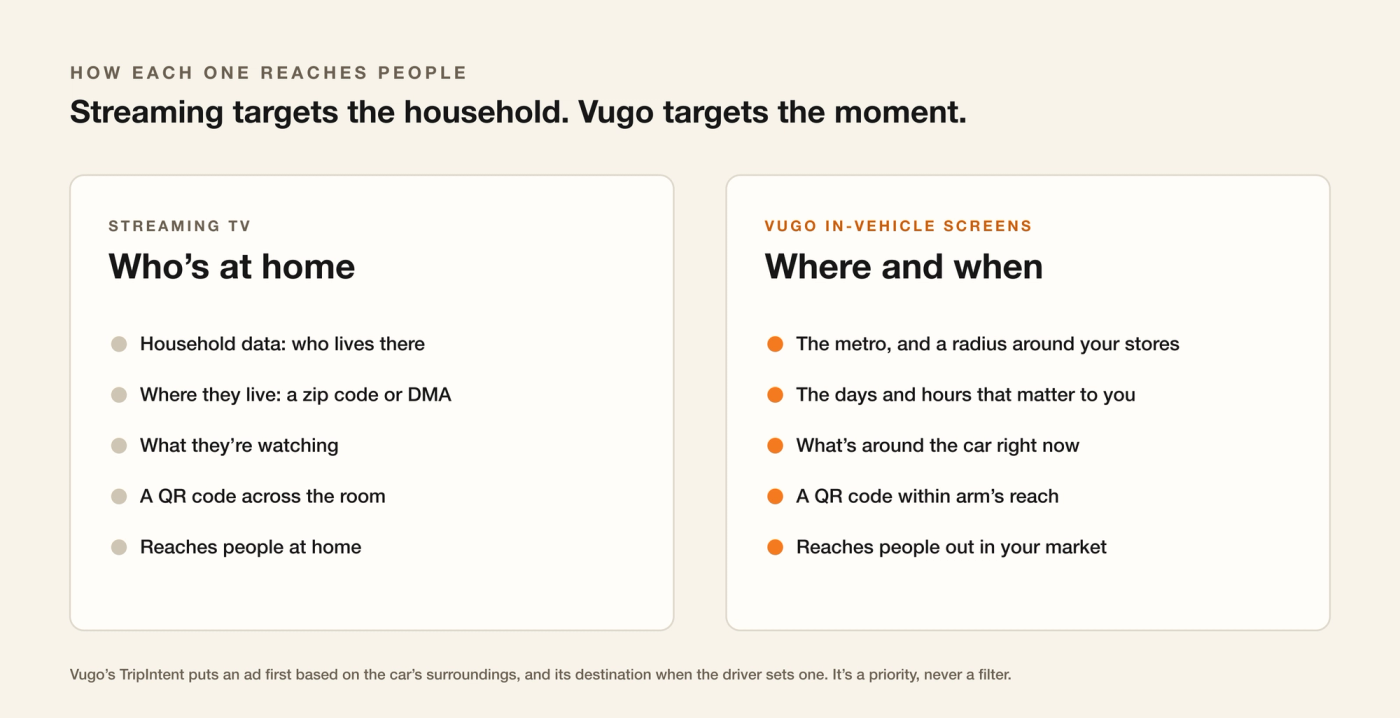
- The places that matter. Choose the metros, and a radius around your stores, your venue or your event.
- The hours that matter. Run on the days and at the times your customers are out: the lunch rush, the weekend, the week before a launch.
- The context of the trip. TripIntent® puts your ad first based on what's around the car, and where it's headed when the driver sets a destination. It's a priority, never a filter, so it never shrinks your reach, and it never uses medical, religious or legal places.
The difference that matters most: a streaming ad reaches people at home, and a Vugo screen reaches people out in your market, a few blocks from where they shop, eat and spend.
The bot problem in streaming
Streaming's fastest-growing cost is one that doesn't show up on the invoice: impressions that no person ever saw, because no person was there.
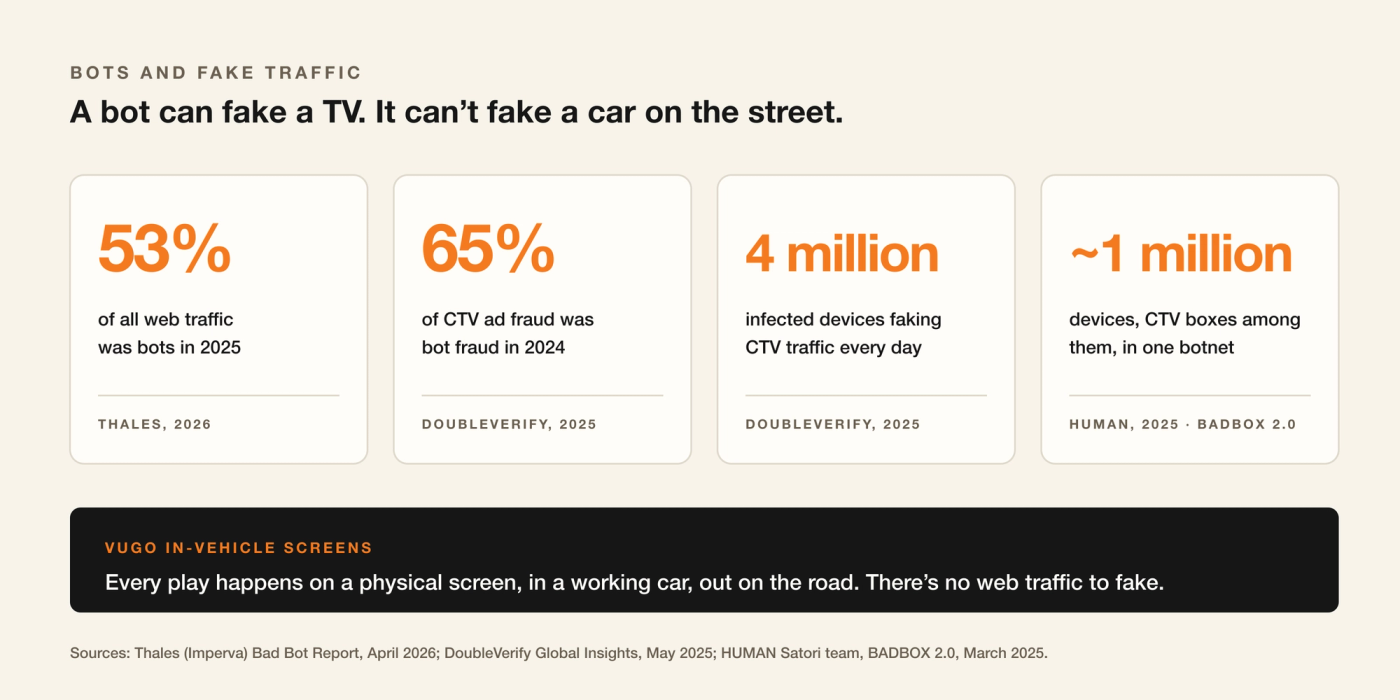
- Most of the internet isn't human anymore. Thales' 2026 Bad Bot Report found that bots made up 53% of all web traffic in 2025. People were 47%.
- CTV is a target. DoubleVerify found that bot fraud made up 65% of all ad fraud in CTV in 2024, with about 4 million infected devices generating invalid traffic every day. It identified 12 new CTV bot variants in a single quarter, and one variant alone was wasting more than $7.5 million of advertisers' media a month.
- The schemes are big. In 2025, HUMAN's Satori team exposed BADBOX 2.0, a botnet of as many as one million infected devices, CTV boxes among them, used for programmatic ad fraud, including ads that play where no one can see them.
- And plenty of real TVs play to nobody. Streaming often runs in the background while people cook, work or step out of the room. A peer-reviewed Cornell study, using TVision's in-room sensors across four million ad exposures, found that about 30% of TV ads play to an empty room, and that viewers were four times more likely to leave the room than change the channel (Marketing Science, 2022). The ad still counts as delivered.
Verification companies catch a great deal of this, and that's why they exist. But the fraud keeps changing, and every impression a bot absorbs raises the real cost of reaching a person above the CPM on the invoice.
Vugo's screens are out of reach of that kind of fraud. They're available by market, in drivers' cars, and bought directly from Vugo. Every play happens on a physical screen, in a working car, out on the road.
And the back seat has no other room to walk into. When a rider is in the car, the screen is right in front of them, at arm's length, and rideshare trips typically run 18 to 30 minutes.
Close enough to act on
A streaming ad can show a QR code, but it's across the room, and the viewer has to find a phone and point it at the TV before the spot ends.
Every Vugo ad carries a QR code built from your landing page, on a screen within arm's reach. A scan takes a rider straight to your offer, your tickets or your app, and UTM tags send those visits into your own analytics. In Nielsen's 2019 Out-of-Home Advertising Study, 20% of smartphone owners had already scanned a QR code, tapped an NFC tag or sent a text in response to an out-of-home ad.
Advertisers have used that on Vugo for years. Warner Music Group's screen campaigns for new releases, including a posthumous album from Prince, delivered hundreds of thousands of impressions with purchases tracked to the campaign (read the case study). Dick Clark Productions has renewed its nationwide screen campaign five times, promoting the American Music Awards, the ACM Awards, the Billboard Music Awards and the Streamys (read the case study).
When to use each
Streaming TV and in-vehicle screens do different jobs, and they work well on the same plan:
- Use streaming for the household. When the audience is defined by who they are at home, and the creative relies on sound, streaming does that well.
- Use Vugo screens for the moment. When the audience is defined by where they are and where they're going, near your stores, around your event, in the hours before a launch, the back seat is the better screen.
- Bring the same video, built for the street. Vugo screens play MP4 or MOV video at 16:9, up to 60 seconds, with captions to carry the message, so put it on screen: the brand and the offer in the first few seconds, large text, and a reason to scan.
- Judge them the same way. Put UTM tags on both, and compare visits and sales, not just CPMs.
Screens are available by market; see how in-vehicle screens work, the industry research on moving media, or talk to Vugo about adding the back seat to your next video plan.