
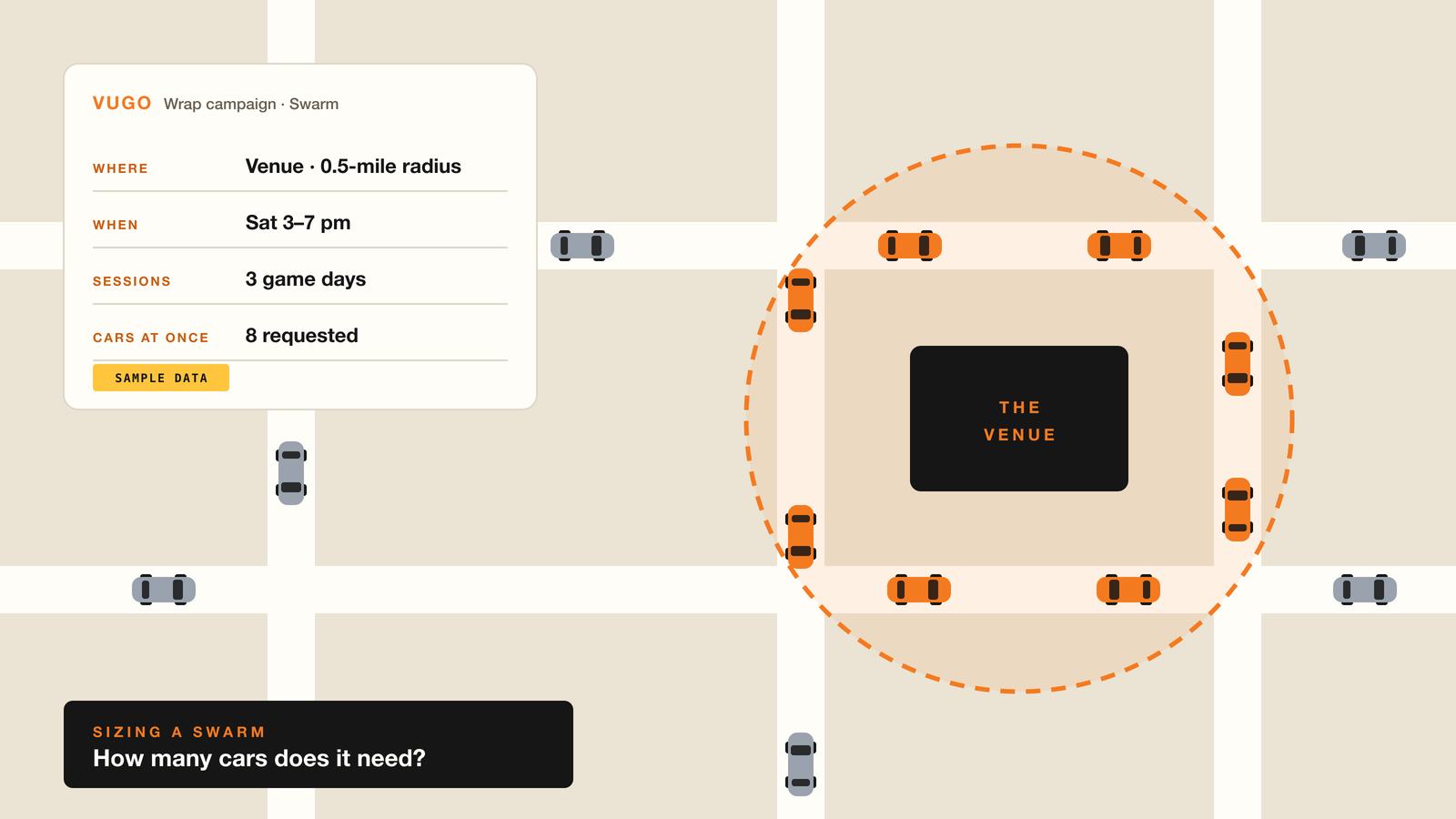
In March we explained how swarms work: you choose a place and a window, and your campaign's wrapped drivers are paid to bring their cars into that zone for the hours you set. The question we hear next is always the same. How many cars do I need?
There's no single number, and anyone who gives you one without asking about your venue is guessing. But there is a way to work it out, and it starts with what you want people to see.
Start with the picture, not the number
Picture the moment. A wall of your brand outside a new store. Your cars at every corner a crowd walks past on the way into a stadium. A wrapped car every few minutes along a festival route. Each of those is a different number of cars, and each one comes from the same simple question: how many places do you want a car to be at the same time?
Count those places, and you have a first answer. Then six things adjust it.
Six things that set the size
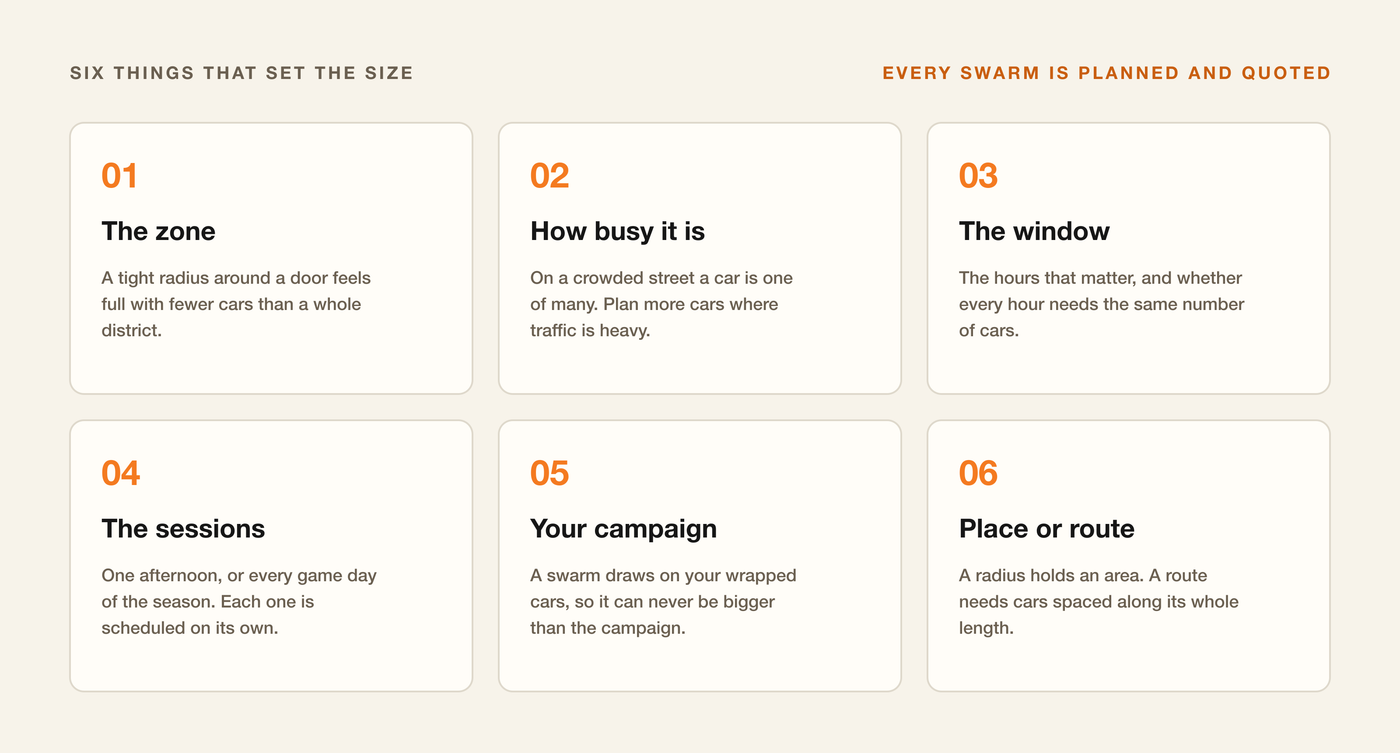
- The zone. A swarm's radius can be anywhere from a tenth of a mile to 10 miles. A tight radius around one door feels full with a handful of cars. A whole stadium district or a downtown core needs many more to look like more than chance.
- How busy it is. On a quiet street a wrapped car stands out. On a packed arterial at rush hour, it's one car of hundreds. Where traffic is heavy, plan more cars, or narrow the zone to the blocks people walk.
- The window. Pick the hours that matter, not the whole day. The hour before the doors open and the hour after the crowd leaves can do more than one long afternoon.
- The sessions. One opening day is one session. Every home game of a season is many. Each session is scheduled on its own, so drivers confirm each one, and the size you need is the size of each session, not the total.
- Your campaign. A swarm draws on the wrapped cars already on your campaign, so it can never be bigger than the campaign. Not every driver will be free for every session, so plan the campaign with room to spare.
- A place or a route. A radius holds an area. A route, like the corridor from a parking garage to an arena or the length of a parade, needs cars spaced along its whole length, in both directions if people walk both ways.
Three worked examples
These are illustrations of the arithmetic, not recommendations or quotes. Your venue, your city and your dates change every number in them, and Vugo plans the real thing with you.
A store opening. You want your brand on the four street faces around a new location for the first two Saturdays, from 10 a.m. to 2 p.m. One car on each face, plus one more on the busiest side, is five cars at once in a tight radius, for two sessions. The campaign carrying them would be larger than five, so that five can confirm on each Saturday.
Game days. A stadium sits in a half-mile radius with six streets that most fans walk in on. Two cars on each is twelve cars at once, for the three hours before kickoff. Over three home games, that's three sessions of twelve cars each, drawn from a campaign that covers the rest of the metro the other days of the week.
A festival route. The route is two miles long, and you want a wrapped car to pass any point on it every few minutes. Spacing cars a quarter mile apart is eight cars moving along the route at a time. If the festival runs both evenings of a weekend, that's two sessions.
Notice what drives each one: the number of places, the hours, and how many sessions. Change any of those and the size changes with it.
What you'll see
Before a session, you see how many drivers have confirmed. During and after it, the coverage map highlights the zone and the time cars spent inside it. That makes the second swarm easier to size than the first: you can see where the cars were and decide whether you need more on one street and fewer on another.
How early to plan
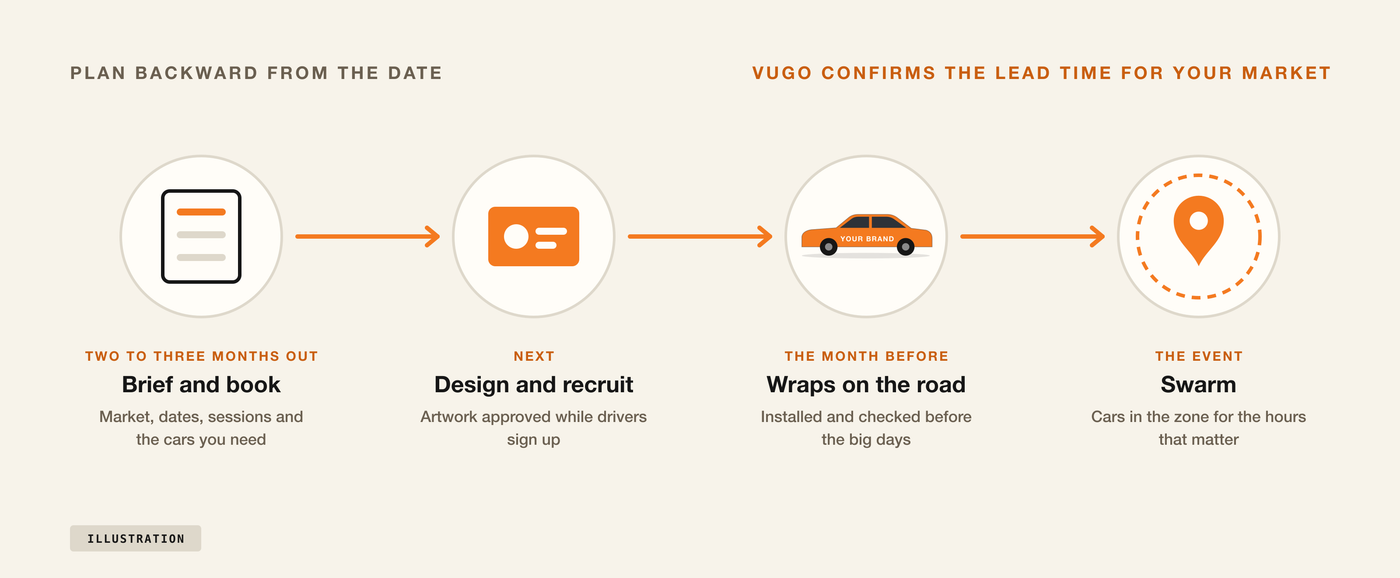
A swarm is the easy part to schedule. The wrap campaign underneath it takes longer, because the cars have to exist before they can gather.
- Drivers are recruited for your campaign, in the market you choose. The earlier you start, the more cars you can have on the road on day one.
- The wraps have to be produced and installed. A Standard Wrap, both sides and the rear window, starts at least 14 days after you submit the artwork. A full or custom wrap takes longer, because the design is fitted to each car. Vugo confirms the lead time for your market.
- Wrap campaigns run two months or more, so a swarm sits inside a longer flight. Here's how to choose its length.
The simple rule: book before the event's month. For a big event, start the conversation two to three months ahead, and earlier still when the whole city will be competing for attention that week. Aim to have the wraps on the road a few weeks before the date, so people have seen your brand around town before your cars gather in one place.
Before you ask for a number
Have these ready, and the conversation with Vugo gets to a plan quickly:
- The place. An address with the radius you have in mind, or the route.
- The dates and hours. Every session, with the hours that matter most.
- The picture. How many places you want a car to be at once, and why.
- The local rules. Some venues and cities limit stopping or staging near events. Plan the zone around them.
- The next step. A short web address or a QR code on the wrap, built for people on foot. Design tips for wraps cover how to make it read at a glance.
When the Bitcoin 2022 conference came to Miami Beach, wrapped cars swarmed the area around the convention center as part of a campaign that also ran rooftop displays and in-vehicle screens. Read how it came together.
Learn more about swarms, or tell us where your crowd will be, and we'll size the swarm with you.