
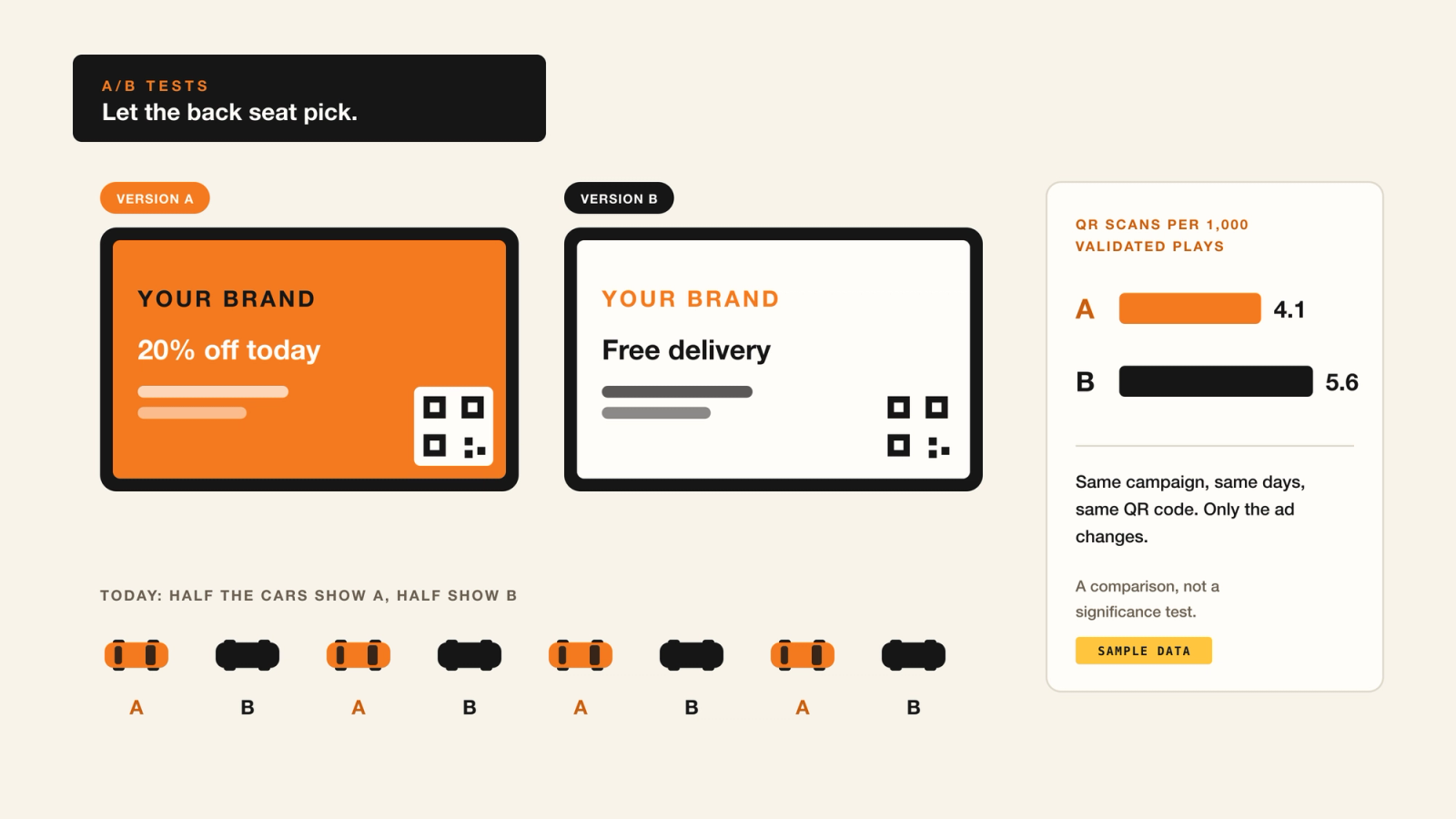
Every advertiser has sat through the meeting. Two versions of the ad, two strong opinions, and nothing to settle it but taste. On Vugo in-vehicle screens you don't have to guess. Run both, and let the people in the back seat show you which one works harder.
How an A/B test works on Vugo
An A/B test splits the cars carrying your screen campaign between versions of your ad. Test two versions, or as many as four, and the split is always even.
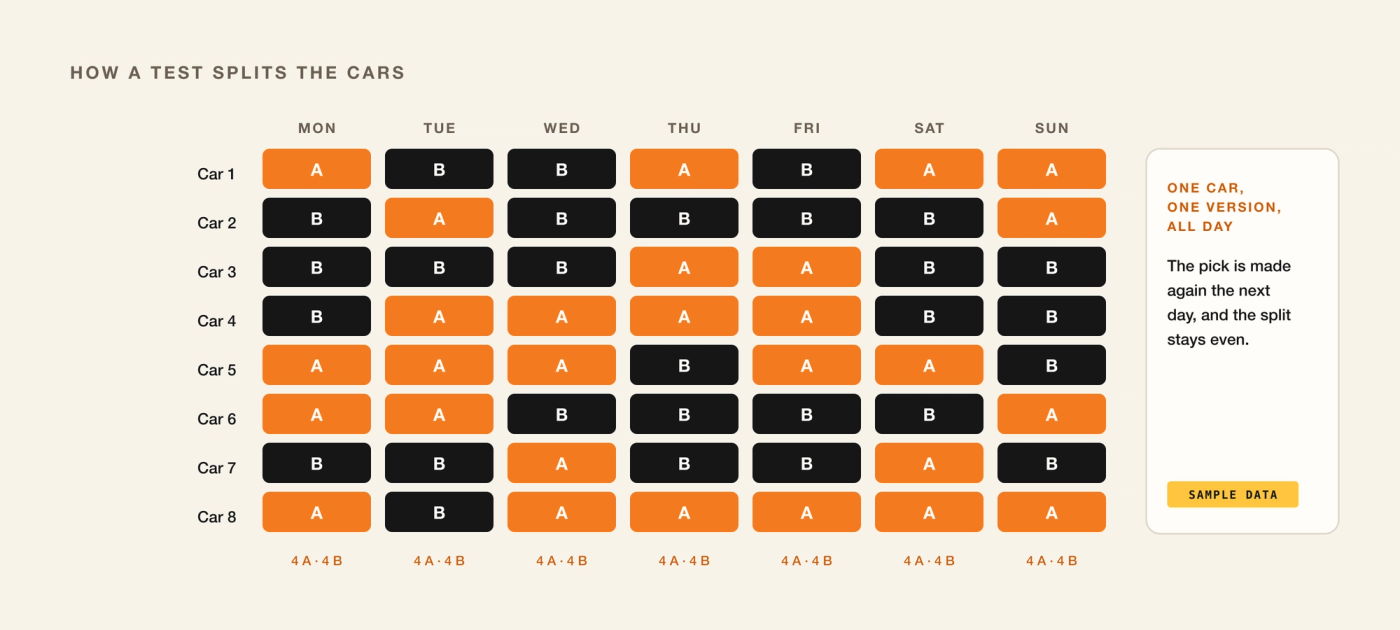
- By car, by day. Each car shows one version for the whole day. The next day the pick is made again, so a car that showed version A on Monday may show B on Tuesday. Over a flight, every version gets a fair mix of cars, neighborhoods and hours.
- Same delivery. A test doesn't change how often your campaign plays. It only changes which version a car shows.
- Same QR code. Every version carries your campaign's QR code and lands on the same page, so scans compare like for like.
- One test at a time. A campaign runs one test at a time, so results never get tangled.
Start one at launch, or on a live campaign
You can build a test into a new campaign: add a second version when you add your creative, and both go to review together. The test starts by itself, split 50/50, the moment both versions are approved, so there's no gap between approval and learning.
Already running? Add another version to a live campaign, from a new upload or from your library, and start a test as soon as at least two versions are approved. On a live campaign you can test up to four versions at once.
Every version goes through the same review as any ad, against Vugo's Content Guidelines, before it reaches a car.
Read the results side by side
While the test runs, your campaign page lists each version with its share of cars and, counted from the moment the test started:
- Served plays: everything that version played.
- Validated plays and the validation rate: plays confirmed in a working car out on the road. Unconfirmed plays are free, on a test as on any campaign.
- QR scans: each one tied to the play that showed it.
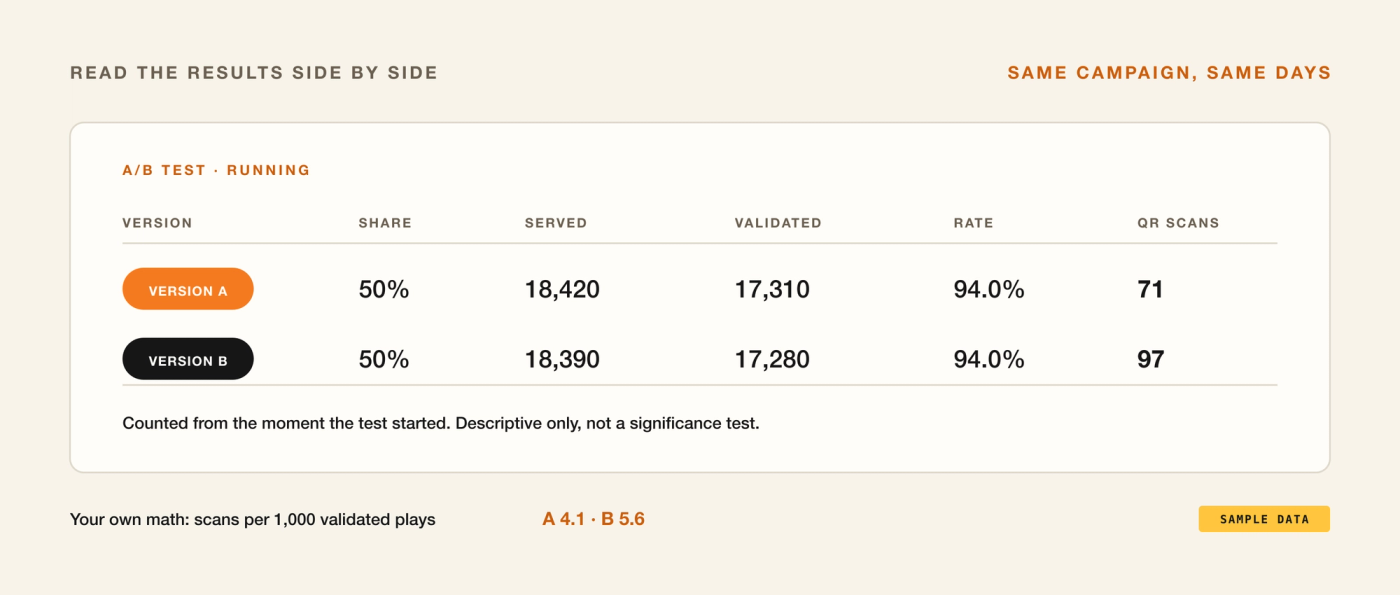
The number that usually decides a screen test is scans for every thousand validated plays. Divide a version's QR scans by its validated plays and multiply by a thousand, and you're comparing versions on the action you asked riders to take, even if one version happened to play a little more than the other.
When you've seen enough, declare a winner. That version goes to 100% of the cars, and the others stop serving and move to Replaced. Nothing is thrown away: the other versions stay in your Library, ready for the next flight. If neither version earned the spot, stop the test and keep both on the campaign.
A comparison, not a lab result
Be clear about what the panel tells you. Vugo's A/B results are descriptive: they show what each version did, side by side, on the same campaign over the same days. They aren't a statistical significance test, and the page says so. Until the test has 100 plays in total, it tells you to let it run.
A few habits keep you from reading too much into noise:
- Give it time. Run a test long enough for every version to see weekdays and weekends, busy hours and quiet ones.
- Watch the gap, not the leader. A lead of a handful of scans can flip in a day. A gap that holds week after week is worth acting on.
- Mind the small numbers. Scans are a much smaller count than plays. If each version has only a few dozen, keep going.
- Leave the test alone. Pausing a version moves its share to the others, which changes what you're comparing. Decide up front how long the test runs, and let it.
What to test
The best tests change one thing. If version B has a new offer, a new opening and a new color, and it wins, you won't know which change did it, or what to carry into your next ad.
Good first tests:
- The offer. A discount against free delivery, or a free trial against a first-month price. The offer is often what turns a glance into a scan.
- The call to scan. "Scan for the menu" against "Scan to book a table". Same page, a different reason to pick up the phone.
- The first seconds. People look up and down from their phones. Put your brand and your promise in the opening seconds of one version, and hold the reveal for the end in the other.
- The length. A 15-second cut against a 30-second cut of the same idea. Screens take videos up to 60 seconds; a test tells you whether the longer story earns its time.
- The words on screen. Captions carry the message in the back seat, so try your key line in bigger type, or on screen for longer.
Test the thing you'd argue about in the meeting. Then the next meeting starts with an answer.
Make the winner count
A test is only as good as what you do next. Carry the winning idea into your next flight, and test the next thing against it: the winner of round one becomes version A of round two. Over a few campaigns, that's how an ad gets steadily better instead of starting from scratch every time.
For more on building creative that lands in the back seat, see the ad specs and creative guide, how QR codes and UTM tracking work and what Vugo tracks on every campaign.
See how in-vehicle screens work, or talk to us about testing your next campaign.