
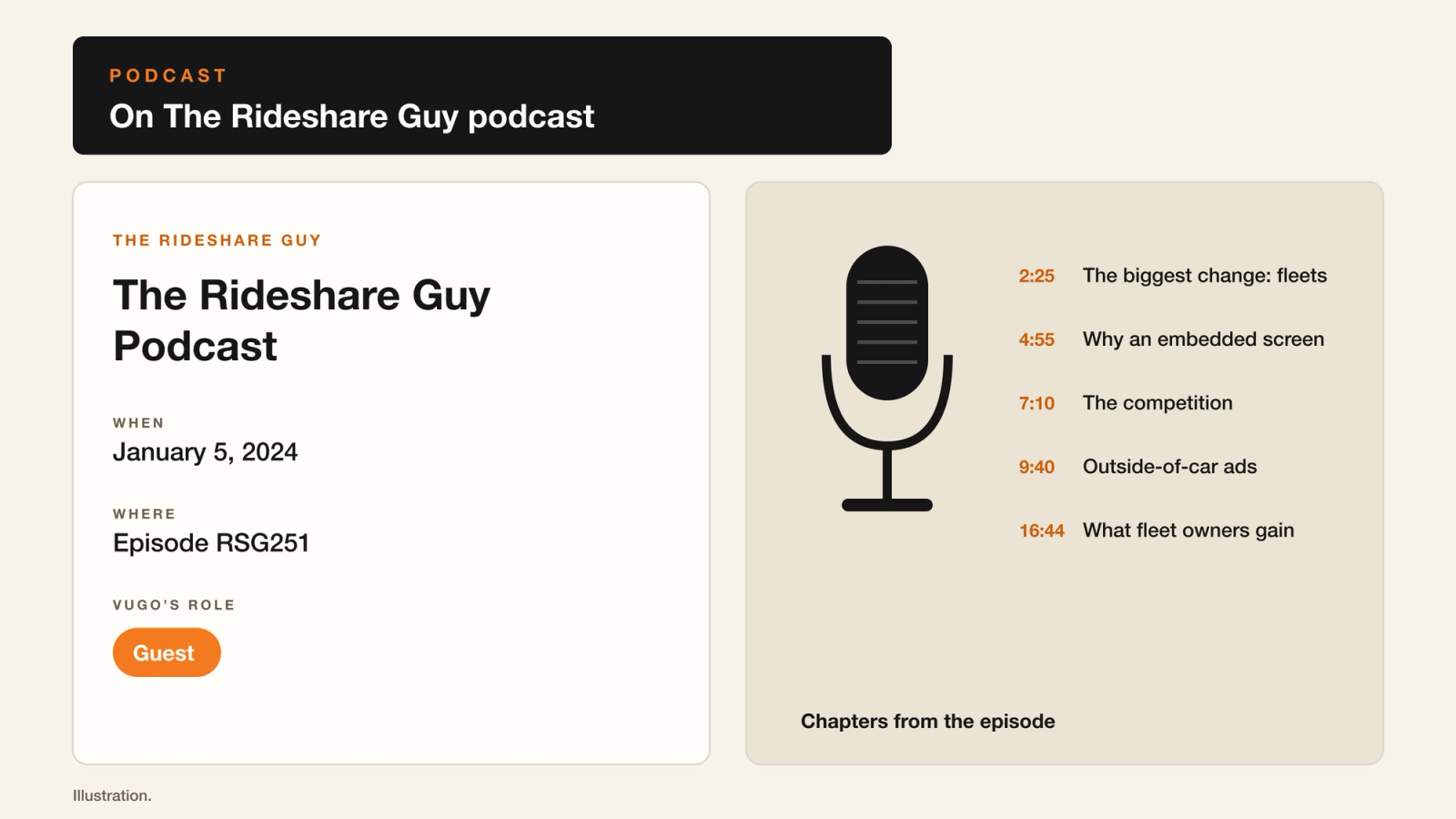
Back in 2015, my co-founder James Bellefeuille sat down with Harry Campbell for one of the early episodes of The Rideshare Guy podcast. Last week, I got to go back. Episode 251 is about how Vugo helps fleet owners earn more, and it covers a lot of what's changed since then.
Where it started
Vugo began with a menu. James was driving rideshare at night in Chicago and working at an ad agency by day when a friend who ran a restaurant gave him a menu to put in the back seat. Around lunch and dinner, riders kept picking it up, and some asked to go to the restaurant instead. Riders in the back seat could be influenced, and the moment mattered. That idea became Vugo.
Our first episode, in 2015
James told the story first, on The Rideshare Guy in October 2015, a few months after we launched. It's a good listen if you want to hear where Vugo began.
A note on the 2015 episode: it describes Vugo's driver program as it was in 2015, and that program is out of date. How drivers join, what they carry and how they're paid have all changed since. For how it works today, see Vugo for drivers.
From drivers to fleets
The biggest change since our first episode is who we work with. Drivers are still at the center of everything, but today we work with fleet owners to bring whole fleets onto the platform at once: taxi fleets, companies that lease cars to rideshare drivers, municipal fleets and non-emergency medical transportation fleets. If you lease your car, ask your fleet about us.
Why we built an embedded screen
We started, like a lot of companies, with a tablet strapped to the back of a headrest. It works when everything goes right. But tablets come unplugged, get knocked loose on a bumpy road, or walk off with a passenger on a Saturday night, and every one of those problems lands on the driver.
So we built a fully embedded display. It takes the place of the rear headrest, powers on with the car and stays part of the car. The driver just drives.
The state of the industry
When Vugo started, there was nothing like it in rideshare. Now there are several companies in the space, and that's good for everyone: out-of-home is growing, and more fleets, automakers and ride services are paying attention.
The way I see it, it'll work like airlines. Everyone flies the same planes, but some give you a great screen and some don't, and you notice the difference. Vugo is independent, so a fleet can use it across Uber, Lyft and its own dispatch, and the screen keeps working whichever platform the trip comes from.
We also talked about ads on the outside of the car. They're seen by more people, and they're a great way to build visibility, while the screen inside can be more targeted. Both have a place.
What fleets gain
The first benefit is revenue: advertising that helps a fleet offset costs like insurance and maintenance. But the screen does more than ads. It can take payments, collect the signatures non-emergency medical transportation requires, and carry the fleet's own messages to its riders.
What comes next
Eventually, more of the ride will be autonomous. When nobody in the car is driving, people will spend that time with media, and in a self-driving car the screen is also how a vehicle talks to its passengers when something goes wrong. That's the passenger economy we're building for.
Closer to home, we talked about our partnership with Renault in Europe and the new things coming to our in-vehicle passenger companion in North America.
Thank you to Harry for having us back. Read about Vugo at the Paris Motor Show, our pitch on the future of infotainment, or get in touch.