
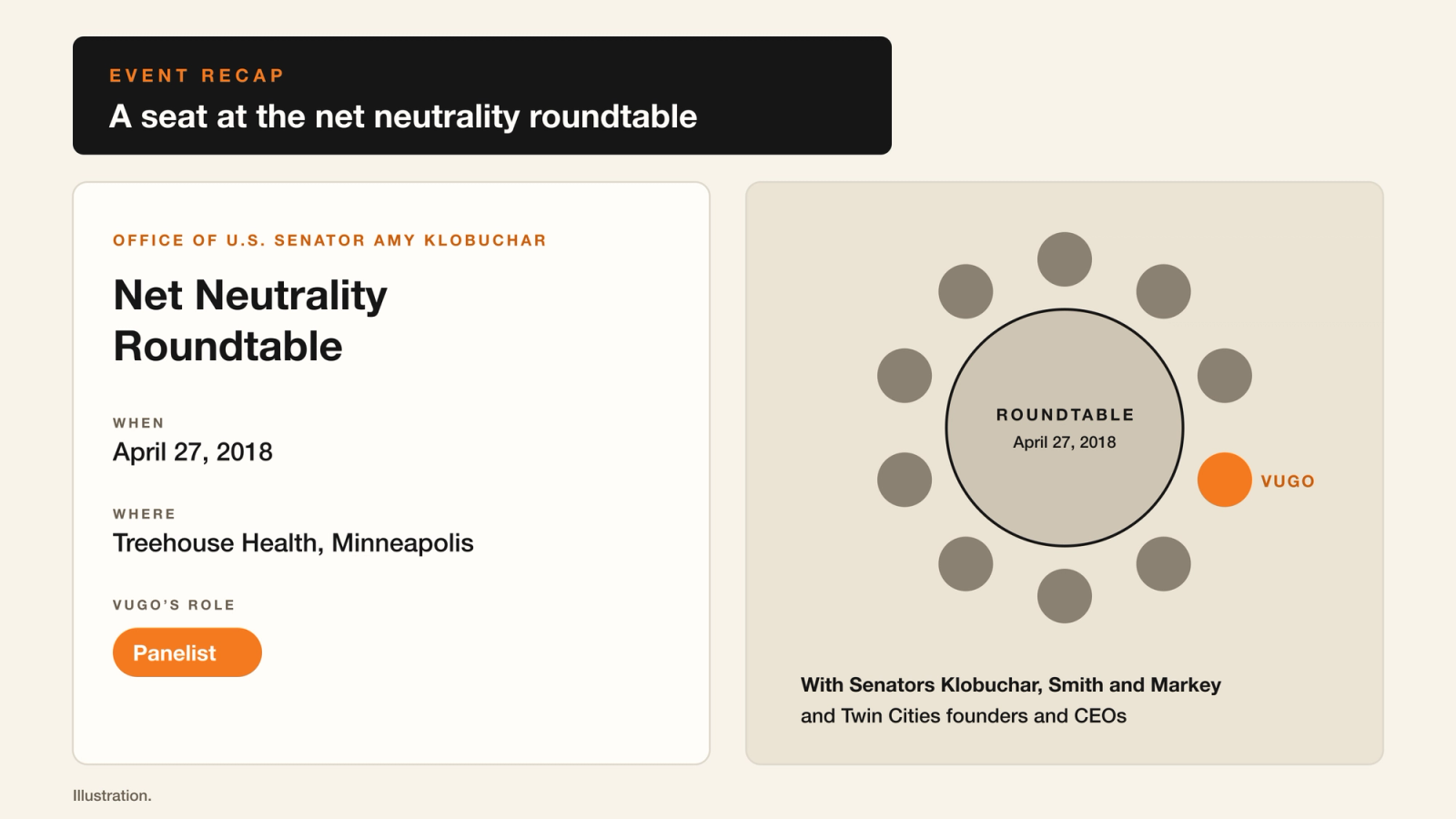
Last Friday, April 27, I joined a roundtable on net neutrality in downtown Minneapolis, at the offices of Treehouse Health. Senator Amy Klobuchar's office invited Vugo to take part, and the table brought together Senators Klobuchar and Tina Smith of Minnesota and Senator Ed Markey of Massachusetts with founders, CEOs, experts and advocates from across the Twin Cities tech scene.
What the roundtable was about
Last December, the Federal Communications Commission voted to repeal its net neutrality rules, the rules that required internet providers to treat all content equally. Without them, a provider can block, slow down or speed up service to particular websites and apps.
Senator Markey is sponsoring a resolution under the Congressional Review Act to overturn the FCC's decision. At the roundtable, he and Senator Klobuchar talked through where it stands: it needs one more vote in the Senate, then has to pass the House and go to the president.
Most of the time, though, belonged to the people around the table, who talked about what the change would mean for their own work. A founder of an online marketplace explained how a slower site can cost a small company its sellers to a bigger rival. An e-learning director from the University of Minnesota pointed to research showing people leave for larger platforms when a page takes more than five seconds to load.
Why it matters to Vugo
Vugo lives on the network. Every screen we put in front of a back seat streams its entertainment and its advertising over cellular data, in cars that are moving through a city all day. When a video loads instantly, the passenger watches it. When it stalls, they look away.
That's why equal treatment matters to a company like ours. An open network means a startup's video loads as fast as anyone else's, and the best experience wins. Without it, the speed of a service can depend on a deal with whoever owns the connection, and that favors the companies that can afford to pay, or the provider's own services.
It matters even more for where cars are going. The car is becoming one of the most important connected devices people own, and one day, as self-driving cars arrive, the back seat will be a place people spend real time with media. We think that time can help pay for transportation itself; it's the case we've made for free transportation. That only works if the people in the car can reach the best services, not just the ones that paid for a faster lane.
Thank you
Thank you to Senator Klobuchar's office for inviting Vugo, to Senators Klobuchar, Smith and Markey for taking the time to listen, to Treehouse Health for hosting, and to everyone around the table. It's not every day a startup gets a seat at a table like that, and we were glad to bring the view from the back seat.
See what we learned at the Detroit auto show this year, read our guide to rideshare advertising, or get in touch.