
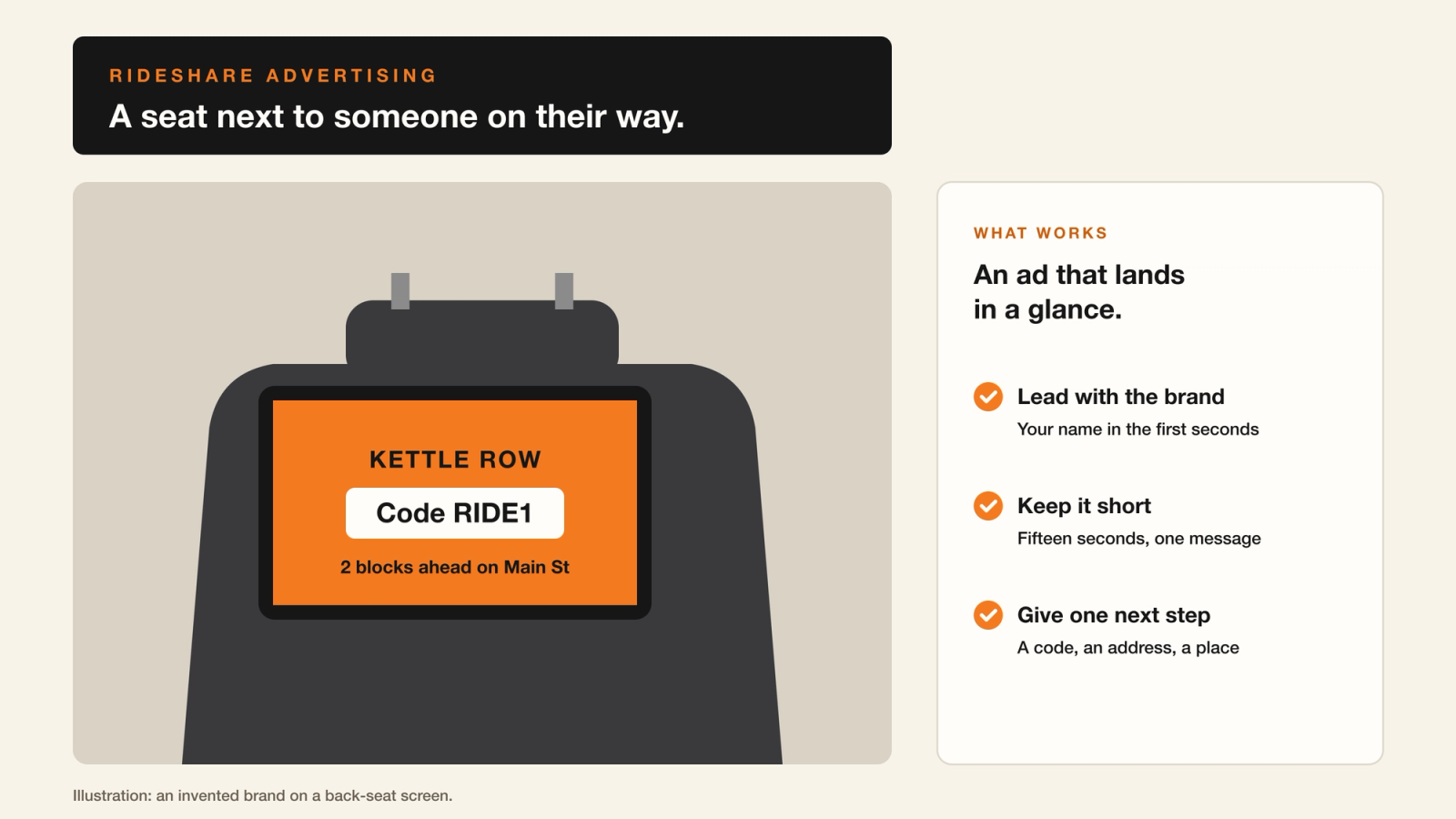
Think about the last time you took an Uber or a Lyft. You gave the driver your destination, said hello, and then sat in the back seat for twenty minutes or so with nothing in particular to do. Maybe you looked at your phone. Maybe you looked out the window.
That's the opportunity in rideshare advertising. It's one of the few places left in a city where people sit still, in a quiet, clean space, with a few minutes to spare. For a brand, it's a seat next to someone who's on their way somewhere.
What rideshare advertising is
Rideshare advertising puts media inside the cars people hail from an app. At Vugo, that means a screen facing the back seat, on a car driven by an Uber, Lyft or other rideshare driver. Riders get free entertainment, like short videos, with ads mixed in. Drivers earn extra income from the advertising, on top of their fares. And brands get a screen in front of the back seat, in the cities where they want to be seen.
Because the screen is in a car, the media can fit the context of the ride: the city, the time of day, where the car is and where it's headed. A Friday-night ad for a bar downtown and a Tuesday-morning ad for a coffee shop near the office can run on the same screen, each at the moment it makes sense.
Who's in the back seat
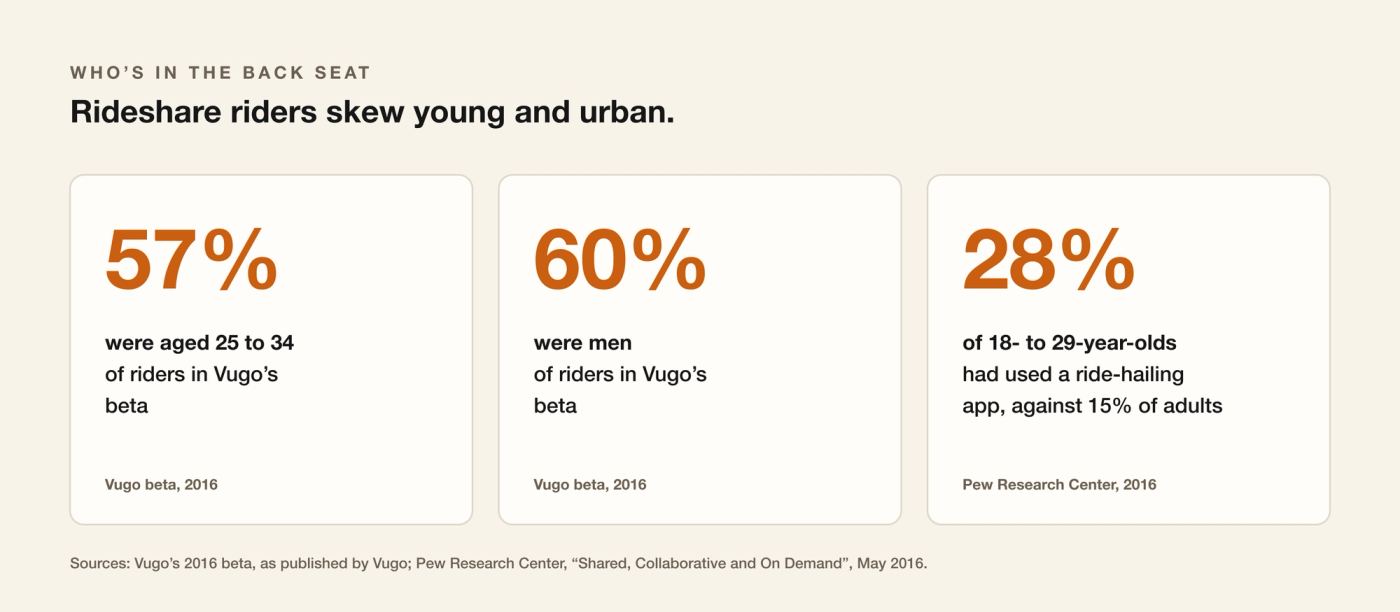
Rideshare is still new, and the people using it are a specific group. In Pew Research Center's 2016 survey, 15% of American adults had ever used a ride-hailing app like Uber or Lyft. Among 18- to 29-year-olds, it was 28%. Urban residents were seven times as likely to have used one as rural residents: 21% against 3%.
Vugo's own beta told the same story. Across tens of thousands of rides in 2016, 57% of riders were aged 25 to 34, and 60% were men. Los Angeles was the busiest market of all, helped by the airport. Here's what else we learned.
That's a hard audience to reach elsewhere. Young, urban professionals are the people most likely to skip TV ads, block banners and stream music without commercials. In the back seat, they're a few feet from a screen, often on their way to spend money: dinner, a show, a hotel, a night out.
Why the back seat works
- Attention. A rider isn't driving, and there's no feed to scroll past the screen. An ad in the back seat isn't one of a hundred on a page.
- Context. People in a rideshare are going somewhere: to the airport, to dinner, to a meeting, home. An ad that fits where they're headed feels useful, not intrusive.
- Local by nature. Every car is in a real city, on real streets. A brand can run in one city or many, and a local business can be in front of the people driving past its door.
- Close to the decision. Many rides end at a restaurant, a bar, a store or a hotel. An ad seen on the way can be acted on minutes later.
How to make an ad that works in the back seat
A screen in a car isn't a TV. People glance up and look away, so the ad has to work in a glance.
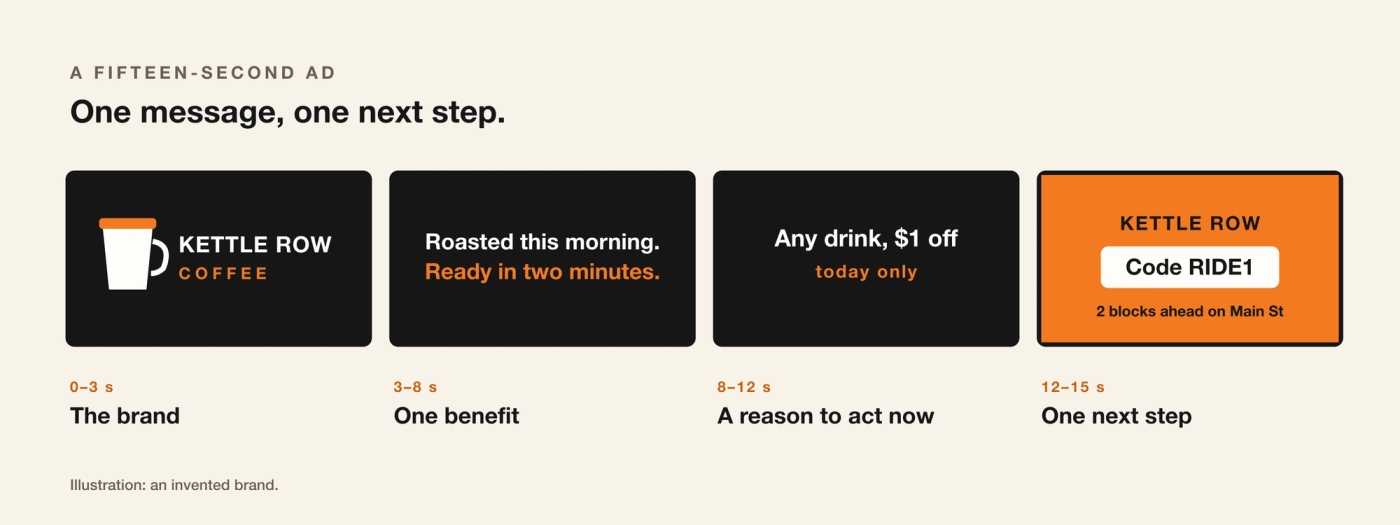
- Lead with the brand. Put your name and your product on screen in the first seconds, in case that's all someone sees.
- Keep it short. Fifteen or thirty seconds is plenty. One message, not three.
- Write it for the screen. Big, readable text and simple visuals work better than small print and fast cuts.
- Make it local. Name the city, the neighborhood or the venue. "Two blocks from here" beats "nationwide".
- Give one next step. A short web address, a promo code to use at the counter, or a place to go. Pick one and make it easy to remember.
How to know it worked
Rideshare advertising can be measured like other local media, if you plan it before launch.
- A promo code used only in the car shows which sales came from it.
- A short web address used only on the screen counts the people who went looking.
- A test market tells you more than a gut feeling: run the campaign in one city, hold back a similar one, and compare your sales or sign-ups over the same weeks.
What to ask a rideshare advertising vendor
- Where do the screens run, and in which cities? Ask for the markets, not a national total.
- What do riders see besides ads? Riders stay engaged when there's something worth watching. A screen that's all ads gets ignored.
- How do you choose which ad plays when? Context, like the time of day and the neighborhood, is what makes the back seat work.
- How do drivers take part? A driver who earns from the screen keeps it charged, clean and on.
- What reporting will I get? Know what you'll see before the campaign starts.
The road ahead
Rideshare is still growing, and the time people spend in the back seat is growing with it. As cars become more connected, and one day drive themselves, the ride becomes time people spend as passengers rather than drivers. The brands that learn to use that time well now will be ready for it.
See in-vehicle screens, read about who rides, or talk to Vugo about your city.