Most video ads are made for a TV with the sound on. A voice explains the offer, music sets the mood, and the picture fills in the rest.
Vugo's in-vehicle screens can play sound, but the message can't depend on it. The video loops on a screen in the back of a working car out on the road, and it has to come across even if no one hears a word. That's not a limitation so much as a different brief, and the ads that follow it work better for it.
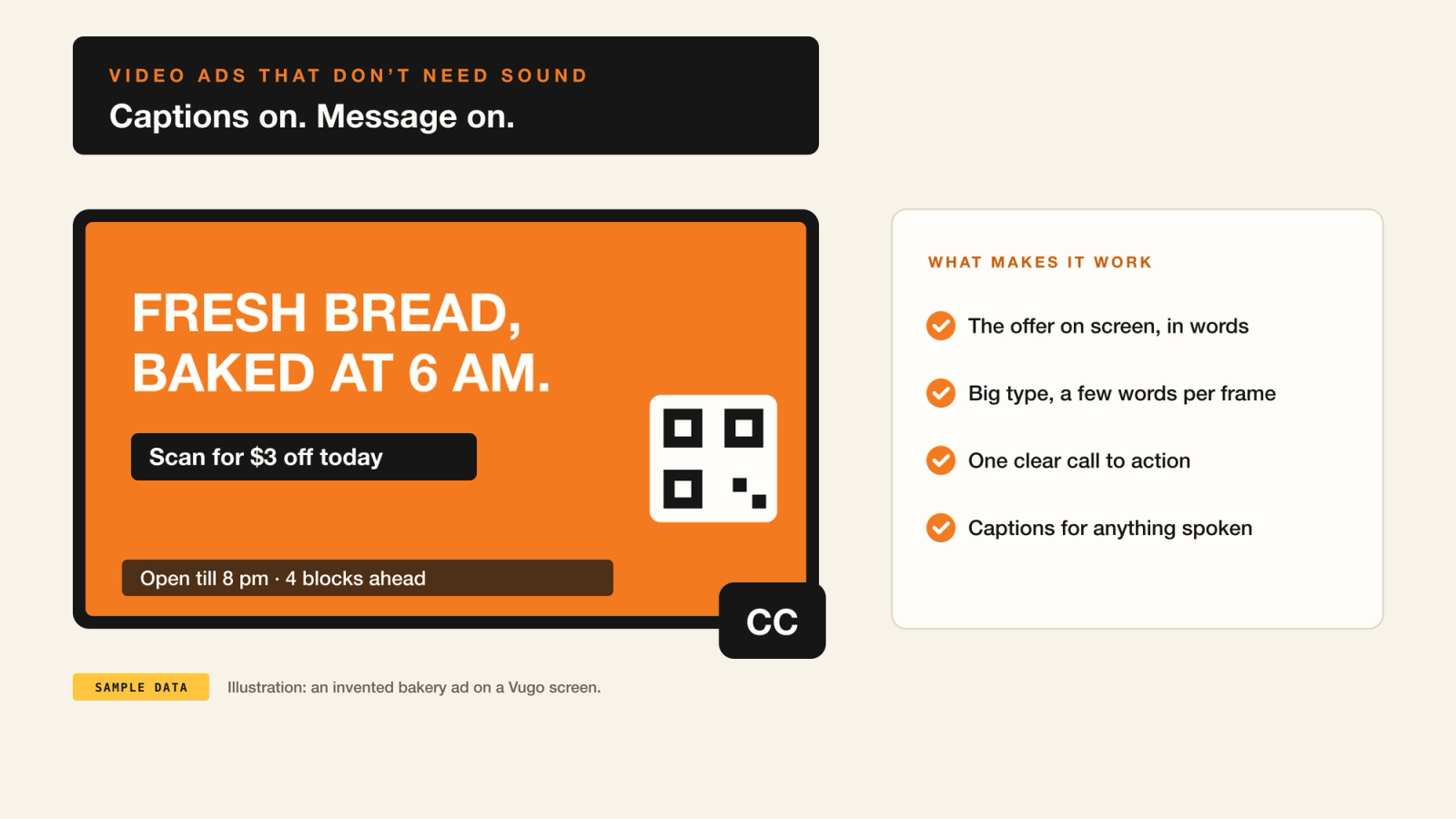
Say it on screen
If the offer only lives in the voiceover, it doesn't exist in the back seat. Everything that matters has to be on screen, in words:
- The brand, large and early.
- The offer or the one thing you want people to know, written out, not implied.
- The call to action, spelled out: "Use code RIDE3 for $3 off", "Scan for tickets", "Search Brightside Bakery", "Two blocks ahead on Main".
If someone is speaking in your video, caption it. If the story depends on the dialogue, it's the wrong cut for the back seat.
The first three seconds
The screen is right there, but attention still has to be earned. Lead with the brand and the offer in the first few seconds, before the story, the mood shot or the logo animation. If someone looks up for three seconds and looks away again, they should still know who you are and what you're offering.
Big type, a few words per frame
A back-seat screen is closer than a TV, but it's smaller, and the car is moving. Write for a glance:
- A few words per frame. Five or six words on screen at once is plenty.
- Large text with strong contrast. White on a dark or saturated background reads; thin type over busy footage doesn't.
- Hold each frame. Leave each message up long enough to read twice before you cut.
A storyboard that works
Here's one way to lay out a 30-second spot. Shorter works too; the order matters more than the length.
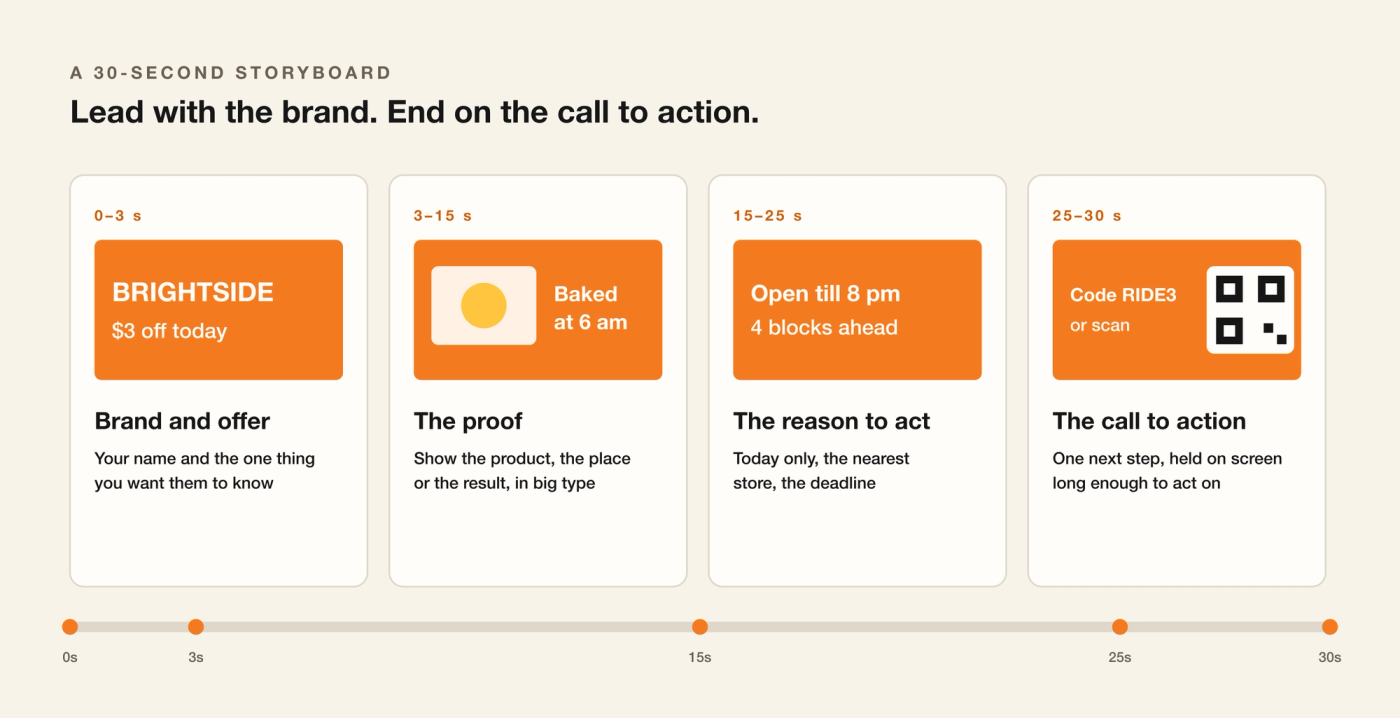
- 0–3 seconds: brand and offer. Your name and the one thing you want them to know.
- 3–15 seconds: the proof. Show the product, the place or the result, with a few words of big type.
- 15–25 seconds: the reason to act. Today only, the nearest location, the deadline.
- 25–30 seconds: the call to action. End on the one thing you want people to do, and hold it on screen long enough for them to do it.
End on one call to action
An ad people enjoy but don't act on is only half an ad. Decide what you want someone in the back seat to do next, and make that the last thing on screen.
There's more than one way to ask:
- Scan a QR code. Every Vugo ad carries one, generated from the landing page you choose, so you don't have to design your own. It's the quickest step for someone with a phone already in hand.
- Use a promo code. "Use code RIDE3 for $3 off" works at the counter, at checkout or in your app, and a code used only on Vugo shows you which sales came from the car.
- Visit a web address, or search for you. A short, easy address, or one simple thing to search for, is something people can remember after they've left the car.
- Go somewhere. "Open till 8 pm, four blocks ahead" turns a nearby rider into a visitor.
- Download, book or call. For an app, a reservation or an appointment, name the action and make it one step.
In Nielsen's 2019 Out-of-Home Advertising Study, 20% of smartphone owners had already scanned a QR code, tapped an NFC tag or sent a text in response to an out-of-home ad. People act on ads they see out in the world when you give them a clear way to do it.
A few rules make any call to action work better:
- Pick one. One clear ask beats three competing ones. The QR code can sit alongside it, but lead with the step you care about most.
- Make it specific. "Use code RIDE3 for $3 off today" beats "Learn more".
- Make it easy from the back seat. Short codes, short addresses, nothing long to type or remember.
- Match the next step to the ad. If the ad promises $3 off, the page, the code or the counter should deliver $3 off.
- Make it countable. With UTM tags on, every scan shows up in your own analytics. A code or a web address used only on Vugo tells you the rest.
The specs
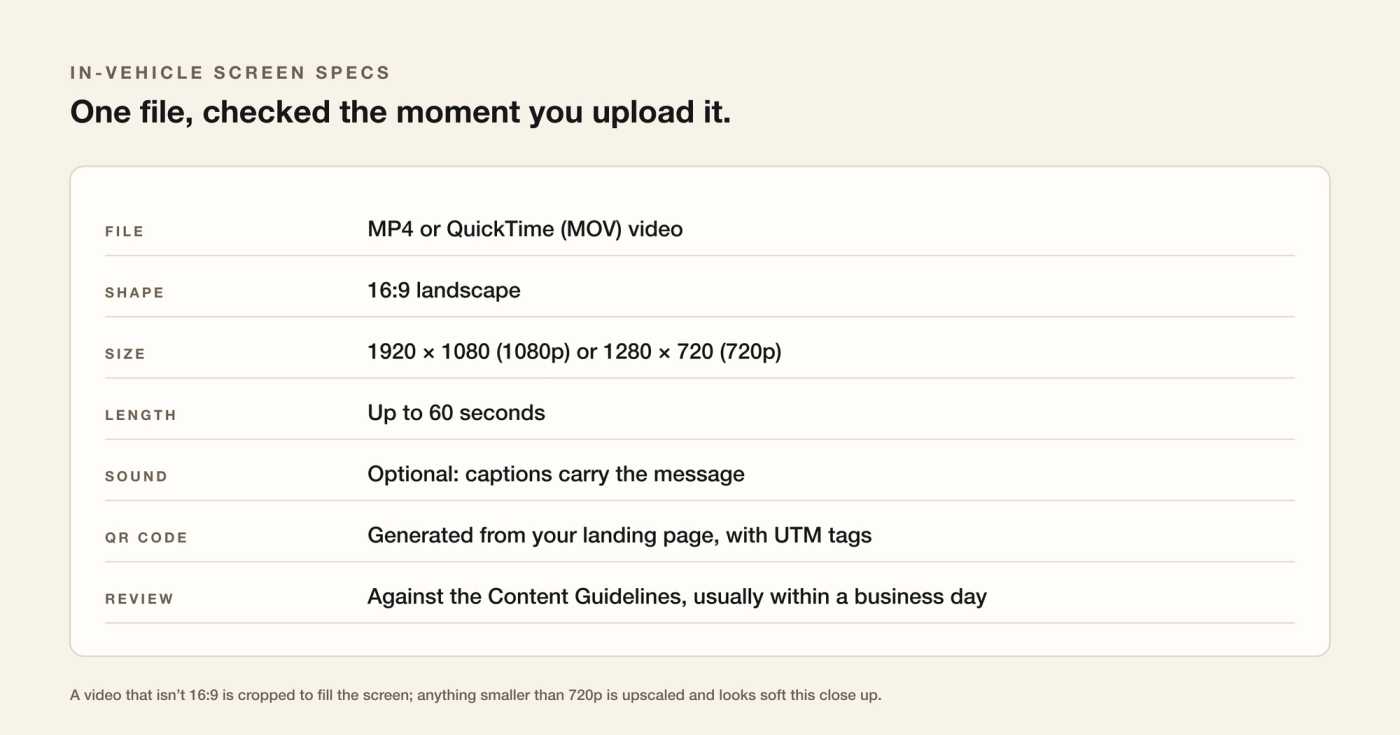
- File: MP4 or QuickTime (MOV) video. A still image never plays, so export a design as a video.
- Shape and size: 16:9 landscape, 1920 × 1080 or 1280 × 720. Another shape is cropped to fill the screen, and anything smaller than 720p is upscaled and looks soft this close up.
- Length: up to 60 seconds.
- Sound: optional. Captions carry the message.
- Review: every ad is reviewed against Vugo's Content Guidelines, usually within one business day.
Re-cut, don't reuse
If you already have a TV or streaming spot, you don't need to start over. Re-cut it for the back seat: move the brand and the offer to the front, add on-screen text for anything the voiceover said, hold the frames longer, and end on the call to action.
Then test it. Add a second version, with a different offer, opening or call to action, and see which one earns more responses: scans, codes used or visits. Swap in a new version any time; it goes through review and reaches the cars on their next update.
See the full ad specs, learn how in-vehicle screens work, or talk to Vugo about your next video campaign.