
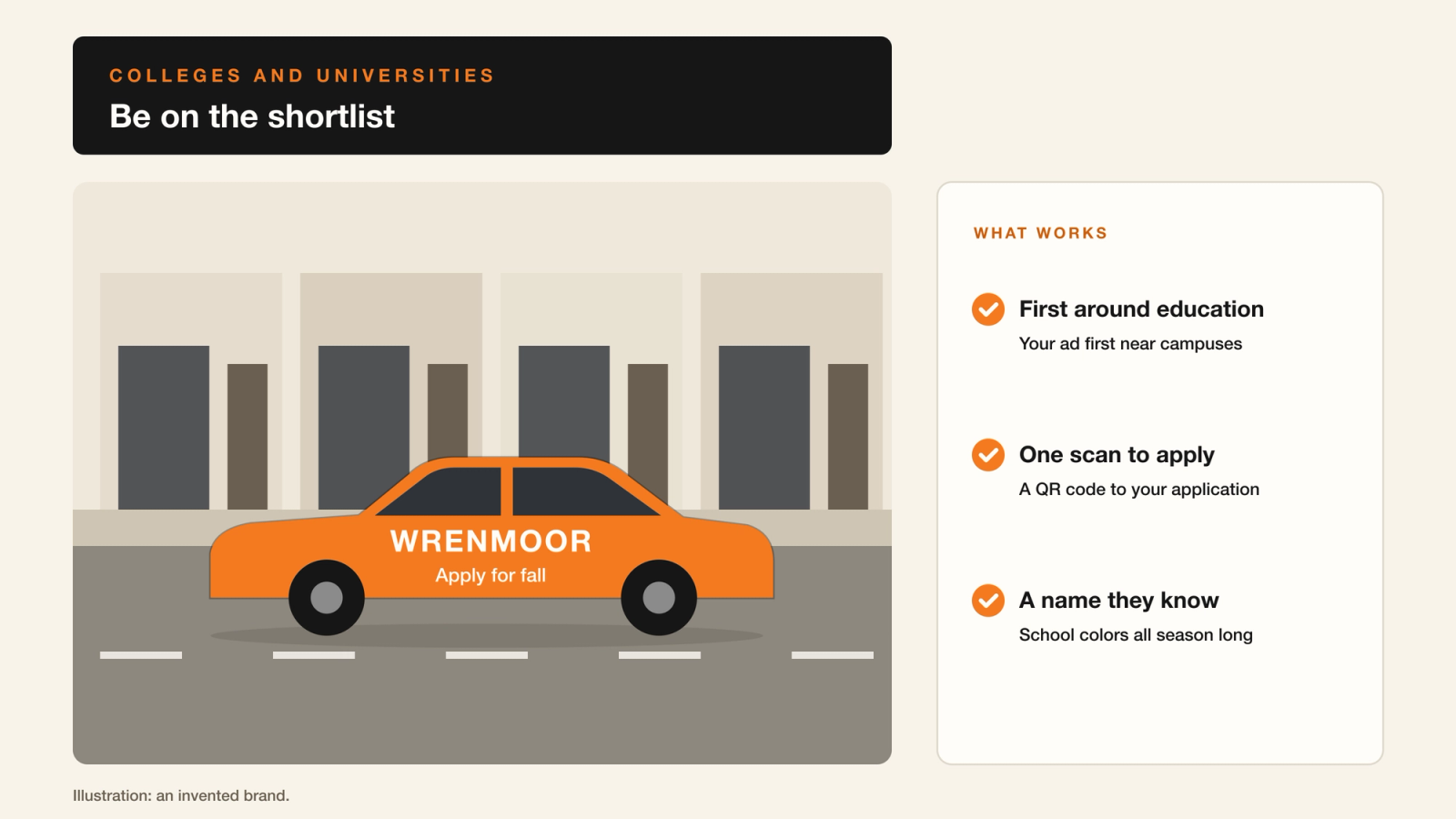
On paper, the fall class looks settled by July. In practice it isn't. Some admitted students never show up in August, the thing admissions offices call summer melt. Community colleges, career schools and certificate programs are still enrolling right up to the first day of class. And the adults weighing a program this year are deciding on their own schedule, not on a national deadline.
The students are out there. The National Student Clearinghouse's spring 2026 report, published last month, counted 15.5 million undergraduates, up 1.3% from a year earlier, with certificate programs growing fastest of all, up 10.2%.
The schools that win the late summer are the ones people already know, and the ones that make the next step easy.
Why cars fit enrollment
- Enrollment is local. Community colleges and career schools draw from the commute around them, and even a school that recruits nationally has home metros it can't afford to lose. Rideshare, taxi and delivery cars spend the day on those streets.
- The decision takes months, then comes due. A name seen all season is on the shortlist when the deadline arrives. A screen ad in the final weeks is the reminder to act.
- The next step is a phone. In Nielsen's 2019 Out-of-Home Advertising Study, 42% of smartphone owners had searched for an advertiser after seeing an out-of-home ad. A QR code skips the search and opens your application.
- Families ride too. Parents, partners and employers help make the decision, and they're on the same streets.
What each format does for a school
In-vehicle screens. Screens are available by market and running in market today. Your ad is a short, captioned program spotlight with a QR code generated from your application or visit page. TripIntent® puts your ad first in cars around education, and when the driver's destination is a campus. It's a priority, never a filter: your ad still plays everywhere else your campaign is set to run. Here's how to make video work without relying on sound.
Vehicle wraps. School colors on the street for a whole enrollment season. A full or partial custom wrap is designed with Vugo and the wrap shop. A Standard Wrap covers both sides and the rear window, is bought in Vugo Platform and starts at least 14 days after you submit. Wraps are recruited per campaign in most U.S. metros, so you can cover every metro your students come from, and they run two months or more.
Swarms. For the days that matter on your own campus, an open house, a visit day, orientation, a swarm brings the campaign's wrapped cars into a zone around your campus for the hours you schedule.
Wraps are priced per car per month, and screen campaigns are budget-based. Every campaign is quoted for its markets and dates, so a single campus and a statewide system can both start where it makes sense for them.
Five plays for colleges and universities
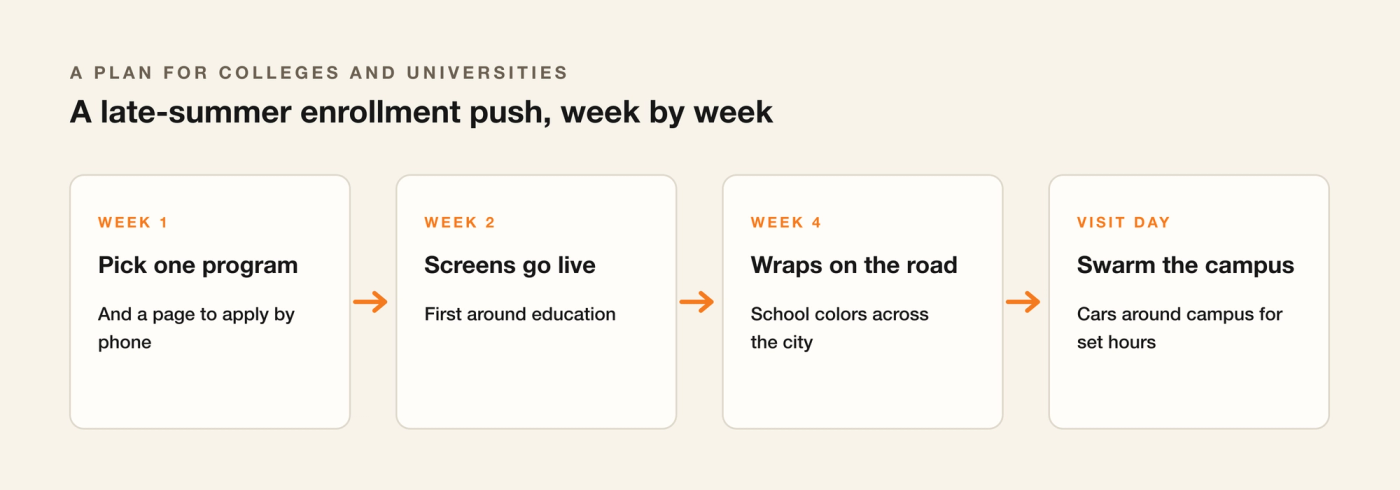
- The late-summer push. From now until classes start, run a screen ad with one message, "Fall classes start August 31" or "There's still time to apply", and a QR code to the application. Screens can start within days, which makes them the format for a push that has to happen this month, and TripIntent puts the ad first around campuses, where people are already thinking about school.
- Open house in force. Swarm the blocks around your campus on visit day, and run a screen ad in the weeks before with a QR code to sign up. Prospective students and their families arrive to a campus that's already part of the street, and the ones who haven't signed up yet have a reason to.
- One program at a time. A nursing assistant certificate, an evening MBA, a welding program, a transfer pathway. One program per ad reads better than a list of majors, and it speaks to the adult learner who's looking for exactly that program.
- Always on for the next intake. Spring starts in January, and the students who'll enroll then are deciding this fall. A wrap campaign that runs through the season keeps your name on the shortlist. American Career College runs Standard Wraps on cars across Los Angeles to keep its healthcare training programs in front of prospective students all year.
- Every metro, one plan. A school that recruits across a region, or an online program with students everywhere, can run wraps in each metro in a single flight, and add screens where they're running.
Keep it true
Vugo reviews every ad against its Content Guidelines before it runs, and ads must be truthful. If your ad quotes an outcome, a graduation rate, a job placement figure, a starting salary, make sure it's one you can back up.
Before you start
Settle these first, and the rest of the campaign follows:
- The program or audience to lead with. One per ad.
- The metros your students come from. That's where wraps are recruited and where screens run.
- Your dates. Application deadlines, open houses and the first day of class, so the flights line up with them.
- A page that works on a phone. Give the QR code its own landing page, an application or visit sign-up, so you can see exactly what came from the car.
- How you'll judge it. Scans, inquiries and applications, in your own admissions system.
See higher education on Vugo, learn about in-vehicle screens, vehicle wraps and swarms, or talk to Vugo about your next intake.