
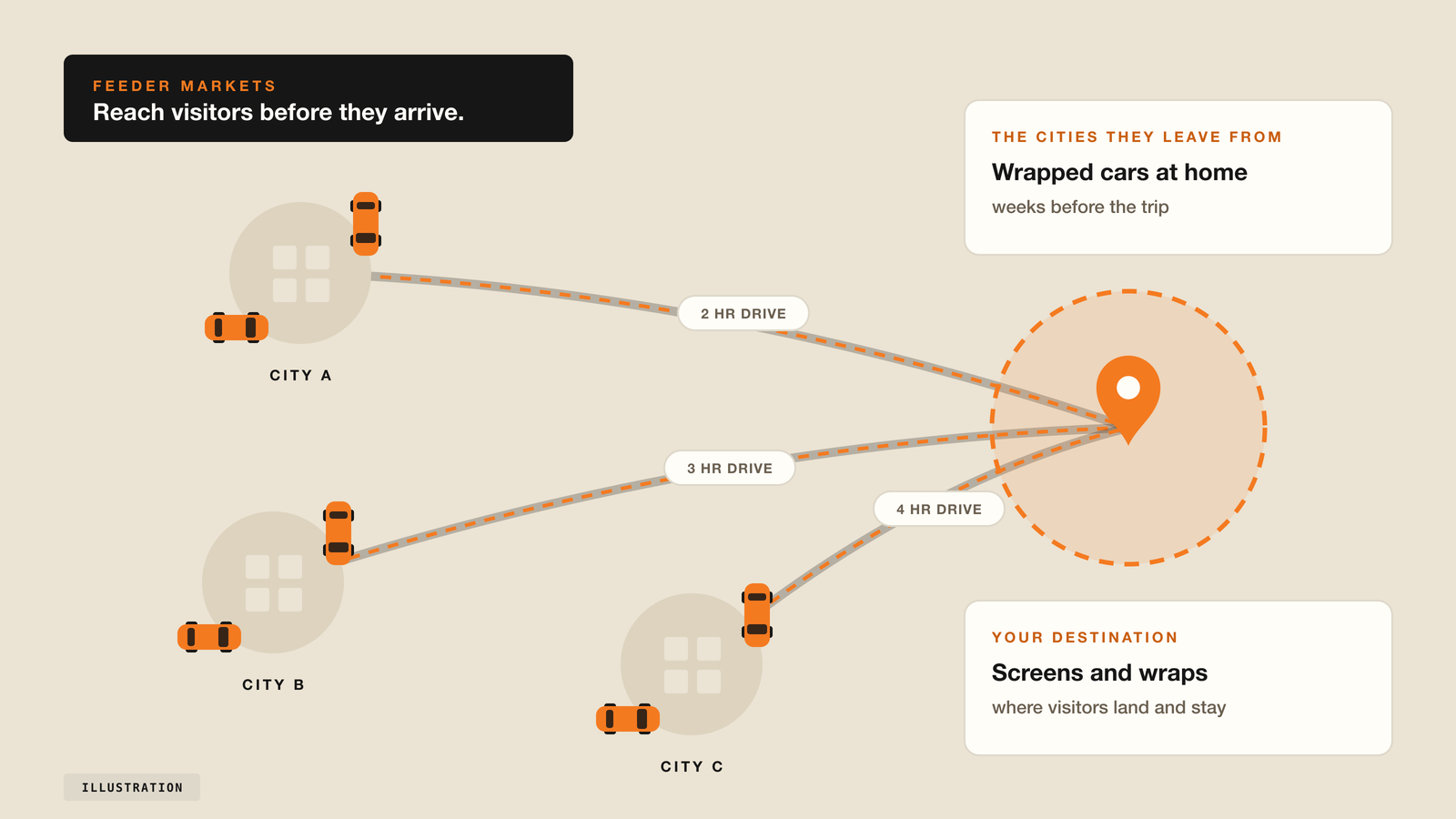
Most tourism advertising waits for the visitor to show up. A sign at the airport, a brochure in the hotel lobby, a billboard on the way into town. By then, the big decision is already made: they've chosen where to go, and often where to stay.
The decision happened weeks earlier, at home, in a city a few hours away. That's where a feeder-market campaign puts your brand.
Most visitors drive
For a lot of destinations, the visitors who matter most aren't flying in from across the country. They're driving in from the cities within a day's reach: the metro two hours away, the college town three hours away, the next state over.
The numbers show how much travel is on the road. AAA forecast that 122.4 million Americans would travel 50 miles or more from home over the 2025 year-end holidays, and that 109.5 million of them would go by car, in its forecast published December 10, 2025. For the Independence Day week in 2025, AAA forecast 72.2 million travelers, 61.6 million of them by car and 5.84 million by air (June 20, 2025). These are forecasts of domestic leisure trips, not counts, but the pattern is the same at every holiday: most people going somewhere are driving there.
The cities those drivers leave from are your feeder markets. Every tourism board and resort knows its own: it's where the license plates in the parking lot come from, and the home ZIP codes in the booking system.
Two ends of the same campaign
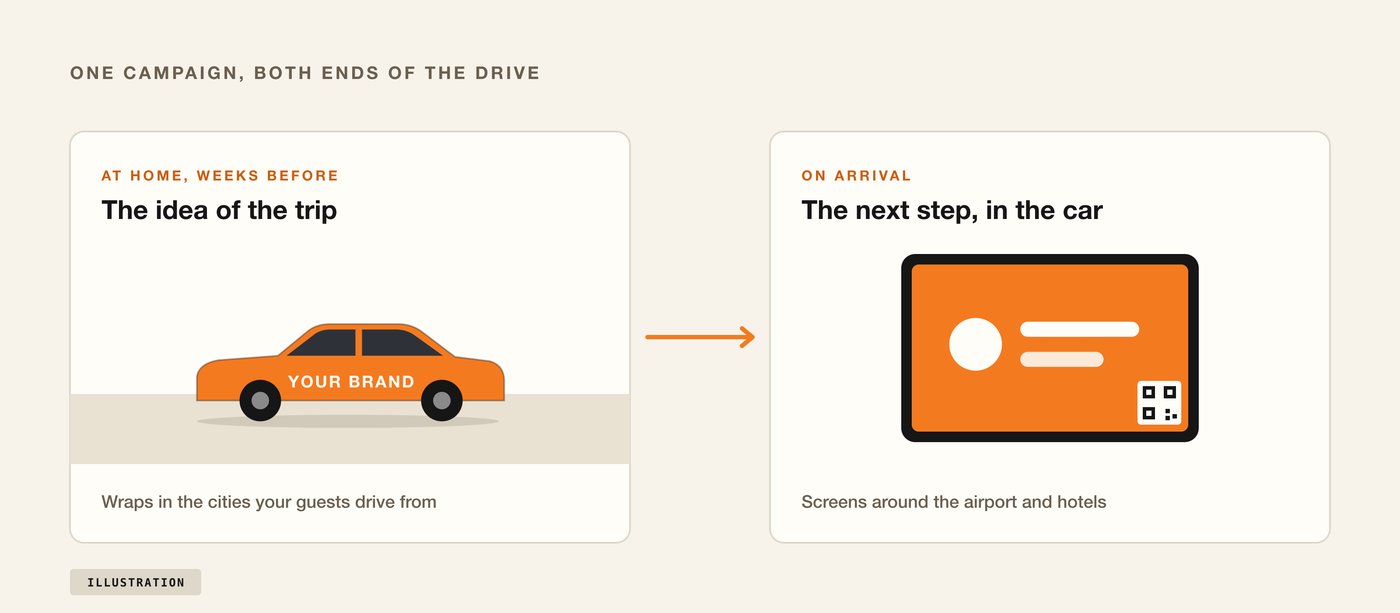
A feeder-market campaign has two halves, and they do different jobs.
At home: put the idea of the trip on the street. In the cities your visitors come from, wrapped cars carry your destination through the neighborhoods, office districts and weekend errands where people live. A beach, a lake, a ski hill or a skyline on a car two hours inland is a vacation idea before anyone has searched for one. It's seen again and again over weeks, which is how a destination moves from "someday" to "this summer."
On arrival: be the next step. Once visitors land, they decide where to eat tonight, which tour to book and whether to stay another night. In-vehicle screens in rideshare and taxi cars play your video with a QR code to the booking or tour page, in the cars visitors ride from the airport, the hotel district and the convention center.
How each part works
Wraps in the feeder cities. Vugo recruits drivers for each campaign in the metros you choose, so a feeder city doesn't need to be a city where Vugo runs screens: wraps can run in any metro you choose. A professional shop installs each wrap, install photos are checked before billing starts, and campaigns run two months or more, which fits a season. The Standard Wrap, both sides and the rear window, is the simplest way to put a fleet of cars on the street; a full or custom wrap makes the bigger statement. Wraps are priced per car per month.
Screens at the destination. Screens are available by market, where drivers and fleets already carry them, so Vugo confirms what's running in your city. You can keep your ad inside a radius around an address you choose, like the airport or the hotel district, and TripIntent® can put your ad first in cars around the airport and travel areas: a priority that changes the order of ads, never a filter that shrinks where yours can play. Screen campaigns are set by budget and dates.
Wraps at the destination, too. A few wrapped cars in your own city keep the postcard going once visitors arrive, and on the weekends that matter most, a swarm brings the campaign's wrapped cars to one place, like the festival grounds or the convention center at arrival time.
The follow-up. Vugo, your agency or your team can run a programmatic mobile campaign that follows up with people who visited your booking page from the QR code, on other apps and sites, while they're still deciding.
Plan it backward from the season
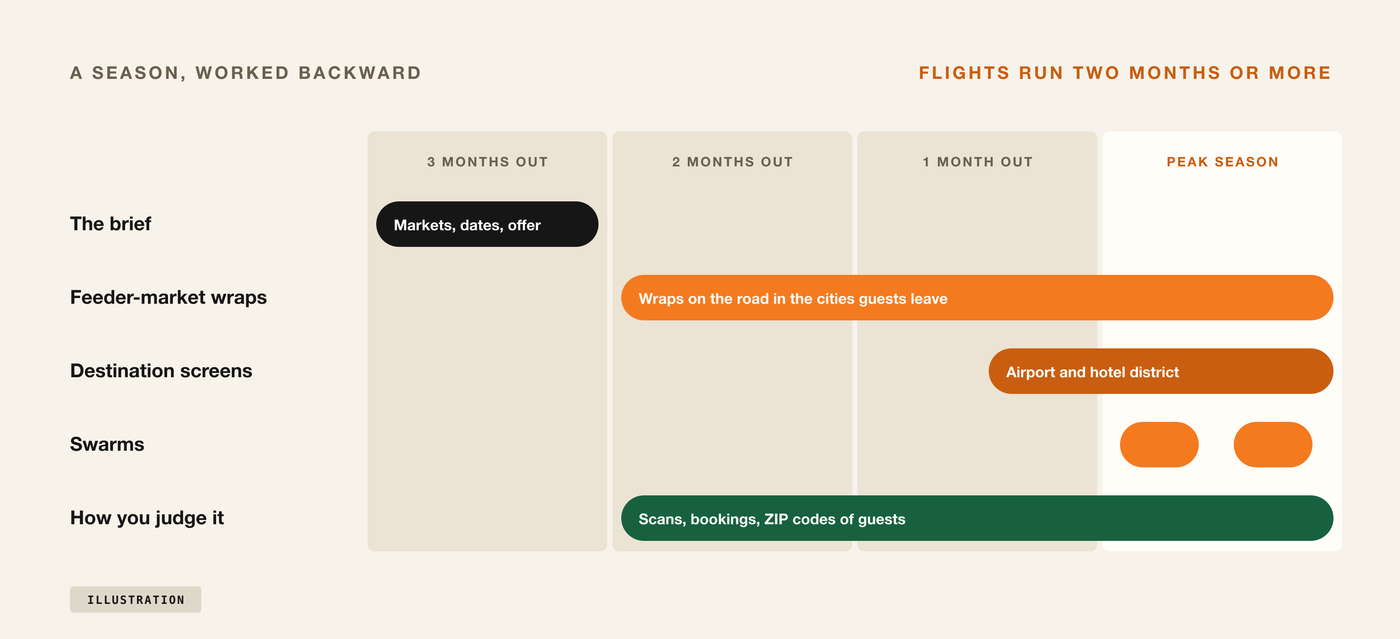
The feeder-market wraps should be on the road while people are planning, not while they're packing. For a summer season, that means the brief in the first months of the year and the wraps on the road in spring.
- Pick the feeder cities. Start with your own data: the home ZIP codes of last season's bookings, the cities in your visitor surveys, the plates in the lot. Two or three cities are usually enough to learn from.
- Pick the moment. Peak season, a festival weekend, or the slow months you want to fill. Each one is a different offer.
- Start the wraps early. Recruiting drivers, producing the wraps and installing them all happen before day one. Aim to have the cars on the road two to three months before the peak, and Vugo confirms the lead time for each market.
- Add the destination. Start the screens a few weeks before the season and run them through it, around the airport and the districts where your visitors stay.
- Mark the big weeks. Schedule swarms for the weekends that draw the biggest crowds.
Make the message travel
A wrap in a feeder city is seen from a sidewalk or the next lane, by someone who isn't on vacation yet. Give them one picture of the place, the name of the destination, and a short web address they can remember. Save the details for the landing page.
At the destination, the screen can do more: show the experience, the view, the boat or the tasting room, and give a QR code straight to booking. If an ad shows a room rate or a ticket price, show the total with every mandatory fee included, as we covered in our post on hotel and tourism advertising. Leading with the experience and leaving the price for the booking page is often the simpler ad.
How you'll judge it
Feeder-market advertising is easier to measure than it sounds, because you already know where your guests come from.
- Bookings from the feeder cities, by home ZIP code, compared with the same season last year and with similar cities where you didn't run wraps.
- Visits to the landing page named on the wrap, and QR scans from the screens at the destination.
- What guests tell you. Add "Where did you hear about us?" to the booking form and the check-in desk.
Your visitors are deciding right now, from home, where they'll be this summer. A feeder-market campaign makes sure your name is on their street while they do.
See how Vugo works for hotels and tourism, learn about vehicle wraps and in-vehicle screens, or talk to Vugo about your feeder cities.