
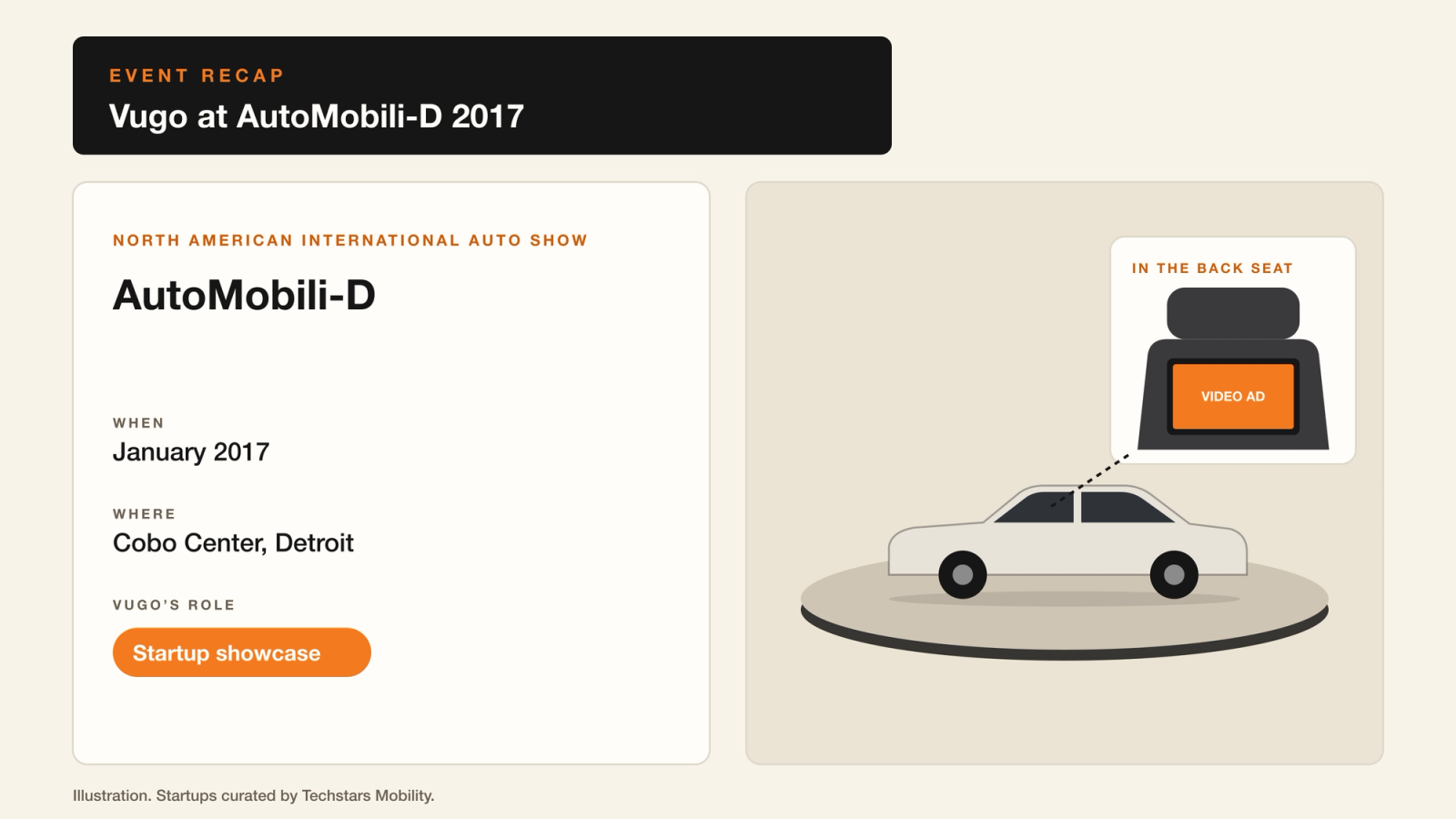
For more than a century, the Detroit auto show has been about the driver: the engine, the handling, the view over the hood. This year it made room for something new. AutoMobili-D, a mobility exhibit inside the North American International Auto Show, brought startups onto the show floor at Cobo Center, side by side with automakers and their suppliers, from the first day of the show through its industry days.
Vugo was one of them. The startups were curated by Techstars Mobility, and Vugo was invited as the 2016 winner of the MN Cup's High-Tech Division. It was a chance to put rideshare advertising, and the passenger experience behind it, in front of the people who build the cars.
What AutoMobili-D is
AutoMobili-D is the auto show's answer to a simple fact: the business of cars is changing faster than the cars themselves. Ridesharing, connected cars, electric vehicles and self-driving technology are all reshaping how people get around, and much of that work is happening at startups. AutoMobili-D gives those companies a place at the show, with automakers, tier 1 suppliers, investors and other founders all in the same building.
For a company like Vugo, that's the right room. Our work sits exactly where the industry is heading: inside the car, with the people who aren't driving it.
Why the back seat matters to carmakers
Riding is the new driving. More and more trips are taken in cars someone else is driving, through Uber, Lyft and taxi apps today, and one day in cars that drive themselves. As that happens, the most valuable seat in the car stops being the one behind the wheel. It's the one in the back.
That's the space Vugo builds for. In rideshare cars today, Vugo puts a screen in front of the back seat with free entertainment for riders and advertising mixed in. Drivers earn extra income from the advertising. Brands get a screen in front of riders on their way somewhere, matched to the context of the ride, in the cities they choose. And everyone learns what people actually do with their time when they're passengers rather than drivers.
For automakers and their suppliers, that's a preview of the connected, shared and eventually self-driving car. When nobody needs to watch the road, what will people do with the ride, and who will pay for it? We think media and advertising are a big part of the answer, the same way they paid for so much of the internet.
The passenger's turn
Much of the conversation about the future of cars is about the car itself: how it's powered, how it sees the road, how it's shared. That work matters. But the car is also becoming a connected device, and the experience inside it, for the person who isn't driving, is still being written. That's the part Vugo is working on, and AutoMobili-D was a good place to make the case.
Thank you to Techstars Mobility and the North American International Auto Show for including Vugo, and to the MN Cup for helping us get there. If we didn't get a chance to meet in Detroit, we'd love to talk.
See in-vehicle screens, read what we learned from our 2016 beta, or get in touch.