
Your sales team has a list of accounts that would change the year if even one of them signed. The trouble is that a deal that size isn't decided by one person. A buying committee weighs it — operations, finance, IT, a sponsor in the C-suite — and most of them have never heard of you when your rep's first email lands.
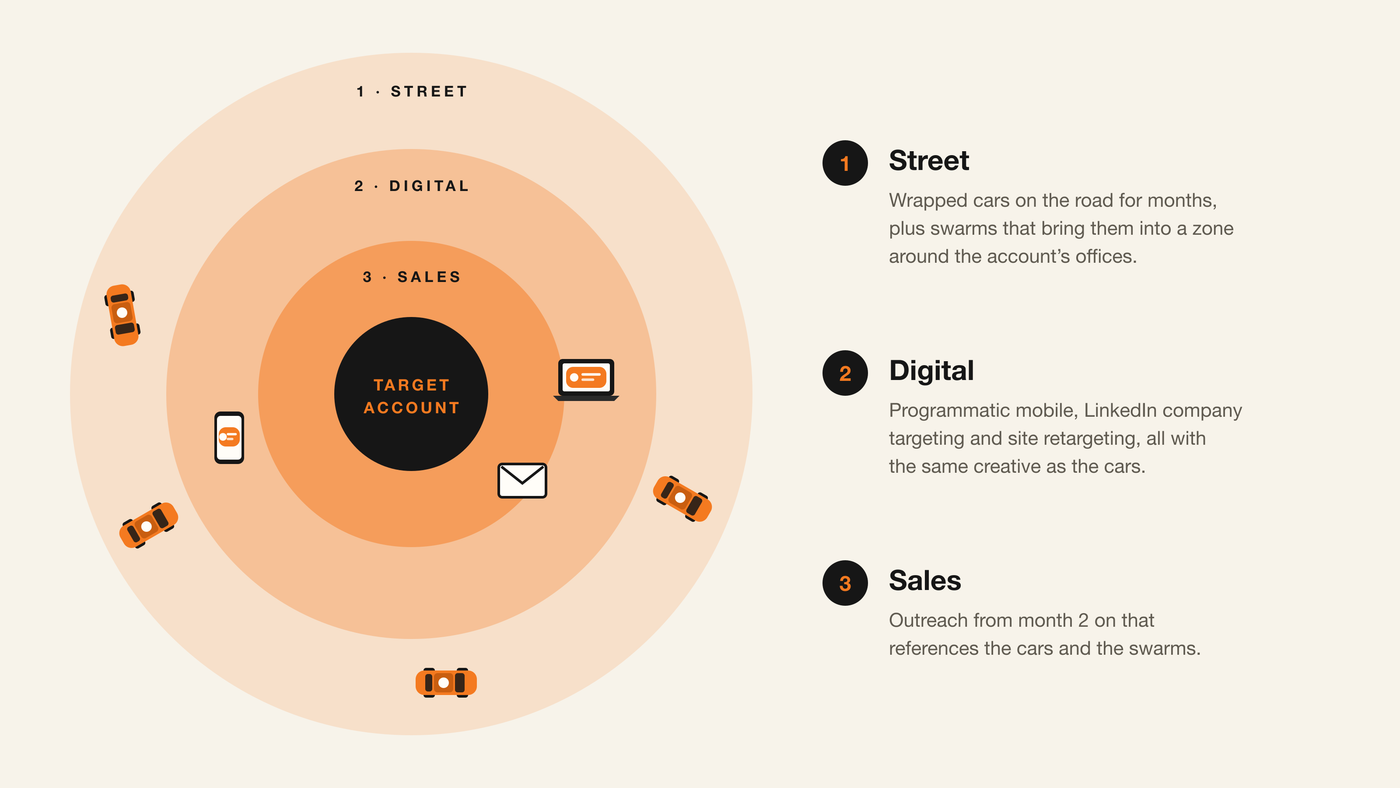
The surround sound strategy fixes that order of events. Before sales reaches out, the people at a short list of target accounts start running into your brand everywhere around them: on the street outside their office, in their feeds, in their inbox. By the time a rep calls, you aren't a stranger. You're the company they keep seeing.
Account-based marketers usually build this with billboards. We think there's a better tool for it: wrapped cars.
Why the street belongs in an account-based plan
Most account-based marketing lives on screens. LinkedIn ads, IP-targeted display and email sequences all compete in the same crowded feeds, and every competitor targeting the same accounts uses the same tools.
The physical world is different. Seeing a brand outside your own building, again and again, makes it feel established and local. Few vendors do it, so it's remembered.
The classic version is buying the billboards nearest a target's headquarters. That works when the right billboards exist. Often they don't. Office parks, suburban campuses and business districts rarely have a board facing the entrance, and the boards that do exist are fixed to one spot, facing one direction, for as long as the contract runs. A billboard can't follow the account to its conference, its other office or the airport. Wrapped cars can, and with a swarm you decide exactly where they gather and when.
Layer 1: Wrapped cars around the account's front door
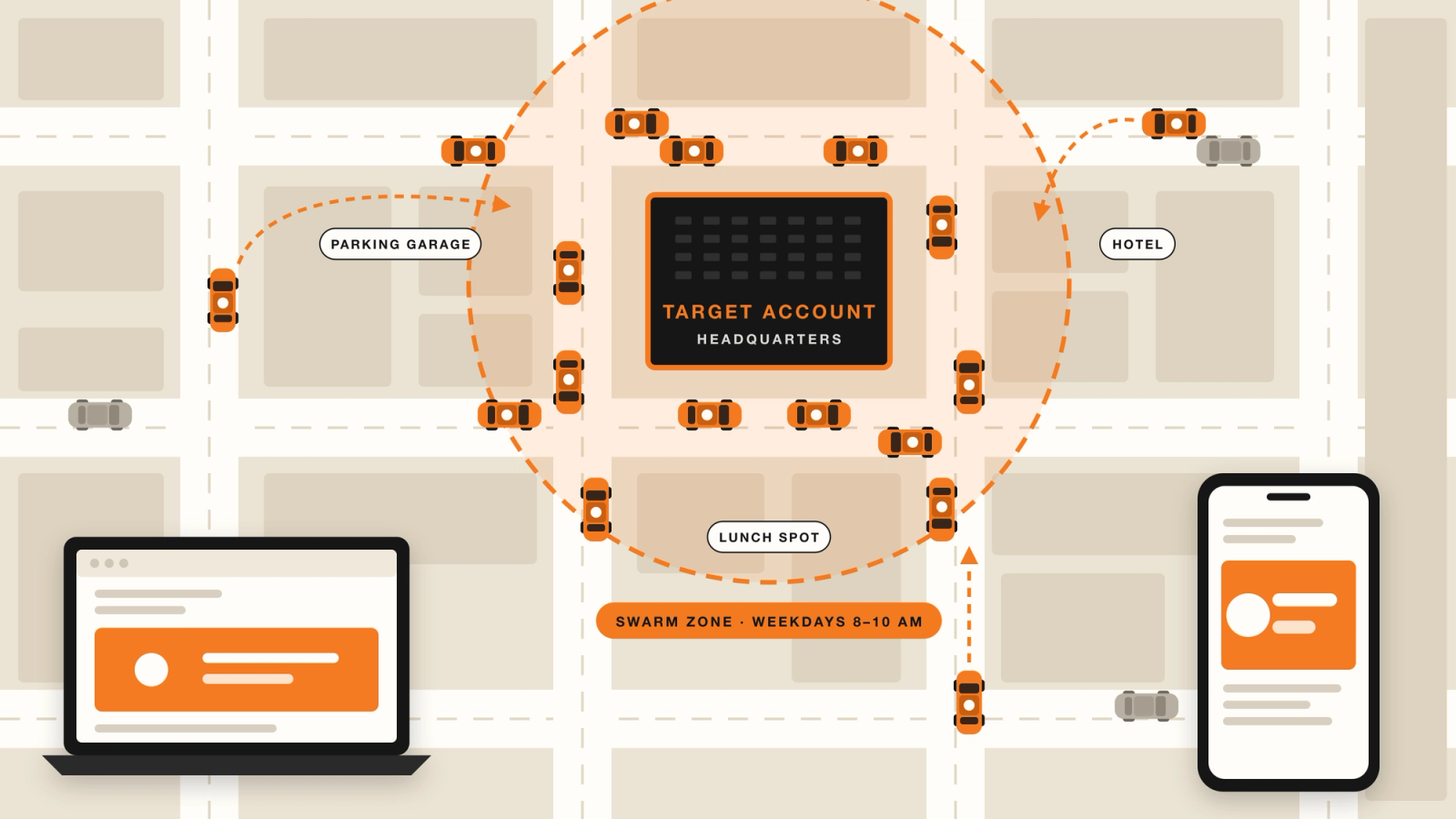
A wrapped car goes where the account's people actually are. It pulls into the parking garage, waits in the hotel driveway, idles at the airport pickup lane and parks outside the lunch spot two blocks from headquarters.
Here's how to set it up with Vugo:
- Map the accounts. List the target companies, then their offices, the business districts around them and the places their teams travel through: the nearest airport, the hotels where visiting executives stay and the corridors between offices.
- Wrap the cars. Vugo recruits rideshare, taxi and fleet drivers in your market for your campaign, has the wraps installed by professional shops, and verifies every car from install photos before billing starts.
- Swarm the fence. This is where wrapped cars leave billboards behind. Draw a zone around the account's headquarters, with a radius anywhere from a tenth of a mile to ten miles, or a route such as the corridor from the parking garage to the front door. Then schedule a swarm for the hours that matter: weekday arrivals, the lunch hour, the evening exit. Wrapped drivers on your campaign are paid to bring their cars into the zone for that window, and you see how many have confirmed before it starts.
- See it happen. The coverage map highlights the zone and shows the cars inside it during each swarm. Wrap reports add maps, route coverage and photo proof each month.
Between swarms, the same cars keep driving the whole metro, so the committee also sees your brand at the airport, downtown and on the way home. That's the surround: a fence you control at the account's front door, and a moving presence everywhere else.
Plan for months, not weeks. Wrap campaigns typically run two to six months, and surround sound needs that runway: long enough for the buying committee to see your cars again and again, and for swarms to land on the moments in the account's calendar, like a board meeting, budget season or the week a decision is due.
If a full wrap is more than the plan needs, Tiles put two or four printed door panels on each car. They are shipped to drivers who apply them, which makes it practical to put more cars on the road around more accounts.
Layer 2: A digital layer aimed at the same accounts
The street gets your brand noticed. The digital layer reminds the same people where they saw it. Vugo can manage it, or your agency or your own team can, with three parts:
- Programmatic mobile. A mobile buy aimed at the offices and districts your cars are covering extends your retargeting beyond one platform, out to the apps and social networks the buying committee scrolls on their phones.
- Account-based platforms. LinkedIn's company targeting and your account-based marketing platform's IP-based display put the same message in front of people at the target companies while they work.
- Site retargeting. When someone from a target account visits your site, ads follow up with the next step: a case study, a demo or the briefing invitation.
The two layers only add up if they look like one campaign. Use the same headline, the same colors and the same single idea on the car and in the feed, so the second time someone sees the ad, it's familiar. Run both in the same window, aimed at the same list.
Whoever manages the digital layer, keep it within each platform's ad rules and the privacy laws that apply to location and account targeting.
In metros where Vugo's in-vehicle screens are available, you can add a third surface. A screen campaign can be limited to a radius around an address, so your video plays only in cars inside that circle, such as the business district around a target's headquarters. Every screen ad carries a QR code with UTM tags, so scans show up in your own analytics.
Layer 3: Sales follows the noise
The first two layers exist to make the third one work. Plan outreach for when the cars have been on the road for a month or so, the first swarms have run and the digital layer has had time to repeat:
- Reference the campaign. "You may have seen our cars around the Galleria" is a better opening line than another cold introduction.
- Give the committee a reason to meet. Invite them to a lunch or briefing in the district you're swarming, and schedule a swarm for that day.
- Keep it consistent. Use the same message and visual identity in decks, leave-behinds and follow-up emails.
Creative that works at street speed
A wrap is read in a glance, from a sidewalk or the next lane over. Design for that:
- One idea, a few words. Lead with the problem your buyers own, not your product list.
- A logo people can read from across the street, and a short, memorable web address.
- Don't name the target company on the car. It reads as pressure rather than presence, the whole street sees it, and it can raise trademark questions. Speak to their industry's problem instead; they'll know it's meant for them.
How to measure surround sound
A surround sound campaign won't show up cleanly in last-click attribution, so decide how you'll judge it before launch:
- Hold out a control group. Pick similar accounts you don't surround, and compare meetings booked, reply rates and pipeline created between the two groups.
- Watch engagement from the target accounts. Your account-based platform can show visits from target companies' networks. Look for a rise in visits during the flight.
- Track the web address and the scans. A dedicated page for the campaign, plus UTM-tagged QR scans from screens where they run, shows direct response.
- Confirm delivery. Wrap reports show the cars were on the road, where they went and what they looked like each month, and the coverage map shows each swarm inside its zone.
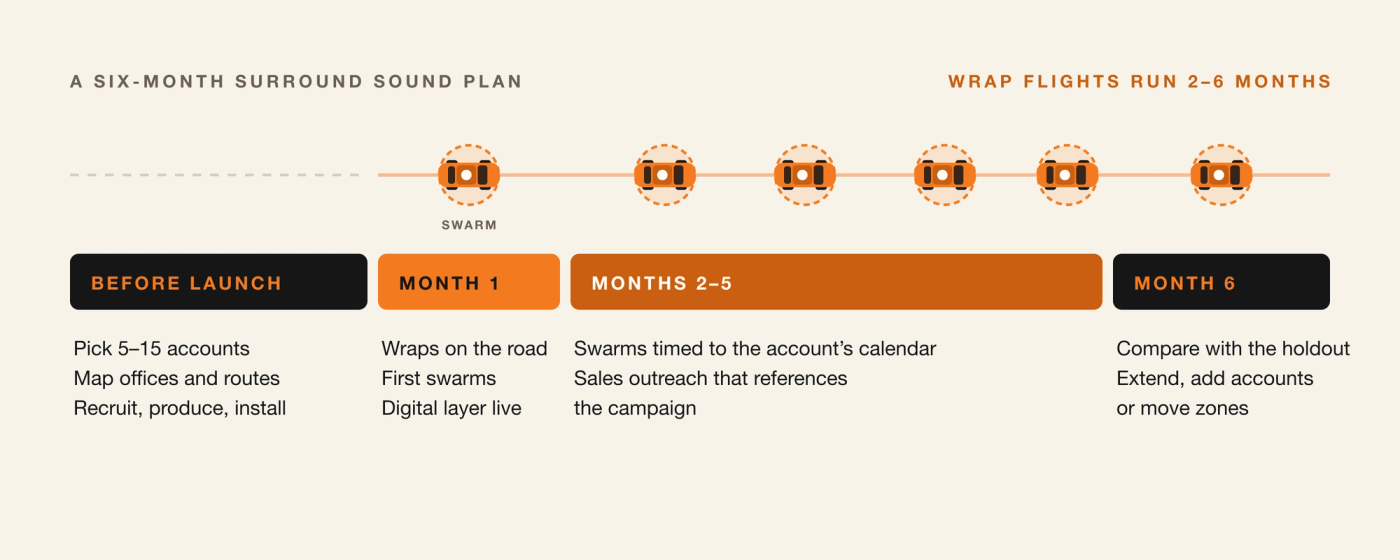
A sample six-month plan
- Before launch: choose 5–15 accounts, map their offices and travel corridors, brief the creative, and give Vugo time to recruit drivers, produce the wraps and schedule installation.
- Month 1: wraps on the road, the first swarms around the target offices, and the digital layer live.
- Months 2–5: swarms timed to the account's calendar, sales outreach that references the campaign, and a briefing in the swarmed district.
- Month 6: compare target accounts with the holdout group, then extend, add accounts or move the swarm zones.
A shorter flight follows the same steps, compressed into two or three months.
When it fits, and when it doesn't
Surround sound is built for deals where one signature is worth a lot: enterprise software, commercial real estate, logistics, professional services, benefits providers selling to employers. It fits best when a handful of accounts are concentrated in a few metros and a buying committee works from known offices.
It isn't the right tool for a low-price product sold to thousands of small customers. There, broad wraps across a metro, or in-vehicle screens across a city, will do more.
If you have a short list of accounts worth surrounding, plan a campaign with Vugo and tell us where their offices are. Or start with how vehicle wraps work.