Summer is moving season. Families try to close between school years, open-house signs fill the corners every weekend, and the agents who own a neighborhood are easy to spot: their names are on the yard signs.
Almost everyone in that market will use an agent. In the National Association of Realtors' 2024 Profile of Home Buyers and Sellers, published in November 2024, 86% of buyers and 90% of sellers used a real estate agent. First-time buyers fell to 24% of buyers, a record low, so most buyers have been through this before, and many may already have an agent in mind.
So the competition isn't whether people hire an agent. It's which name comes to mind first.
Why cars fit real estate
Real estate is sold one neighborhood at a time. Most agents work a defined farm, a few school districts, one side of a city, a stretch of new construction, and the business comes from being the familiar name there.
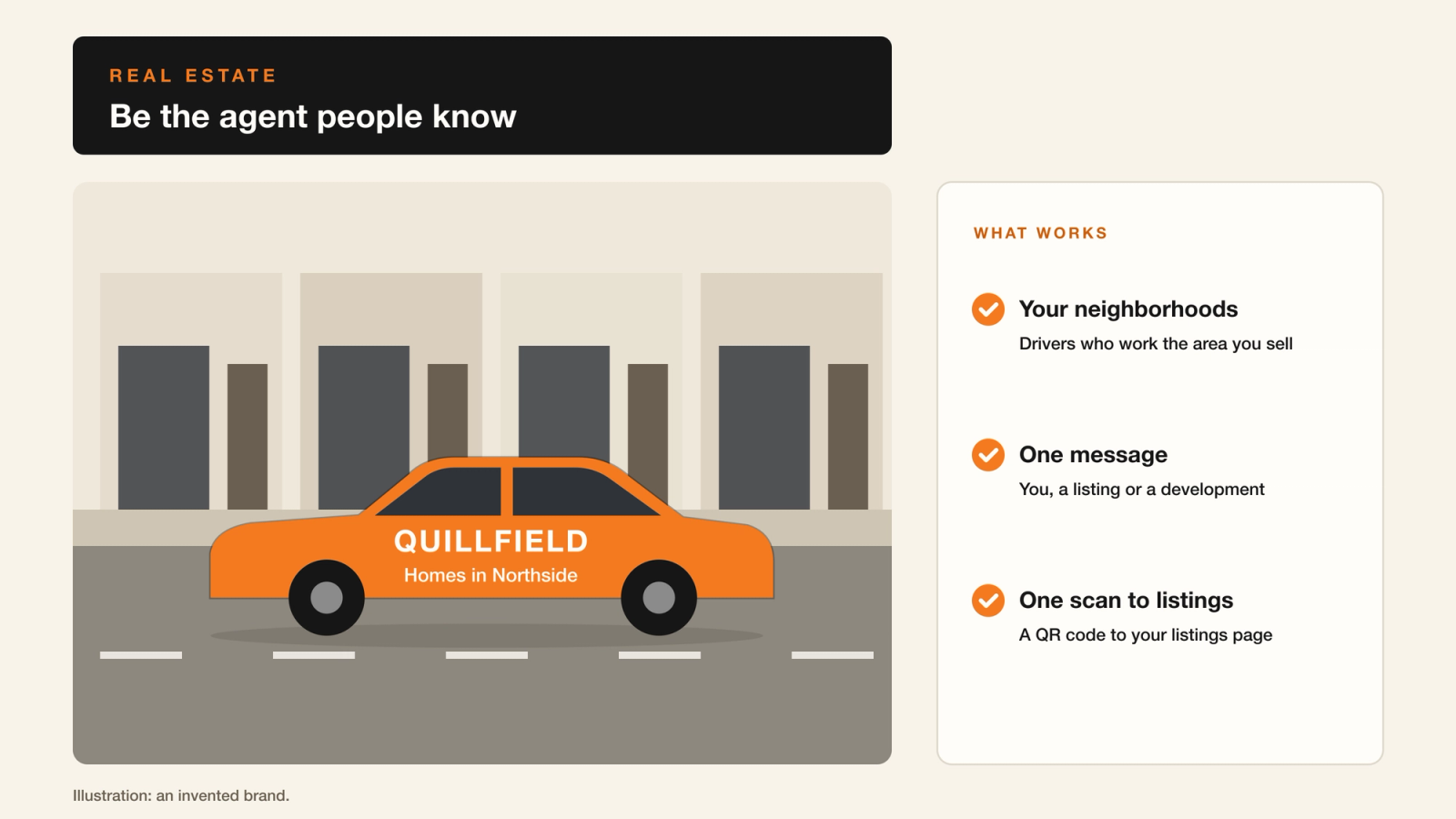
A yard sign does that on one lawn for a few weeks. A wrapped car does it on the move, on the streets of the neighborhoods you sell, every day for months. Rideshare and delivery drivers spend their days on exactly those residential streets, past the parks, the coffee shops and the school pickup lines. In Nielsen's 2019 Out-of-Home Advertising Study, 64% of U.S. residents 16 and older had noticed a wrapped-vehicle ad in the past month.
And recognition compounds. Most people don't sell this month. The neighbor who sees your name all summer may call you next spring.
What each format does for real estate
Partial and full wraps. A partial wrap puts your name or your brokerage and a short web address on the sides and rear of the car. A full wrap makes the whole car the ad, which suits a brokerage launch or a new development. Vugo recruits drivers per campaign, from drivers who work the area you sell, and a professional shop installs the wraps before the start date. Campaigns run at least two months, most run two to six, and wraps are priced per car per month.
In-vehicle screens. Passenger-facing screens in working rideshare and taxi cars play your short video, captioned so the message lands, and a QR code to your listings or a home-valuation page. Screens are available by market, so Vugo confirms what's running in your city, and you can keep your ad inside a radius around your office or a development. Screen campaigns are set by budget and dates.
Swarms. A swarm brings your campaign's wrapped cars to a place and a window you schedule, like a development's opening weekend, and pays the drivers to be there.
Five plays for agents, brokerages and developers
- Farm your neighborhoods. Recruit wraps from drivers who work the area you sell, and keep the message to one thing: your name, the neighborhood and a short web address. Familiarity is the whole job, so give it a full season.
- Offer the valuation. Homeowners who are thinking about selling want to know one number first. Run screens inside your radius with a QR code to a home-valuation page, and you meet them before they've called anyone.
- Launch a development. For a new community or a building's sales launch, full wraps carry the development's name across the metro, screens offer a QR code to book a tour, and a swarm brings the cars to the sales center on opening weekend.
- Fill the open-house weekends. Schedule a swarm around a busy listing or a cluster of open houses on a Saturday afternoon, so the cars carrying your name are on the same streets as the signs.
- Meet the relocation buyer. People moving for a job arrive by air and get to know a city from the back seat. Screens inside a radius around downtown or a big employer's district, with a QR code to a relocation guide, put you first in line.
Fair housing and license language
Real estate ads follow fair housing rules, and those rules cover where an ad runs as well as what it says. Choose your areas by where you do business, not by who lives there, and don't skip neighborhoods inside the market you serve. Describe the home, not the buyer you picture: an ad shouldn't state or suggest a preference about who should live there. Many states also require the brokerage's name, and sometimes a license number, on every ad. Check your design with your broker or your counsel before it runs. Your business stays responsible for its ad meeting those rules, and Vugo reviews every ad against its own Content Guidelines before it reaches a car.
A plan for the season
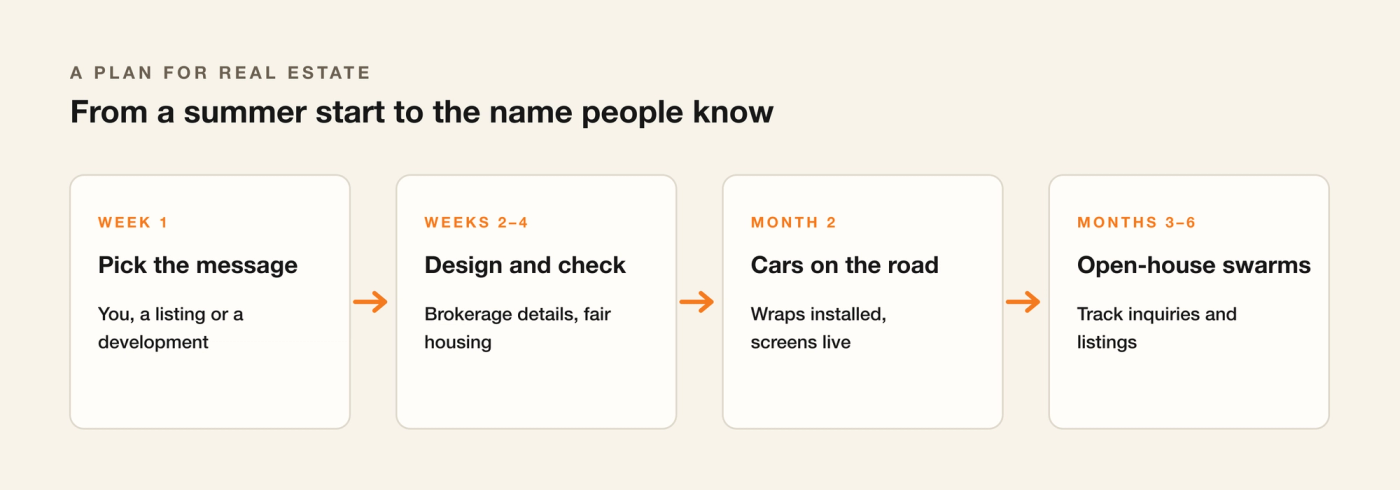
Recruiting, production and installation all happen before day one, and Vugo confirms the lead time for your market. A campaign that starts now is on the road for late summer and the fall market, and it builds the familiarity that pays off when next spring's listings start. Settle five things first:
- The message. You, a listing or a development. One per campaign reads best.
- The neighborhoods you sell. That decides where Vugo recruits drivers and where your screens play.
- A listings or valuation page that works on a phone. Give the QR code its own page, so you can see the visits it brings in your own analytics.
- Flight dates around the selling season. Two months at least, and longer if you're building a farm.
- How you'll judge it. Scans, inquiries and listing appointments, and how many new clients say they've seen your name around.
The agent people call is rarely the one with the cleverest ad. It's the one they've seen, again and again, on their own streets.
See how Vugo works for real estate, learn about vehicle wraps, in-vehicle screens and swarms, or talk to Vugo about the neighborhoods you sell.