
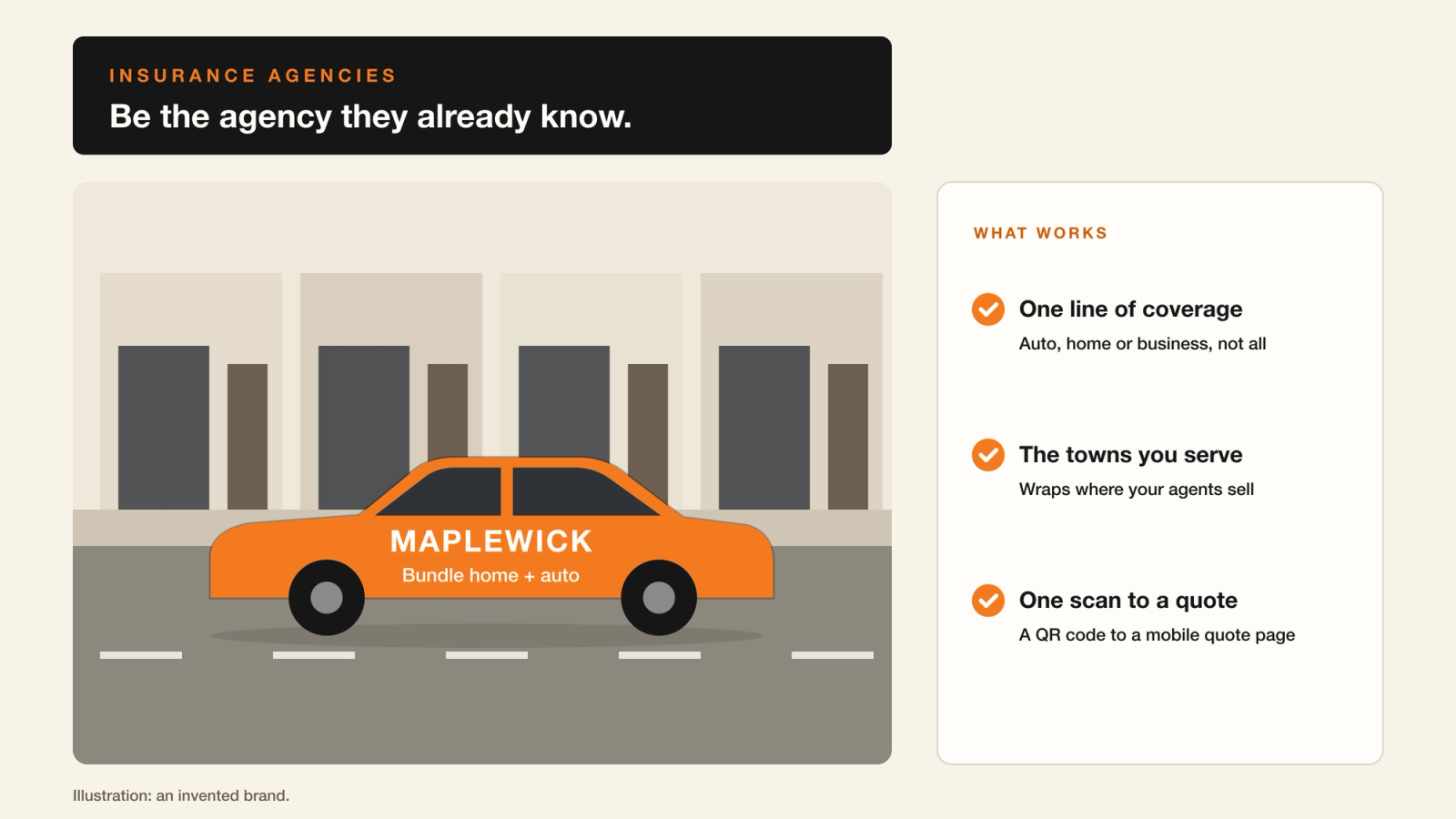
Nobody wakes up wanting to buy insurance. People shop when something changes: a renewal notice with a bigger number on it, a move, a new car, a teenager with a fresh license, a business that just hired its first employee. You can't predict when that moment comes for any one household. You can make sure your agency is the name they already know when it does.
And a lot of people are having that moment. In J.D. Power's 2025 U.S. Insurance Shopping Study, 57% of auto insurance customers had actively shopped for a new policy in the past year, the highest rate in the study's 19 years. A third of those shoppers (33%) were looking to bundle their auto policy with a homeowner's policy.
That's an opening for a local agency. Here's how wrapped cars and in-vehicle screens help you take it.
Why cars fit insurance
An agency's best advertising has always been familiarity: the sign by the grocery store, the banner at the Little League field, the agent half the street already uses. Rideshare, taxi and delivery cars carry that familiarity further. They drive the same neighborhoods, school runs, shopping centers and commuter routes your clients do, all day, for months.
That matters because the buying cycle is long and uneven. Auto policies renew every six or twelve months, homeowners' policies once a year, business policies on their own dates. Moves cluster in summer. Back-to-school season is when many families add a new driver. A campaign that keeps your name on the streets you serve for a few months is there for many of those moments, not just one.
What each format does for an agency
Wraps put your agency's name on working cars across your market. Vugo recruits drivers for each campaign in the metro you choose, from the thousands of cars in its driver database, so your wraps go where your agents sell. A full or partial wrap is designed with Vugo for the cars on your campaign and installed by a professional wrap shop, and most wrap campaigns run two to six months.
Swarms bring a wrap campaign's cars to one place for the hours you schedule: the blocks around a new office in its opening week, the county fair, a Friday night home game. The campaign's drivers are paid to bring their cars into the zone, and you see how many confirmed.
In-vehicle screens play a short video with a QR code to your quote page in the back seat of rideshare and taxi cars, in the markets where screens are available. They're the format for a direct ask: compare your home and auto rate, book a policy review, check your Medicare options.
Programmatic mobile can follow up with people who visited your quote page from the QR code, across other apps and sites. Vugo can manage it as part of the campaign, or your marketing partner or your own team can.
What the screens don't collect
Insurance runs on data, so the question comes up: does Vugo know who is in the car? No. Screens don't sense who is in the car, and Vugo doesn't count passengers or build profiles of riders. Nothing about the person in the back seat is collected, shared with you or used to decide where your ad plays.
What you learn comes from people who choose to act. Someone scans the code and lands on your page, and from there it's your website and your analytics, like any other visitor. There's no rider data for you to store, secure or explain to a carrier.
Five plays for insurance agencies
- The hometown agency. A partial wrap with your name, one line of coverage and a short web address, on cars across the towns your agents serve. Run it for two months or more so it's there through a renewal cycle, not just a week of it.
- The bundle. Lead with one idea: home and auto together. A third of active auto shoppers in J.D. Power's study wanted to bundle, and "Bundle home + auto" reads at a glance from the next lane. Put the details on the quote page, not the car.
- Open enrollment. Medicare's Annual Enrollment Period runs October 15 to December 7. Screens with a QR code to book an appointment put your agency in front of people in the weeks that count. Insurers have used Vugo for enrollment windows before: Humana used Vugo bus wraps two years in a row for Alabama's open enrollment. Medicare plan ads follow CMS marketing rules, so plan the copy with your compliance team early.
- The new office. Opening a location? Schedule a swarm so your wrapped cars fill the blocks around it in opening week, and run screens in that market with a QR code to book a review.
- The follow-up. Most people don't buy a policy the first time they see your name. Programmatic mobile retargeting reaches people who visited your quote page again while they're still comparing.
Licensing and disclosure language
Insurance advertising has its own rules. Depending on your state and your lines, an ad can need licensing details, such as a license number, or disclosures a carrier requires, and Medicare plan ads follow CMS marketing rules. Your agency stays responsible for its ad meeting those rules, so check your state's requirements and your carriers' guidelines, or ask your counsel, before the design is final. Vugo reviews every ad against its own Content Guidelines before it runs.
Before you start
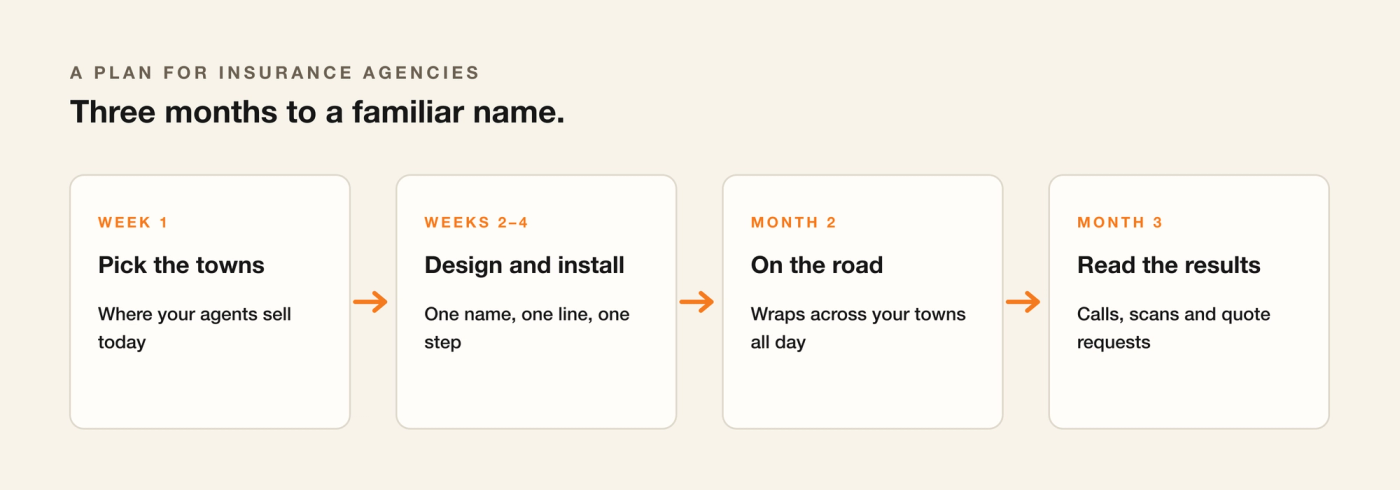
- Pick one line to lead with. Auto, home, life or business, or the bundle. One message per car reads best.
- Choose the towns. The neighborhoods your agents serve today, or the ones you're growing into.
- Build a quote page that works on a phone. It's where the QR code goes, so keep it short. A page only the ad points to lets your own analytics show what the campaign brought in.
- Set the dates. At least two months for wraps, around renewal season or an office opening; screens for the windows that matter most, like open enrollment.
- Decide what success looks like. Scans, quote requests and calls, counted on your side.
Wraps are priced per car per month, screens by budget, and every campaign is quoted for its format, market and dates.
See how Vugo works for insurance agencies, learn about vehicle wraps, swarms and in-vehicle screens, or talk to Vugo about your market.