
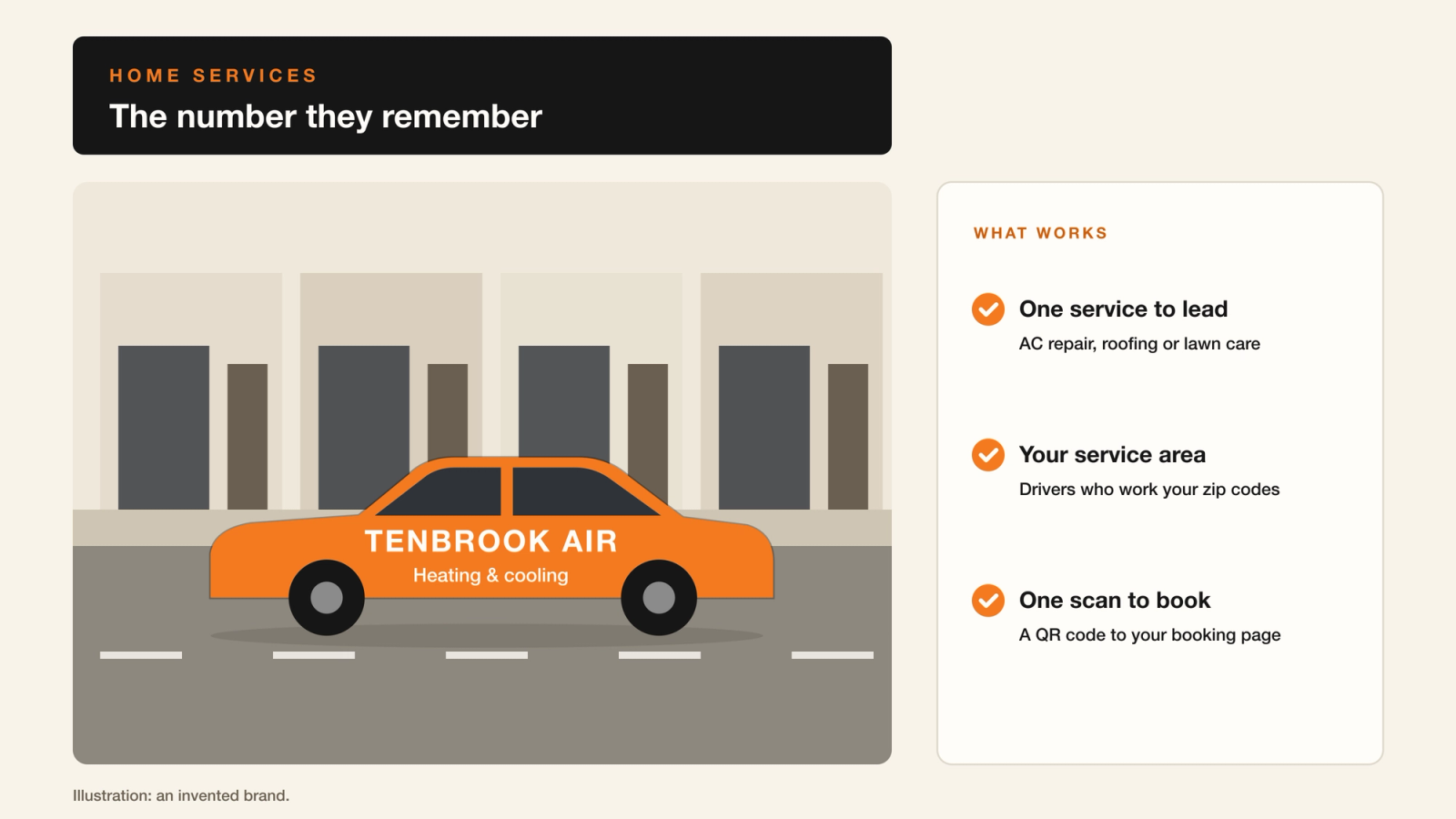
Sometime in the next few weeks, the first hot afternoon will arrive, and thousands of air conditioners that sat quiet all winter will be switched on at once. Some won't start. The same thing happens to roofers after the first big storm, to landscapers on the first warm Saturday, and to pest and pool companies all through June.
When it happens, homeowners call the name they already know. If they don't know one, they search, and pick the name that looks familiar.
Why cars fit home services
Home services are about as local as a business gets. You work a set of zip codes, and your customers live on the streets between your shop and the edge of your service area.
That's where rideshare, taxi and delivery drivers spend their days: residential streets, school pickups, grocery runs, the same neighborhoods over and over. A wrapped car carries your name through those streets for months, and it's seen at the curb and in the driveway, not only on the highway.
The trade already knows this. Your own wrapped vans are probably your best-known ad. A wrap campaign puts that same name on many more cars than your fleet, without taking a technician off a job.
And the work is coming. In Angi's 2024 State of Home Spending report, released in January 2025, 93% of homeowners said they planned to take on home projects in 2025. And plenty of that work won't be planned at all: when something breaks, nobody has time to shop around.
People notice wraps, too. In Nielsen's 2019 Out-of-Home Advertising Study, 64% of U.S. residents 16 and older had noticed a wrapped-vehicle ad in the past month.
What each format does for home services
Partial and full wraps. A partial wrap, your name, your service and a phone number or short web address on the sides and rear, reads like a service van and covers a season at a lower cost per car. A full wrap makes the whole car the ad, for a launch or a new market. Vugo recruits drivers per campaign, from drivers who work your area, and a professional shop installs the wraps before the start date. Campaigns run at least two months, most run two to six, and wraps are priced per car per month.
In-vehicle screens. Passenger-facing screens in working rideshare and taxi cars play your short video, captioned so the message lands, and a QR code to your booking or quote page. Screens are available by market, so Vugo confirms what's running in your city, and you can keep your ad inside a radius around your shop that matches your service area. Screen campaigns are set by budget and dates.
Swarms. A swarm brings your campaign's wrapped cars to a place and a window you schedule, like the expo center on home show weekend, and pays the drivers to be there.
Follow-up. Vugo, your agency or your team can run a programmatic mobile campaign that follows up with people who visited your booking page from the QR code, while they're still collecting quotes.
Five plays for home services
- Beat the first hot week. For HVAC, have the wraps on the road before the heat, with one clear message: your name, "AC repair" and a number. Pair them with screens offering a tune-up booking by QR code.
- Be the name before the storm. For roofing, gutters and tree work, run wraps across your service area for the whole storm season. When the hail comes, your name is already the familiar one, and you never have to chase anyone.
- Sell the Saturday quote. For landscaping, pools and outdoor work, run screens inside your radius with a short video of a finished yard and a QR code to request a quote. A before-and-after says more than a list of services.
- Swarm the home show. Home and garden shows draw exactly the people planning projects. Bring your wrapped cars to the expo center for show weekend, so your name is on the curb as they arrive and leave.
- Hire for the season. Peak season needs technicians. A screen ad or a wrap line like "Now hiring HVAC techs" with a QR code to apply reaches people who already know the area. Keep job ads to the job, the pay range and how to apply, and never state an age, sex or any other preference.
Put your license on it
Many states require a contractor's license number on advertising, and some require it on vehicles too. Check your state's rules, and your licensing board's, before the design is final. Make sure the phone number on the car is one your team answers at 7 p.m. on a Saturday, because that's when the call will come. Your business stays responsible for its ad, and Vugo reviews every ad against its own Content Guidelines before it runs.
A plan for peak season
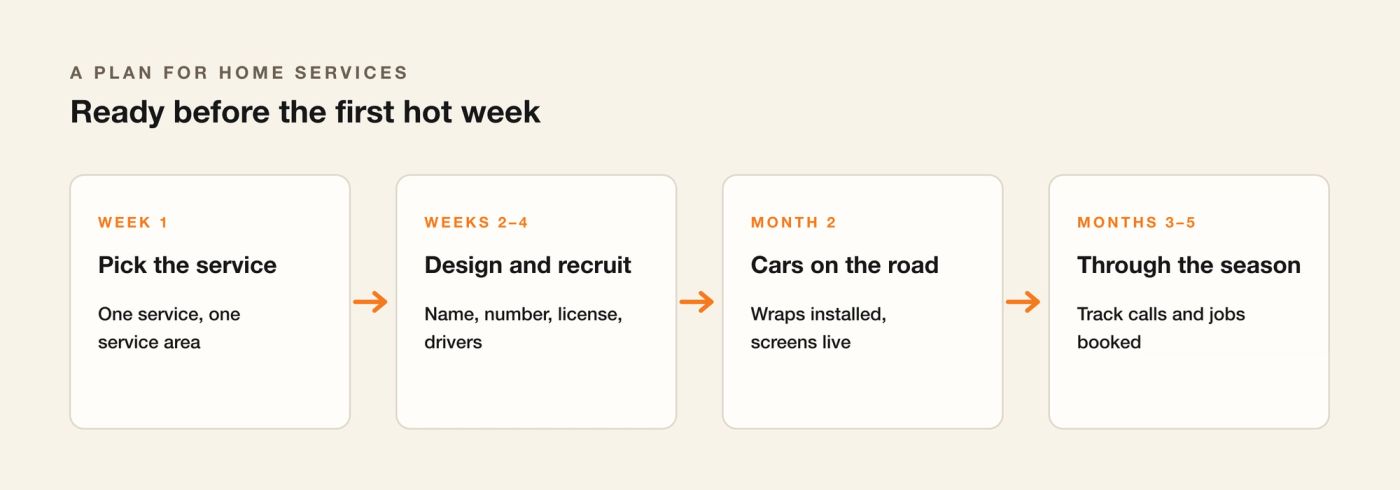
Recruiting, production and installation all happen before day one, and Vugo confirms the lead time for your market, so the time to start is before the phones get busy. Settle five things first:
- The service to lead with. One per campaign: AC repair, roof inspections, lawn care. Not all of them.
- Your service area. A radius around your shop, or the metro if you cover it.
- A booking or quote page that works on a phone. Give the QR code its own page, so you can see the visits it brings in your own analytics.
- Flight dates around your busy season. Two months at least, and longer if your season is.
- How you'll judge it. Calls, quote requests and jobs booked, and how many new customers say they saw your name around town.
When something breaks, nobody wants to research. They want a name they trust, right now. Peak season is the time to make sure it's yours.
See how Vugo works for home services, learn about vehicle wraps, in-vehicle screens and swarms, or talk to Vugo about your service area.